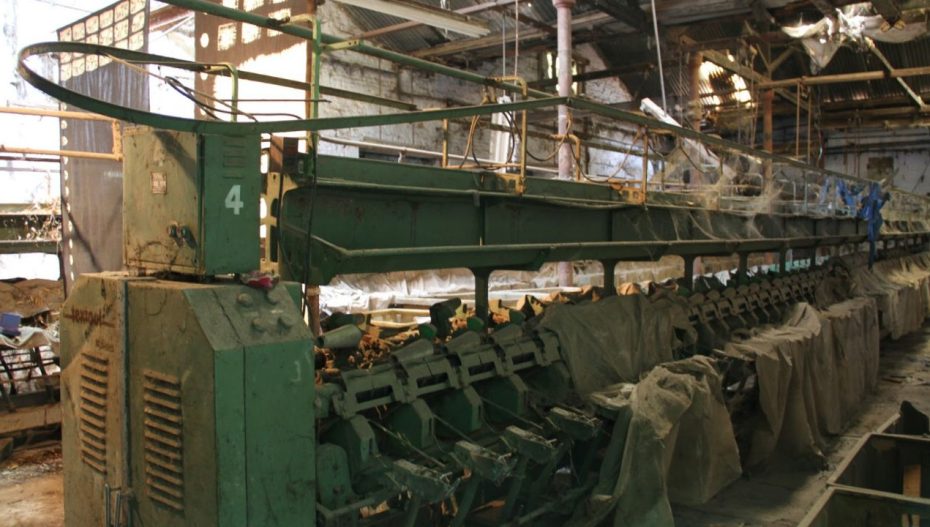
There was a time when Ahmedabad was the nerve centre of India’s textile revolution. It had the boon of a steady supply of raw materials. The industry flourished with the proud presence of skilled artisans — and mills in Ahmedabad hummed with the promise of prosperity. It deservedly earned the title Manchester of India. Is that legacy unraveling?
This concern is not misplaced given that the last operational National Textile Corporation (NTC) textile mill in the city faces an imminent shutdown. The Rajnagar Mill, operated by the NTC in Asarwa, is preparing to shut down permanently. The process of liquidation has been set in motion, and workers have been informed that operations will cease entirely within the next three to four months.
According to media reports, operations at the mill ceased in March 2020, when the COVID-19 lockdown forced the closure of 23 NTC mills across India. Since then, payments to workers have become inconsistent. Workers claimed that for the past eight months, not even half their salaries had been disbursed.
The situation for employees has become dire. They said they were no longer receiving salaries or payslips—both missing for eight months. Frustrated by the mounting financial strain, they staged a protest within the mill premises and approached management with their demands. When they pressed for payment, they were told of the mill’s impending closure.
During the protest, the workers said they had raised concerns regarding Employees State Insurance (ESI) and unpaid wages. They reportedly stated that without an active ESI subscription, they could not seek treatment at ESI hospitals, and without official salary slips, securing alternative employment was nearly impossible.
They further explained that household pressures were increasing. Many were struggling to manage their homes, cover school fees, and afford daily necessities. They urged the management to restart mill operations and clear all outstanding dues at the earliest.
Ajay Dixit, General Manager of Rajnagar Mill, reportedly contacted his superiors during the protest and assured workers that the company would attempt to pay all outstanding dues within three months. He also confirmed that the process of liquidation would move forward.
The Rajnagar Mill had provided employment to over 400 workers and staff before operations halted. The closure is not an isolated case. In a statement to the Lok Sabha, Union Textile Minister Giriraj Singh acknowledged that 23 NTC textile mills across the country had shut down due to financial difficulties. This nationwide closure has affected 7,391 workers, including 442 employees from Rajnagar Mill.
Despite the ground reality, Singh maintained that no NTC mill had been officially shut down since 2015. The pandemic in 2020, he reminded, forced a suspension of activities. Although some mills resumed functioning in January 2021, NTC was unable to sustain them. Limited working capital and general financial crunch have been cited as the constraints.
Singh claimed that IDA employees and essential workers had been paid full salaries up to October 2024, while non-essential staff, who had stayed home, received payments until June 2023. Between July 2023 and October 2024, these workers were reportedly given half their regular salaries.
The Minister confirmed that the government had received complaints from workers’ unions across the country, including Gujarat. He stated that NTC management was actively seeking funding to resolve the situation, and once funds were secured, outstanding worker dues would be cleared.
Reports added that NTC operates seven mills in Tamil Nadu, five in Maharashtra, four in Kerala, two in Madhya Pradesh, and one each in Pondicherry, Kolkata, Andhra Pradesh, and Karnataka.
And so, thousands of mill workers remain uncertain about their livelihood. The workers remain caught in the crossroads of a proud heritage and a precarious tomorrow.
When industries decline, it entails a human cost.
Also Read: SUV Horror In Gandhinagar: Four Killed https://www.vibesofindia.com/suv-horror-in-gandhinagar-four-killed/