


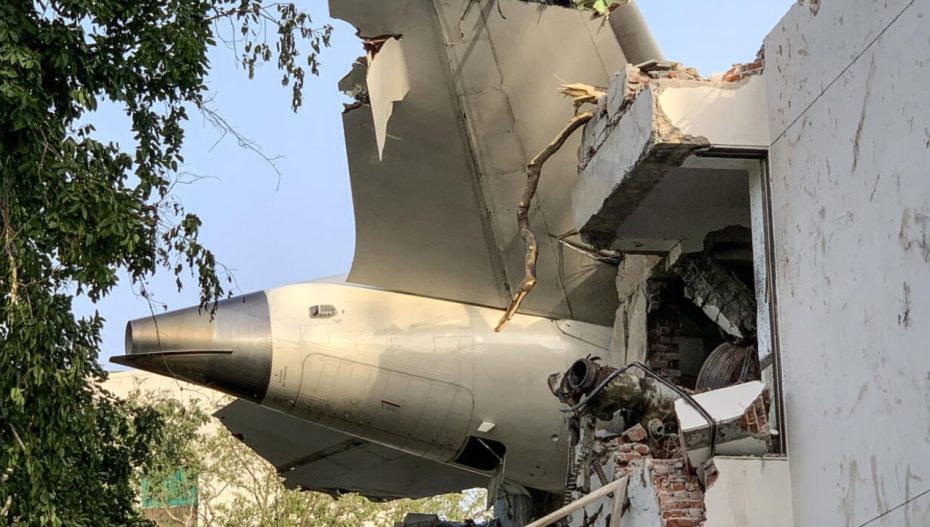
A month after Air India Flight 171 crashed into the BJ Medical College hostel complex in Ahmedabad, the site remains under tight police security as investigations near completion and authorities begin assessing structural damage to determine the fate of four damaged hostel buildings.
The four hostel buildings — Atulyam 1 to 4 — remain blackened and deserted. The mess building shows extensive damage, with a collapsed overhead section and a gaping hole where the aircraft’s tail had been embedded before its removal on June 22. Scorched trees are among the only remaining evidence of how active the area once was.
According to reports, the crash site has been sealed off by Gujarat Police to facilitate the Aircraft Accident Investigation Bureau (AAIB)’s inquiry, conducted in coordination with investigators from the UK and the US.
Additional Commissioner of Police (Sector-2) Jaypalsingh Rathore indicated that the police would withdraw from the site once the AAIB formally states that security is no longer required.
More than 100 police personnel remain deployed at the crash site and at the GujSAIL shed at Ahmedabad airport — located 6.6 km away — where the aircraft debris was moved two weeks after the crash. Three police pickets continue to guard the area: one near the 1,200-bed Woman, Child and Super-specialty Hospital on Ghoda Camp road, a second near the National Institute of Occupational Health (ICMR-NIOH), and a third at the hostel compound’s main gate.
That gate was the point from which survivor Ramesh exited in a state of shock before being taken to hospital. It was also where GISF watchman Rajendra Patankar sustained injuries and later died during treatment.
Approximately 150 medical students and doctors who had lived in the Atulyam hostels were relocated following the crash. Most were shifted to nearby hostel buildings, with a clear view of the destroyed site.
Dr Minakshi Parikh, Dean of BJMC, said students were also moved to rented accommodations. She noted that Atulyam 8 — which remained structurally unaffected and served as the National Disaster Response Force (NDRF)’s base during rescue operations — has now been handed back to the college.
To compensate for the loss of the mess facility, the college converted canteens in the adjacent Sopanam 7 and 8 hostels into a new dining facility. Dr Parikh stated that 27 kitchens were established there, and students were provided with new utensils and one month’s provisions.
The medical college resumed classes on June 23, held a prayer meeting for the deceased on June 24, and conducted examinations two days later. Dr Parikh added that remedial exams would be organised for around eight students who were unable to appear earlier, and that writers would be arranged for those who required assistance.
Authorities will assess the structural integrity of the four damaged Atulyam buildings once the AAIB releases the site.
Based on suggestions by experts, the government will take a call on whether the buildings can be retrofitted or must be rebuilt.
During the first two weeks after the crash, the onlookers, grieving relatives, and students overwhelmed the site. They attempted to recover their belongings.
Rathore acknowledged that preserving the integrity of the crash site for investigation was a significant challenge, necessitating a heightened security presence.
Security measures were gradually relaxed when the barricades were fixed. Additionally, to prevent unauthorised access, a break in the compound wall close to the Gujarat Housing Board apartments—which was initially watched around-the-clock—was covered with metal sheets.
Life around the areas where the disaster happened is limping back to normalcy. But the shadow of the crash will continue to linger.
Also Read: Traveling International Film Festival SamaBhav In Ahmedabad From Today https://www.vibesofindia.com/traveling-international-film-festival-samabhav-in-ahmedabad-from-today/