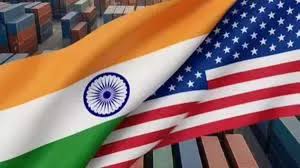
In another installment of US’s anti-India rhetoric, US President Donald Trump’s trade advisor Peter Navarro accused New Delhi of using American trade dollars to help finance Russia’s war in Ukraine.
His remarks come in defense of Washington’s recently imposed 50 percent tariffs on Indian imports.
According to the latest reports, Navarro argued that Indian oil refiners—allegedly working in concert with “silent Russian partners”—are profiting significantly by refining discounted Russian crude and reselling it internationally, allowing “Russia (to) pocket hard currency to fund its war on Ukraine.”
He claimed, “Before Russia’s invasion of Ukraine, Russian oil made up less than 1% of India’s imports. Today? Over 30% — more than 1.5 million barrels a day. This surge isn’t driven by domestic demand—it’s driven by Indian profiteers and carries an added price of blood and devastation in Ukraine.”
He repeated this assertion in detail: “India’s Big Oil lobby has turned the largest democracy in the world into a massive refining hub and oil money laundromat for the Kremlin.” According to Navarro, India now exports more than 1 million barrels of refined petroleum daily—over half of it derived from Russian crude.
In an interview with a media house, Navarro sharpened his tone, stating, “Everybody in America loses because of what India is doing. The consumers and businesses and everything lose, and workers lose because India’s high tariffs cost us jobs, factories and income and higher wages. And then the taxpayers lose because we got to fund Modi’s war.” When questioned if he meant Putin’s war, Navarro responded, “I mean Modi’s war, because the road to peace runs, in part, through New Delhi.”
Beyond energy, he accused India of “strategic freeloading,” criticising its simultaneous purchases of Russian weapons and demands for sensitive American military technology. “It doesn’t stop there. India continues to buy Russian weapons, while demanding that US firms transfer sensitive military tech and build plants in India. That’s strategic freeloading. The Biden admin largely looked the other way at this madness. President Trump is confronting it. A 50% tariff, 25% for unfair trade and 25% for national security, is a direct response. If India, the world’s largest democracy, wants to be treated like a strategic partner of the US, it needs to act like one. The road to peace in Ukraine runs through New Delhi,” he said.
Reports added that Navarro went on to explain the mechanics of the trade relationship from his perspective: “Here’s how the India-Russia oil mathematics works: American consumers buy Indian goods while India keeps out US exports through high tariffs and non-tariff barriers. India uses our dollars to buy discounted Russian crude. Indian refiners, with their silent Russian partners, refine and flip the black-market oil for big profits on the international market while Russia pockets hard currency to fund its war on Ukraine.”
He emphasised the scale of this shift, reiterating that India’s Russian crude imports have surged from under 1% to over 30%, equivalent to around 1.5 million barrels per day. “This surge isn’t driven by domestic demand, it’s driven by Indian profiteers and carries an added price of blood and devastation in Ukraine,” he was quoted as saying.
Navarro also took aim at what he described as India’s dismissive attitude toward criticism. “What’s troubling to me is that the Indians are so arrogant about this. They say, ‘Oh, we don’t have higher tariffs. Oh, it’s our sovereignty. We can buy oil from anyone we want.’ India, you’re the biggest democracy in the world, okay, act like one,” he reportedly said.
In response, Indian officials rejected the allegations, insisting that the country would continue to seek the “best deal” on oil to protect the needs of its 1.4 billion citizens. They pointed out that Russia, which once supplied under 2% of India’s crude, now accounts for between 35% and 40% of imports.
New Delhi has also highlighted the apparent double standard in Washington’s approach, noting that China imports more Russian oil than any other country and that the European Union continues to trade extensively with Moscow, yet neither has faced similar penalties.
At home, Prime Minister Narendra Modi has pledged tax cuts to offset the effect of the new tariffs, while India’s finance ministry stressed in its July review that “ongoing India-US trade negotiations will be crucial.”
Despite Navarro’s confrontational tone, other voices in the US administration struck a more conciliatory note. Treasury Secretary Scott Bessent told Fox Business: “I do think India’s the world’s largest democracy, the US is the world’s largest economy. I think at the end of the day we will come together.”
Navarro’s remarks came shortly after a summit in Alaska where President Trump and Russian President Vladimir Putin reported no progress on Ukraine. However, Putin noted the improvement in US-Russia economic ties, saying: “Incidentally, when the new administration came to power, bilateral trade started to grow. It’s still very symbolic. Still, we have a growth of 20%. As I’ve said, we have a lot of dimensions for joint work. It is clear that the US and Russian investment and business cooperation has tremendous potential.”
Observers have noted the contrast: Navarro has made no similar public criticisms of China or Europe, despite their deeper economic ties with Russia.
The immediate effects of the US tariffs on India appear modest. However, analysts caution that the broader fallout could spread across key export-driven industries like textiles and seafood.
As Washington and New Delhi trade barbs, it remains to be seen whether these economic strains will escalate into deeper diplomatic friction or open the door to renewed dialogue.
Also Read: India Muscles Up Lobbying Efforts In America https://www.vibesofindia.com/india-doubles-up-lobbying-in-america/