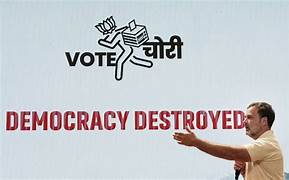
That there is no unity of purpose between the prime minister, the CEC and the LoP on vital questions linked to the future of democracy is a national misfortune.

Illustration: Pariplab Chakraborty
What’s the real threat: a cry to protect democracy, or an act to destroy it? Democracy is hollowed out when constitutional principles are trampled upon, not when somebody screams for justice. Blame the amoral deeds, not righteous indignation.
Electoral malpractices should concern the chief election commissioner (CEC) and the prime minister as much as the leader of opposition (LoP). Institutional roles are well-defined and CEC Gyanesh Kumar has little personal discretion in responding to the problems brought out by LoP Rahul Gandhi.
The Constitution doesn’t envisage a wrestling match between the two. Kumar is duty-bound to rectify anomalies or mischief. Any vitiation of the process, from drawing up electoral rolls to counting votes, needs to be attended to.
Article 324 of the Constitution gives the CEC the mandate to conduct fair elections, not to be seen as acting like the government’s henchman. Isn’t it true that the opposition parties in Maharashtra filed a complaint in 2024 about Bharatiya Janata Party (BJP) leaders allegedly adding and deleting votes with the help of a mobile app? Was that complaint addressed?
A random survey on who is respected more by voters, T.N. Seshan or Rajiv Kumar, might help Kumar in choosing the right path. The BJP too is barking up the wrong tree by accusing Gandhi of conspiring to derail India’s democracy. Issues raised by him are critical to the health of democracy and deserve honest answers. Attempts to vilify or intimidate him will be of no purpose to the nation because the concern is about democracy, not the Congress.
That there is no unity of purpose between the prime minister, the CEC and the LoP on such a vital question linked to the future of democracy is a national misfortune. In an ideal democracy, the three would have come together to find a remedy: for instance, a judicial committee to reform the system and a temporary mechanism evolved through consensus to conduct immediate elections. But the responses of the prime minister and the CEC have been shockingly undemocratic. Gandhi’s words can’t trigger a public revolt, but a perception that avenues of justice and accountability are getting closed certainly might.
It’s the job of the Election Commission to answer certain critical concerns:
- Are people sitting outside the state filing online applications for deletion of votes?
- Is there a possibility that the entire operation is being conducted through a centralised electronic system?
- Why have complaints of bulk addition and deletion of voters become so prevalent?
- Why can’t digital, machine-readable data be made available for a thorough examination?
- Why can’t a video-recording of polling booths be given to candidates who demand it?
- Why is the EC not cooperating with the investigation done by the Karnataka CID, which is demanding destination IPs and other details?
And the prime minister has to answer just two questions:
- Why can’t the CEC be appointed through democratic consensus to mitigate this acrimonious political atmosphere?
- Why was the law passed in 2023 to accord immunity to election commissioners from legal consequences of their deeds?
Manufactured eminence?
You can order a birthday cake on food delivery platforms. Fortunately, they don’t yet deliver respect or adulation. But that doesn’t mean that respect, adulation, or stories designed to impress the birthday boy, can’t be ordered at all.
An unseemly controversy erupted on September 17, when some people accused the BJP of manufacturing a wave of birthday wishes for Prime Minister Narendra Modi. They said the campaign was orchestrated not only because it was a special occasion – Modi had turned 75 – but to silence critics who have been saying his charms have withered.
The propaganda that propelled him to the top now looked like a political tragedy. As tycoons, celebrities and sports stars – from Shah Rukh Khan to Alia Bhatt and Mukesh Ambani to Mohmmad Siraj – took pains to release videos talking about how inspiring Modi is and how he is taking India to greater heights, a cloud of suspicion hovered over social media. While some people countered the propaganda with facts, others ridiculed what they described as sponsored drama.
Let’s believe the outpouring was spontaneous and authentic. That every bit of the campaign, running with the hashtag #MyModiStory, was real. And let us assume that from Israeli Prime Minister Benjamin Netanyahu’s claim about “accomplishments” to Bollywood actress and MP Kangana Ranaut’s views about “sabka saath sabka vikas”, every sentiment expressed was genuine. But the question invariably arises: Does Modi need such endorsement?
Should a leader, who was chief minister for 13 years and has been prime minister for 11, need to refurbish his image constantly through such praise? Will Modi, as a true leader, instead pay heed to the #MyModiStory of people like Zakia Jafri, Stan Swamy, Sudha Bharadwaj, Bilkis Bano or Umar Khalid? Can Modi digest the #MyModiStory of Ranjan Gogoi, Ajit Pawar or Praful Patel? Does he remember the famous #MyModiStory of Atal Bihari Vajpayee: ‘Follow Rajdharma’?
Credibility is the most precious ornament of a leader. One noble act can earn a leader greater credibility than a thousand propaganda videos. All actors and actresses speaking in one voice about “sabka saath sabka vikas” is meaningless if he keeps targeting Muslims in election speeches. All cricketers singing praises of robust nationalism sound hollow in the face of failure to confront Donald Trump’s claim that he made India and Pakistan cease fire.
Isn’t Modi conscious about the growing unease in the country over the allegations of Vote-Chori? Can tell-tale evidence of electoral irregularities be erased by brazen denials and counter-propaganda? Nothing can substitute a prime ministerial intervention to purge the system. Videos – sponsored or genuine – can’t wipe the blot clean.
Sleeping lion’s roar
Ironically, even the orchestrated messages failed to weave a credible story of greatness. MyGovIndia, a citizen engagement platform on X managed by the government, ran a campaign on the theme – How Modi awakened the Sleeping Lion. It claimed Modi’s leadership is defined by service, and that India has become a “global manufacturing hub” during his tenure. Global manufacturing hub? Sounds interesting! The data, though, tells a different story. The total global share of India’s merchandise export is barely 1.6% while China’s share is 14.33%.
The government boasted that Modi has led with the spirit of Vishwaguru, offering solutions to the world. The achievements MyGovIndia listed include: Repeal of 1,500 outdated laws, Rajpath named Kartavya Path, 150 Vande Bharat trains, Mahakal and Kashi Vishwanath corridors, inauguration of Ram temple, Jan-dhan accounts and direct benefit transfer, digital payments, Mudra loans, GST reform, ease of doing business, women’s reservation and more.
Now let’s see what was achieved before Modi awakened the “Sleeping Lion.” A nation, deeply fractured and impoverished in the aftermath of Partition and ruthlessly looted by the colonial rulers, was put on the path of democracy and self-reliance.
In the first few decades after Independence, India had established a huge network of public sector units; healthcare, education and civic infrastructure; apart from nurturing a liberal democratic culture. Jawaharlal Nehru was not thinking merely about industries, he set up great institutions to promote culture, films, music, drama and literature. From the Green Revolution to space technology, from thermal power to nuclear energy, the “Sleeping Lion” achieved all this without the roar of propaganda.
Sanjay K. Jha is a political commentator. This piece was originally published on The Wire.
Also Read: Software, Fake Applications Used For Vote Chori: Rahul Gandhi Makes Strong Claims https://www.vibesofindia.com/software-fake-applications-used-for-vote-chori-rahul-gandhi-makes-strong-claims/