

Tarushi Aswani
In Chhota Udepur, one teacher is often found teaching the entire school, with children of different ages and classes all sitting in the same room.
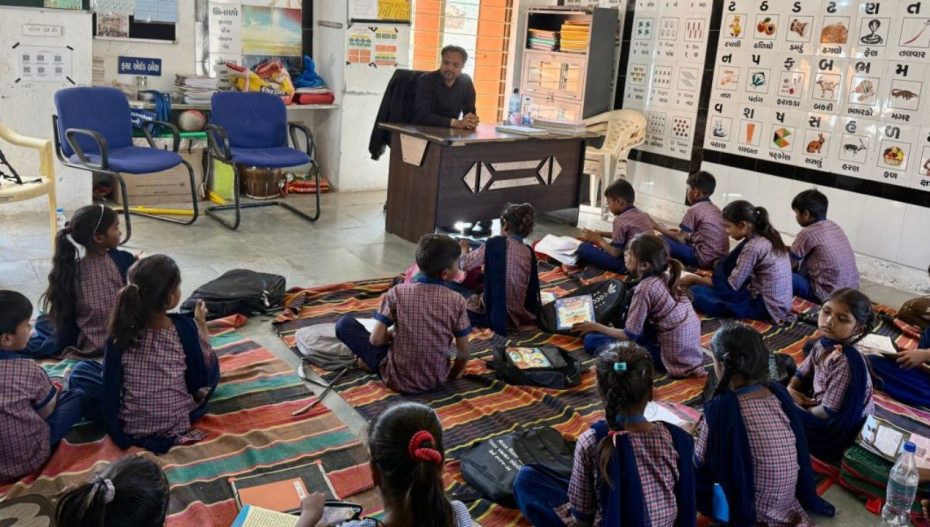
In a sunlit classroom, around 30 children of different ages sit on the floor, holding notebooks and slates. The children are talking to each other in groups of three or four when their common teacher declares that it’s time to start the day’s lessons.
Kishan Kumar Rathore is a group principal (overseeing schools at the block level) and heads 11 schools in Naswadi taluka in Gujarat’s Chhota Udepur district. Currently, he is at Naswadi’s Dharsimel Primary School, teaching a total of 33 children from nursery to class 5, in the same room at the same time, all on his own.
Rathore moves between groups, correcting a word here, solving a sum there. “This is not how teaching is supposed to work,” he says meekly. “But there is no one else.”
Across Adivasi belts of eastern Gujarat, several schools officially listed as functional are operating with one teacher, or none at all. Buildings exist. Enrolment registers are maintained. Textbooks, slates, bags and pencils arrive. But lessons are sporadic, and children often spend hours waiting for attention that never comes.
Tracking teachers
Sitting at the eastern edge of Gujarat, Chhota Udepur borders Madhya Pradesh in the northeast and Maharashtra in the southeast. As of the 2011 Census, Chhota Udepur is Gujarat’s third-largest Adivasi-dominated district, with Scheduled Tribes making up a significant portion of its population. Their livelihood often involves agriculture, animal husbandry, forestry and daily-wage labour, linked to the district’s forest-rich geography. Chhota Udepur was carved out of Vadodara in 2013 – a move that was meant to ensure better access to government services and development for the region’s Adivasi population.
Despite these claims, education in Chhota Udepur remains a struggle for teachers, students and parents.
Official data shows that Gujarat’s overall pupil-teacher ratio masks sharp regional disparities. While the state government has told the assembly that Gujarat broadly meets the Right to Education norm of 30:1 at the primary level, education department records and replies to legislative questions show that Adivasi-dominated districts such as Chhota Udepur, Dahod, Narmada and Tapi continue to have a high concentration of single-teacher and zero-teacher schools.
In several instances, sanctioned posts remain vacant for years, forcing one teacher to handle multiple grades simultaneously. The issue has repeatedly been raised on the floor of the Gujarat assembly by the opposition and Adivasi-area MLAs, who have flagged stalled recruitment, frequent teacher transfers out of remote schools, and the failure of “teacher rationalisation” policies (transferring teachers from schools with more teachers to those with scarcity) to account for difficult terrain and low retention in Adivasi regions. The government has acknowledged shortages in written replies but has maintained that temporary arrangements and redistribution are sufficient – a claim that teachers and parents on the ground sharply contest.
“I will share basic realities with you. I have been transferred, yet I am coming here because I care about these children. They are living in a tribal region. Illiteracy is common here; I don’t want them to suffer,” Rathore told The Wire.
Naswadi is currently 239 teachers – or 50% of the teaching staff – short of the requirement, said Rathore, who has been the lone teacher at Dharsimel for the past one and a half years.
Data shared by the state government revealed that up to 1,606 government-run primary schools, of the approximately 32,000 such schools in the state, were operating with only one teacher for all students of classes 1 to 8 in 2023. In 2022, there were only 700 schools run by a single teacher – so that figure had nearly doubled in two years. State education minister Kuber Dindor claimed in the assembly that this increase was largely because of the transfer of educators to places of their choice.
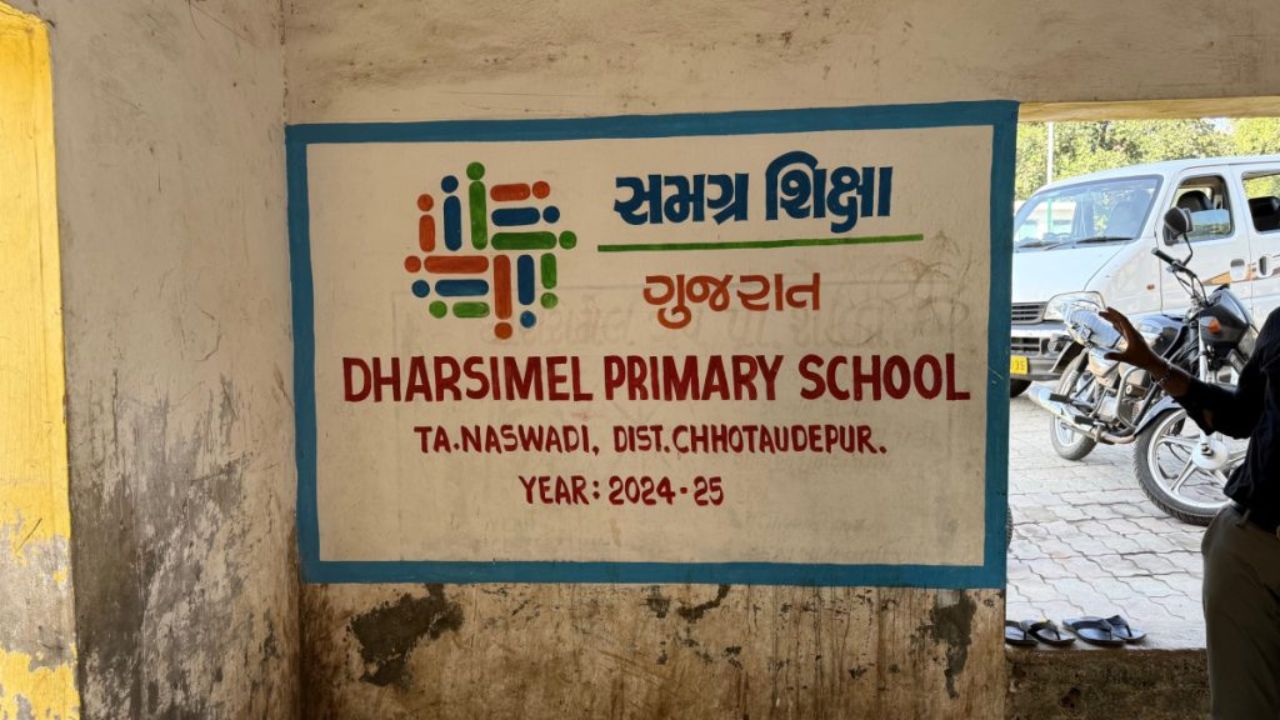
Photo caption: Dharsimel Primary School in Chhota Udepur’s Naswadi Taluka currently has 33 students enrolled from nursery to Class 5. All photos by Tarushi Aswani.
Under the Right of Children to Free and Compulsory Education (RTE) Act, 2009, the law lays down minimum norms and standards for elementary schools – including how many teachers schools should have based on the number of enrolled students. The Act specifies that for Classes I–V, a school with up to 60 admitted children should have at least two teachers; three teachers are required for 61–90 students, four for 91–120, and so on. This norm is meant to ensure that larger schools are staffed with more than one teacher rather than function on a single educator alone, and that pupil–teacher ratios (30:1 at the primary level) are maintained in practice rather than in name.
Rathore knows these and several other regulations laid down concerning pupil-teacher ratio. He has met and encouraged several Adivasi community parents and elders to keep their children in school, despite the state’s apathy towards school in Adivasi belts. “I keep urging them to keep sending their children to schools, I motivate them to believe in the system, but they feel the system doesn’t care about tribal people,” Rathore said.
Barriers beyond the chalkboard
In Kantiyabar Primary School, around six kilometers away from Dharsimel, students are loud and the atmosphere chaotic. Alpesh Pikhadia is currently serving as a substitute at the school, covering for a teacher who has gone to cover for another teacher at another primary school in the Naswadi block.
Pikhadia believes in the government school system and supports it, but feels the pressure of fulfilling the job of at least four teachers and also an administrator. And his troubles don’t end there. Chhota Udepur has a high concentration of the Bhils – and their first language is not Gujarati, but Bhili.
“I am not a Bhil, so I don’t understand their language. Sometimes I tell the older students, who understand Gujarati, to instruct the younger students,” Pikhadia said. Rathore also agrees with this. “We do receive a day of training from the government to understand Bhili,” Pikhadia continued. The government mandates a 12-day training period for these teachers, of which one day is reserved for being ‘introduced’ to the local tribal language.
Both Pikhadia and Rathore point to the dire need for teachers in what they call an extremely backward and illiterate region. The Census of 2011 found the literacy rate of Chhota Udepur to be 43.51% – the lowest in all of Gujarat. Infrastructure too is a hurdle, with schools now dilapidated and in need of repair.
The Wire accessed Right to Information (RTI) applications filed in Naswadi taluka which point to chronic teacher shortages and the dilapidated condition of government primary schools in the Adivasi belt. Bharatbhai Bhil, a young local resident in Kevdi, filed these RTIs to seek answers on the lack of attention towards education in the region and later, to follow up on unanswered RTIs.
On June 30, 2025, Bhil filed an RTI request to narrow the focus to Naswadi’s Kevdi Primary School, about the school’s dilapidated infrastructure. The school building is completely unusable at the moment. He asked whether the reconstruction of the school was sanctioned as yet and if it was, he requested copies of the work orders by concerned departments. As of December 26, 2025, this RTI received no response. The Kevdi Primary School is running in a small room which a local person has loaned to the teacher out of goodwill. The Wire visited the abandoned school building as well as the room where classes were being held.
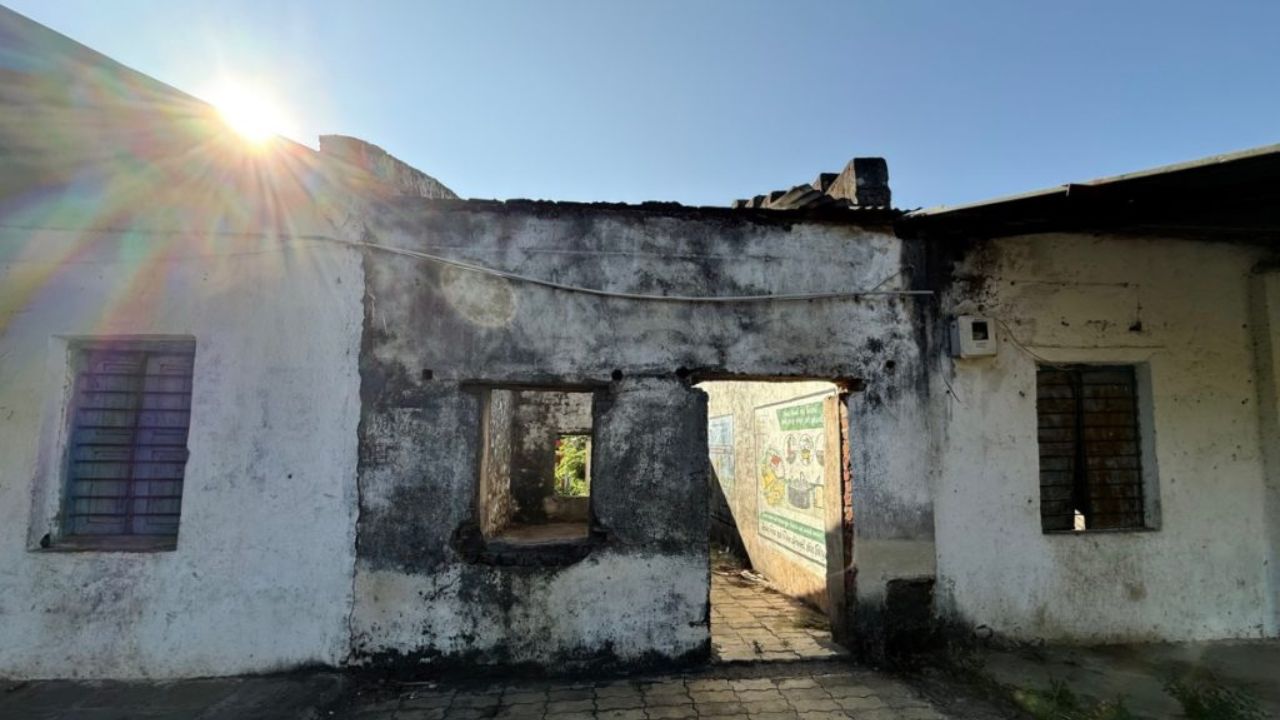
Photo Caption: The original building of the Kevdi Primary School, abandoned due to disrepair.
Another RTI filed by Bhil in October 2023 sought Naswadi-wide data on schools operating with single teachers, subject-wise teacher availability, schools lacking classrooms, and the application also seeks data regarding the number of dilapidated or unusable schools in the block. The RTI received a response in January 2024, with the Block Education Department detailing that there were at least 138 schools with a single teacher tending to grades 1 to 5, and the names of these schools were also listed. The response also shared that 152 schools functioned with teacher shortage in grades 1 to 5 and also stated that there was a shortage of subject teachers in grades 6 to 8, with a shortage of 44 teachers across 36 schools. The response also admitted that there were 30 schools with dilapidated and unusable classrooms.
Taken together, the applications and their responses map both the scale of understaffing and the absence of corrective action over multiple academic years. The Wire has reached out to Anandkumar Parmar, the district education officer of Chhota Udepur, and Milind S. Torawane, principal secretary (primary and secondary education), Gujarat, to ask about these gaps. This article will be updated when a response is received.
n addition to the RTI filings, official correspondence reviewed by The Wire shows that the education department formally acknowledged these concerns. A written communication issued by district education authorities in January 2024 records receipt of an application under the RTI Act and notes that it was processed through the District Primary Education Committee and forwarded to the relevant taluka-level officials. The document confirms administrative awareness of the staffing issues raised, but does not indicate whether the correspondence led to the appointment of permanent teachers, even as schools in Naswadi continued to function with acute shortages.
Students at a loss
Eight km away from Kantiyabar Primary School sits the Kaduli Mahudi Primary School. The school currently has 129 students and is being tended to by the group principal Gawanda, Jaydeepbhai Sonjibhai.
Sonjibhai, who currently looks after 10 schools, is deeply anxious about the way he has to manage the students, his staff and the schools. At a total of 430 students, he feels that students are at a loss owing to the current situation. “Certain schools have reported that students have stopped attending classes or dropped out when teachers are not available for longer periods of time. You can look at our school, we have books, smart boards, pencils but we lack teachers. How do we cope with that?” he asked.
In this struggle for schools, local education activists associated with Udaan, an NGO for education rights, have been providing support classes to Bhili speaking students and creating a database that would help the area’s citizens claim their rights. Ishvar Dunbhil, a local activist from the NGO, has been observing a lack of teaching staff in the region for almost seven years now. Dunbhil said that the education gap is only increasing. A local from Naswadi, Dunbhil recalled how educational facilities in the block had never received the government’s attention. For instance, in 2009, locals protested over the shutdown of 12 girls’ residential schools in the Adivasi pockets of Kwant, Naswadi, Pavi Jetpur and Chhota Udepur in October 2008. In 2024 as well, parents spoke to local Gujarati media about the pitiable conditions in the block’s schools.
On the other hand, Janisar Sheikh, another education activist with the NGO, who has been closely monitoring the region for the past year and a half, said that the district is so remote that nobody wishes to transfer there and teach. But Sheikh feels that the state must initiate a policy to fit teachers in Naswadi. “They have come up with a no-transfer policy in the Kutch region, which also faced a similar lack of teachers. The government must also create a similar policy for this belt,” he told The Wire.
Udaan’s data, too, backs the evidence on teacher shortages. Sheikh shared that in Naswadi’s 12 schools, from kindergarten to grade 5, the total number of students is 518, while the number of teachers in service is 12 – the shortage stands at 14 teachers. In the same 12 schools, the total number of students enrolled in grades 6 to 8 is 251, while the number of teachers in service is nine, and the shortage stands at four.
While the Gujarat government recently moved to address statewide teacher shortages by launching a major recruitment drive for around 10,700 vidya sahayaks, with more than 73,000 applicants and thousands of posts still being filled, the situation on the ground in Adivasi talukas like Naswadi tell a different story.
The Wire’s field visit, interaction with educators, review of RTI responses and official correspondence shows that many primary schools in Naswadi continue to function with just one teacher or prolonged vacancies, and repeated requests for additional teachers by local schools have gone unaddressed. The contrast highlights a gap between broad recruitment plans at the state level and the persistent staffing shortfalls in remote, predominantly Adivasi districts.
In February 2024, the government shared in the Gujarat assembly that 341 primary schools were operating with just one room. In February 2025, questions in the assembly revealed that 54 government primary schools across 33 districts had been shut down in the past two years due to dipping student enrollment.
Recently, in the parliament, in reply to a question by Congress MP Renuka Chaudhary, Union minister of state for women and child development Savitri Thakur revealed that over the past five years, 65.7 lakh children quit school. Out of this figure, Gujarat reported the highest number of out-of-school children in 2025-26. The state recorded 2.4 lakh students who were no longer attending school. In 2024, the state had recorded only 54,541 out-of-school children. The jump to 2.4 lakh this year represents an increase of over 340%.
Congress MLA Tushar Chaudhary, who posed the question regarding teacher shortages in the assembly, feels that educating Adivasi children is not a priority for the BJP government. “There is a shortage of 35,000 classrooms, we lack 15,000 teachers. This is all because the BJP has twisted the policies Congress created. The government shuts schools or merges schools with enrollment below 100 students, so this way, students have to travel more to attend school. That discourages economically weaker families,” he told The Wire. He also added that the Gujarat government’s education expenditure rises in every budget presented year after year, but its reflection on ground is deeply questionable.
Under the RTE Act, every government primary school is required to meet minimum staffing norms, including the appointment of at least two teachers and adherence to prescribed teacher–student ratios. In Gujarat, responsibility for meeting these norms, including sanctioning posts, approving appointments and deploying teachers come under the Samagra Shiksha programme, launched in 2018. The Samagra Shiksha programme merged three earlier schemes: the Sarva Shiksha Abhiyan, the Rashtriya Madhyamik Shiksha Abhiyan and the Teacher Education, into one unified programme covering classes 1 to 12. This became the state’s implementation arm of the Union government’s flagship school education programme. But on the ground, prolonged vacancies and single-teacher schools in Adivasi talukas such as Naswadi point not just to local shortages, but to systemic gaps in how RTE obligations are being fulfilled under the scheme.
(This article first appeared in The Wire)
Also Read: Tribals in Gujarat protest against Par-Tapi Narmada river link project https://www.vibesofindia.com/5000-tribals-from-waghai-in-gujarats-dang-district-held-a-rally-to-protest/