For Indian markers, the fields may look the same. The handpumps will groan at dawn. The fields will wait for rain. But a sense of uncertainty might pervade acres of land.
Something negotiated in air-conditioned rooms across oceans may change their lives.
India’s agricultural sector had traditionally been excluded from US trade discussions.
Now, the new deal is expected to expand exports of American agricultural products into India’s vast consumer market.
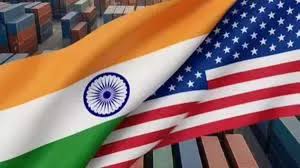
For those who came in late, the announcements by US President Donald Trump and Prime Minister Narendra Modi that the US will reduce “reciprocal” tariffs on Indian goods from 25% to 18% have come as a significant relief to Indian exporters.
The move eases pressure on key sectors such as apparel, gems and jewellery, which were badly hit by last year’s tariff hike. It signals an improvement in bilateral relations after a year marked by sharp trade tensions and public disputes.
As analysts pointed out, it will support higher farm prices and increased income for rural America.
In 2024, the US recorded a $1.3 billion agricultural trade deficit with India. With India’s population continuing to grow, the agreement positions American farmers to tap a crucial market.
What happens to Indian farmers?
That said, the heavily subsidised US agricultural products threaten to undercut Indian prices.
This holds especially for dairy and staple crops, threatening incomes and local rural economies.
Even a modest inflow of cheaper imports can pull prices down. For a farmer whose margins are already thin, a fall in price is the difference between surviving the season and slipping into debt.
Staple crops are especially vulnerable. When domestic prices drop, there is no cushion, no alternate income waiting in the wings.
Nowhere is the anxiety sharper than in the dairy belt.
Experts outlined the fact that milk in India is not just an industry; it is a livelihood woven into daily life, sustained by millions of small producers owning two or three animals.
Reports warn that opening the dairy sector could slash milk prices by around fifteen percent. That single number echoes loudly in rural homes.
A dip like that could translate into massive annual losses and ripple through households that depend on daily milk sales for cash flow.
Smallholders feel especially exposed. Unlike their American counterparts, most Indian farmers do not farm hundreds of acres or operate with heavy automation. They rely on family labour, seasonal rains, and local markets.
When faced with subsidised imports, efficiency becomes irrelevant. The playing field is not level, and they know it.
Farmer groups worry that opening agriculture too widely risks surrendering food sovereignty itself. That is why unions have drawn firm red lines, urging the government to keep core agricultural sectors (especially dairy and sensitive crops)outside the deal.
Genetically modified crops, too, remain a quiet but persistent concern, hovering in the background of negotiations.
Meanwhile, financial markets celebrate. Stocks rise, currencies strengthen, headlines speak of confidence and opportunity. But these gains feel distant in villages where prosperity is measured in stable prices, not indices.
For Indian farmers, the concern is simple, even if the deal is not: in a world of global trade, survival still begins at home.
Clear picture awaited
Meanwhile, India awaits a clearer picture of the deal.
Is it just a limited agreement that only lowers reciprocal tariffs?
The other is a much broader Free Trade Agreement or FTA. Trade officials from both countries worked on this larger deal after Prime Minister Modi’s visit to Washington in February 2025.
There are no official details on tariffs, non-tariff barriers, market access, or investment commitments.
Donald Trump has also claimed that India will reduce tariffs and non-tariff barriers against the US to zero. New Delhi has not confirmed this claim. It has not explained which products, if any, would see tariffs reduced to zero.
Does the 18% tariff improve India’s position?
In April 2025, the US imposed a 25% reciprocal tariff on Indian exports. This placed Indian exporters at a disadvantage compared to regional competitors.
Bangladesh and Vietnam faced tariffs of 20 per cent. Pakistan faced 19 per cent. China faced higher tariffs, but many of those were delayed until late 2026.
The new tariff rate of 18 per cent is therefore an improvement for India. It is particularly helpful for apparel exporters and the gems and jewellery sector, which were among the hardest hit earlier.
However, India still lacks an important advantage. Many neighbouring countries receive a Generalised System of Preferences, or GSP, from the US. This reduces tariffs by about five per cent. India lost this benefit in 2019 during Trump’s first term.
Because of this, Indian exporters had hoped for a tariff closer to 15 per cent. While 18 per cent offers relief, it does not fully remove India’s disadvantage.
What is happening with Russian oil?
Trump has said that PM Modi agreed to stop buying Russian oil and to increase purchases from the US and possibly Venezuela. India has not confirmed this statement.
The Indian government has consistently said that oil imports are commercial decisions based on market prices and energy security. In August 2026, India publicly criticised US penalty tariffs on its purchase of Russian oil, calling them unfair and unjustified.
Despite this position, data shows that India’s imports of Russian oil have declined. Purchases peaked in 2024 and began falling later in the year. Orders of Russian Ural crude dropped sharply in October and again in December.
Is India yielding to US sanctions?
India has faced similar pressure before. In 2019, it stopped importing oil from Iran and Venezuela after Trump threatened sanctions. The pressure was public and direct.
The US has now indicated that countries may once again import Venezuelan oil. While this offers India an option, it also raises questions about how much control India has over its energy choices.
The US has also warned of tariffs on countries doing business with Iran. It has withdrawn sanctions waivers related to India’s investment in Iran’s Chabahar port.
India is reportedly willing to reduce its limited trade with Iran to avoid further penalties. The Union Budget presented on February 1 contains no allocation for Chabahar, indicating a possible pause in the long-running project.
How much has India committed to the US?
Trump has claimed that India has committed to buying more American goods, including energy, technology, agriculture, and coal, worth over $500 billion. India has not confirmed this figure.
The scale of the number suggests this would be spread over many years and across multiple sectors. For context, total India–US trade in goods currently stands at about $131 billion.
Indian investment in the US is around $40 billion.
Without official confirmation, it remains unclear whether such a commitment has been made or how it would be implemented.
Also Read: India’s Strategic Weight Grows In US And Germany Ties https://www.vibesofindia.com/indias-strategic-weight-grows-in-us-and-germany-ties/