


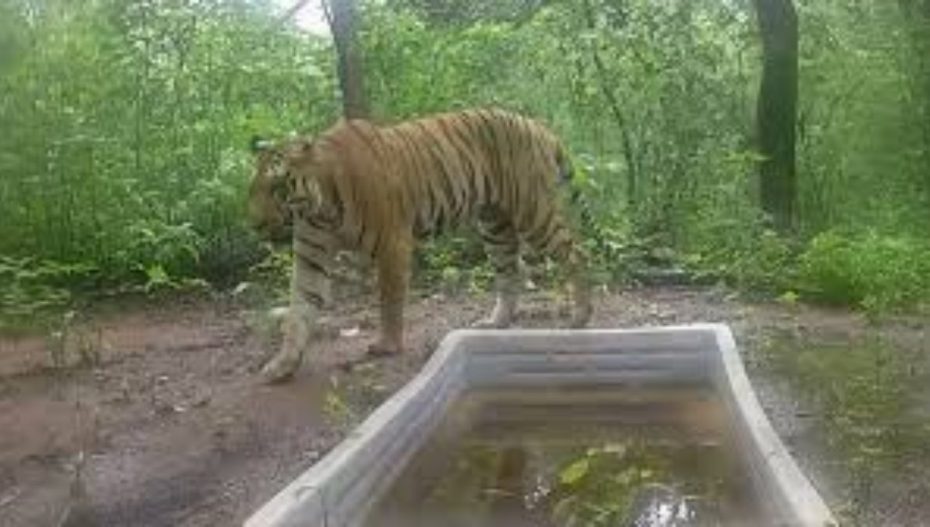
Forest officials tracking the solitary tiger roaming eastern Gujarat have found that the animal has so far relied entirely on natural prey, showing no signs of straying into human spaces or attacking livestock.
According to media reports, the tiger, which has carved out a territory of nearly 120 square kilometres in the Ratanmahal landscape, has now become the focus of an intensive scientific study. Over the past 11 months, the forest department has been running a structured programme to closely observe its movement, feeding behaviour and territorial patterns.
According to findings from scat samples collected in the region, the tiger’s diet mainly consists of barking deer, along with evidence of nilgai and wild boar. Wildlife experts say this offers an important glimpse into how the big cat has managed to establish itself in a landscape where forests and human activity exist side by side.
Officials in the forest department said the analysis has not revealed any remains of cattle or domestic animals. A senior officer noted that the research team monitoring the tiger has found no indication of livestock kills, suggesting the animal has been deliberately avoiding villages and grazing areas.
Teams on the ground are collecting scat, recording scratch marks, pugmarks and scent sprays, and using geographical mapping tools to build a detailed ecological profile of the animal.
Sandeep Kumar, Chief Conservator of Forests for the Vadodara Circle, has been quoted in the media saying that the goal is to understand both what the tiger eats and how it uses the forest. “Scat analysis helps identify prey species, while field evidence allows us to track its movement and territorial behaviour,” he said, adding that the tiger has so far not entered any village or human settlement.
The monitoring effort has also produced surprising conservation insights beyond the tiger itself. Camera traps installed in the area have captured sightings of flying squirrels and pangolins, species that are rarely documented in this part of Gujarat.
Forest officials said the pangolin recordings are particularly important, as they challenge the long-standing belief that the species in Gujarat is largely restricted to the Gir region.
A senior forest officer from Gandhinagar has been quoted saying that the new data is changing how authorities view the ecological importance of the Ratanmahal belt. “This is no longer only about one tiger. The findings highlight the broader biodiversity value of this forest,” the officer said, noting that a wider conservation plan for the region is now being considered.
For the moment, the tiger continues to move quietly through the jungle, hunting wild prey and remaining away from human habitation — making it one of Gujarat’s most closely observed and scientifically studied wild animals.
Also Read: Back On The Map: Gujarat Gains Tiger-State Status https://www.vibesofindia.com/back-on-the-map-gujarat-gains-tiger-state-status/