Suvendu Adhikari has been sworn in as the first-ever Chief Minister of West Bengal from the Bharatiya Janata Party, marking a historic political transition in a state long dominated by the Left Front and later the All India Trinamool Congress. He became Chief Minister in six years after quitting the TMC and joining the BJP. Just before six years, he was then Chief Minister Mamata Banerjee’s closest confidant.
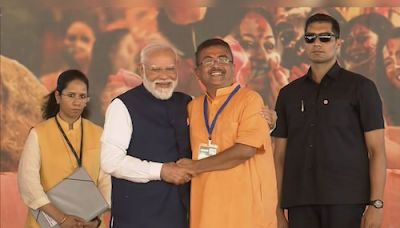
Governor RN Ravi administered the oath of office at a high-profile ceremony attended by Prime Minister Narendra Modi, Union ministers, NDA leaders and chief ministers from several BJP-ruled states.
Five other BJP MLAs were also sworn in as ministers alongside Adhikari: Dilip Ghosh, Agnimitra Paul, Ashok Kirtania, Kshudiram Tudu and Nisith Pramanik.
The six-member Cabinet is being seen as the BJP’s first attempt at striking caste, regional and community balance in one of India’s most politically polarised states.
BJP Ends 15 Years of Mamata Rule
Adhikari’s elevation comes after the BJP’s sweeping victory in the recently concluded Assembly elections, ending 15 years of rule by Mamata Banerjee and her Trinamool Congress government.
The BJP’s victory is being viewed as one of the most dramatic electoral breakthroughs in recent Indian politics, especially given Bengal’s historically resistant political culture and the BJP’s relatively weak position in the state until the late 2010s.
Adhikari himself emerged as the central face of the BJP’s Bengal campaign, winning both Nandigram and Bhabanipur — the latter regarded for years as Mamata Banerjee’s political fortress.
His victory in Bhabanipur by over 15,000 votes carried immense symbolic value because the constituency had become closely identified with Mamata Banerjee’s personal political authority.
From Mamata Loyalist to BJP’s Bengal Strongman
Adhikari’s political journey has been among the most dramatic realignments in Bengal politics.
Once one of Mamata Banerjee’s closest confidants and organisational architects, Adhikari played a major role in building the Trinamool Congress network across rural Bengal, especially in East Midnapore and adjoining districts.
His family wielded enormous influence in coastal Bengal politics and was instrumental in anti-land acquisition agitations in Nandigram and Singur that helped propel Mamata Banerjee to power in 2011.
However, relations between Adhikari and the Trinamool leadership deteriorated sharply over issues of internal power concentration, succession politics and growing influence of Mamata Banerjee’s nephew Abhishek Banerjee within the party.
Adhikari quit the Trinamool Congress in late 2020 and joined the BJP in a move that fundamentally altered Bengal’s political landscape.
Earlier Friction With Modi-Shah Leadership
Ironically, Adhikari’s relationship with the BJP leadership — especially Narendra Modi and Union Home Minister Amit Shah — was not always smooth.
For years, Adhikari had been among the Trinamool’s most aggressive anti-BJP voices in Bengal and frequently attacked both Modi and Shah during intense political confrontations between the Centre and the Mamata government.
He had once accused the BJP leadership of attempting to “import communal politics” into Bengal and was known for leading fierce grassroots campaigns against BJP expansion in the state.
Even after joining the BJP, sections within the party’s old Bengal leadership reportedly remained uncomfortable with Adhikari’s rapid rise and dominant influence.
Some BJP veterans privately viewed him as a late entrant who had overtaken long-serving cadre leaders within a short period.
There were also reports of tensions between Adhikari loyalists and older BJP state leaders over ticket distribution, organisational control and campaign strategy.
However, Adhikari gradually emerged as indispensable to the BJP’s Bengal ambitions because of his mass connect, organisational networks and ability to directly challenge Mamata Banerjee on her own political turf.
His stunning victory over Banerjee in Nandigram in 2021 transformed him into the BJP’s principal Bengal face and strengthened his relationship with the Modi-Shah leadership.
By the 2026 election campaign, Adhikari had effectively become the BJP’s chief strategist and mass mobiliser in the state.
Violence Shadows Political Transition
The transition of power has, however, unfolded amid continued political tension and post-poll violence across several districts of West Bengal.
Since election results were declared earlier this week, multiple incidents of clashes, intimidation and attacks have been reported from different parts of the state.
The atmosphere further escalated after the killing of Adhikari’s personal assistant in Madhyamgram in North 24 Parganas district earlier this week. The BJP alleged targeted political violence, while investigations remain ongoing.
The new BJP government is expected to face immediate challenges relating to law and order, political reconciliation and administrative transition after years of Trinamool dominance over the state machinery.
Cabinet Reflects BJP’s Balancing Strategy
The ministers sworn in on Saturday represent diverse geographical and social constituencies across Bengal.
Dilip Ghosh won from Kharagpur Sadar and remains one of the BJP’s oldest organisational faces in the state. Agnimitra Paul emerged as one of the party’s most visible women leaders after her victory from Asansol Dakshin.
Ashok Kirtania represents the politically sensitive Bangaon Uttar region near the Bangladesh border, while Kshudiram Tudu’s induction reflects outreach to tribal communities from western Bengal. Nisith Pramanik, elected from Mathabhanga in Cooch Behar, brings representation from north Bengal — a region where the BJP performed strongly.
The portfolios of the ministers are expected to be announced later, with more inductions likely in the coming days.
A New Political Era in Bengal
With Adhikari now occupying the state’s top political office, Bengal enters one of the most consequential political transitions in its modern history.
The BJP’s challenge now shifts from opposition mobilisation to governance in a politically volatile and deeply polarised state where Mamata Banerjee and the Trinamool Congress are expected to remain powerful opposition forces.
For the BJP leadership, Bengal represents not only a major electoral breakthrough but also a symbolic expansion into a region that had long resisted the party’s ideological and organisational advance.
Also Read: West Bengal’s Suvendu Adhikari Urges Amit Shah To Implement CAA Soon https://www.vibesofindia.com/suvendu-adhikari-urges-amit-shah-to-implement-caa-soon/