

Patrick McCartney
Today, June 21, is observed as International Day of Yoga.
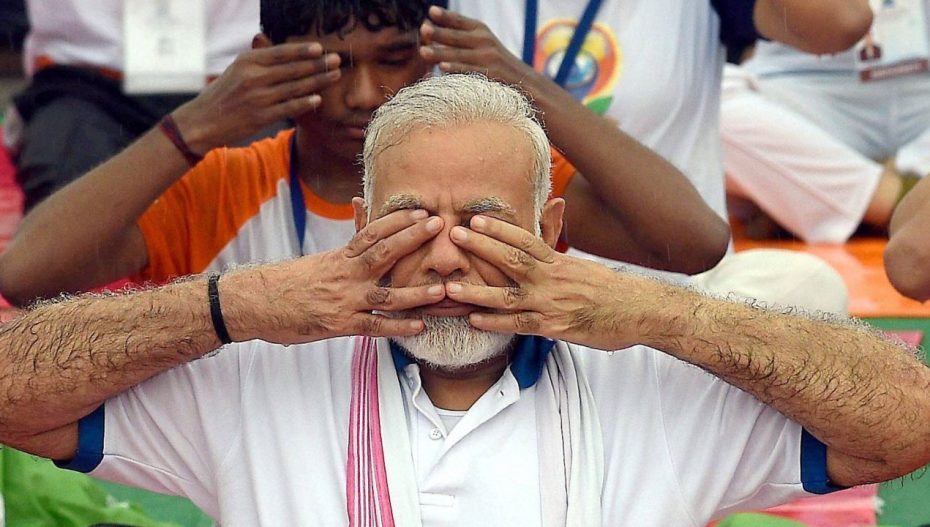
Just like the summer solstice every June 21, the International Day of Yoga (IDY) reappears as a familiar global ritual. Across the world, public parks fill with bodies moving in synchrony while political leaders roll out mats in carefully staged formations. Social media becomes filled with images of military personnel, schoolchildren, diplomats, and citizens performing the same sequences in different countries under the same name, at the same time.
On the surface, this looks like a wellness event aimed at creating uptake in yoga’s perceived benefits. However, it is also a carefully stabilised attempt that converts an embodied practice into a global language of governance legitimacy. It is not merely cultural diplomacy, but an attempt to position India at the interpretive centre of a “timeless and eternal” practice. At the core of this positioning is the assumption that yoga can fill in the blanks, as it were, to become the vocabulary of a new global order itself: health, balance, unity, sustainability.
The rise of the yoga state
The rise of IDY did not happen by accident. This is a coordinated effort that began with Narendra Modi’s success to get the United Nations to adopt June 21 as the IDY in 2014. Widely framed as a diplomatic success, it also marked something more structurally significant: the consolidation of yoga into a state-legible civilisational object. Yoga had long operated as a floating signifier. This abstract term refers to yoga’s broad spectrum hybridity across fitness culture, spirituality, tourism, consumer wellness, and New Age mysticism.
The intervention of the Indian state did not create yoga’s global popularity. Instead, it piggybacked off decades of steady global consumption to attempt something much more specific. What the Indian state has attempted to do is stabilise – by proxy – its own geopolitical meaning through retroactively anchoring yoga to a civilisational narrative of origin.
In official framing, yoga becomes not one practice among many global wellness forms, but a uniquely Indian contribution to universal wellbeing. In fact, it is positioned as the final form wellness ought to take. For example, in Prime Minister Narendra Modi’s 2015 UN address, yoga is described as:
“an invaluable gift of India’s ancient tradition… a holistic approach to health and wellbeing.”
It is easy to be swayed by the emotional undercurrents and front-facing charisma, and look past the political work this formulation is doing. Yoga no longer simply circulates globally. Its signal has complexified into greater claims attached with more weight to origin, authority, and interpretive legitimacy. For example, in Narendra Modi’s IDY 2021 speech, the framing tightens further:
“Yoga is not just an exercise, it is a way of life.”
This is the key transformation: from activity to ontology, from practice to worldview. Alongside this, figures such as the External Affairs Minister Subrahmanyam Jaishankar consistently situate yoga within India’s soft power repertoire, as being part of its diplomatic language that is instrumentalised toward potentiating India’s ability to project influence through “civilisational values.”
At the UN level, diplomats and institutional representatives have repeatedly reinforced yoga as a universal wellness practice, further stabilising its legitimacy as a globally shared cultural object. Across political leadership, diplomacy, and multilateral endorsement, a shared vocabulary emerges: yoga as unity, yoga as harmony, yoga as global wellbeing.
There is not one single narrative, however. Instead, there is stacked institutional convergence of language.
Building the visibility machine
To understand how this discourse operates at scale, I constructed a longitudinal dataset of IDY content spanning 2015-26. The system combines:
- scraped YouTube transcripts (~900 videos)
- Instagram and Twitter/X hashtag ecosystems
- Google Trends and Wikipedia attention proxies
- institutional communication patterns (embassy and ministry outputs)
These are analysed as a single “visibility ecology,” rather than being treated as separate datasets. At its core, the method involves clustering YouTube transcripts into structurally similar discourse groups and measuring their internal coherence using a Discourse Structure Index (DSI).
DSI does not measure meaning. Instead it measures how language holds together across institutional contexts through noticing variation in repetition, fragmentation, and structural stability. What this reveals is not what Yoga Day ‘says’, but how Yoga Day behaves as a language system.
From body to governance language
Across this combined corpus, a consistent transformation appears. For example, at the level of embodied practice, yoga is physical: posture, breath, repetition. However, in institutional circulation, it becomes rapidly abstracted. While in political and diplomatic framing, it becomes:
- a “gift from India to the world”
- a symbol of “unity of humanity”
- a tool for “global peace and harmony”
This is not just descriptive language. It is the translation of a yogic sentiment into an abstracted governance-compatible mood aimed at effecting a more profound globalising atmosphere that lifts “Yoga” from the body into a framework for thinking within a global ordering index. Thus, Yoga’s “grammar” institutes a language through which institutions can speak about balance, stability, and collective wellbeing without reference to coercion or conflict.
Civilisational framing and soft power logic
What emerges across institutional speech is a subtle but consistent civilisational framing. Yoga is repeatedly positioned as:
- ancient
- Indian in origin
- universal in relevance
- apolitical in form
- stabilising in effect
This produces a particular discursive structure: the particular (civilisation) becomes the source of the universal (global wellbeing). This is where soft power becomes more than influence. Importantly, through projecting an apolitical yogic affect the overtly Hindutvafied project currently being expressed by the Indian state, which is diluted (ideally) through the IDY project. Yet, under the surface, the battle for Yoga’s soul and its derivatives rumbles at a tectonic level. Its interpretive centrality is linked to its ability to define the meaning of a globally circulating practice without overt enforcement. After all, it was gifted to the world and any attempt to claim this gift back would ironically lead to being an “Indian giver” of epic proportions. However, the effect is not explicit ideology in the traditional sense. It is a backgrounding of civilisational identity within universal language threaded with integral philosophy. In other words, yoga patches the BJP’s ideological pillars of Integral Humanism and Hindutva into a global wellness consciousness.
The platform layer: repetition without full control
Once this discourse enters YouTube and social media platforms, it detaches from its institutional origin. For example, clips of speeches circulate alongside instructional videos, news coverage, embassy content, and wellness influencers. This leads to a stable set of phrases emerging:
- “global celebration”
- “message of peace”
- “unity of humanity”
- “ancient Indian tradition”
- “wellness for all”
Through mediation across multiple platforms, these phrases lose their connection to specific speakers and institutions, nestling into more subtle layers of the collective mind. It is here that they function as what could be “portable legitimacy units.” This generates a more coordinated system which is partially emergent through repetition, editorial convention, and institutional imitation.
Annual cycles: design or convergence
Each year, the IDY provides a particular thematic emphasis. Across the dataset, these shift gradually:
- unity and harmony (early phase)
- global health and wellbeing (mid phase)
- resilience and recovery (pandemic phase)
- environmental > global > cosmic balance (later phase)
This raises a structural ambiguity, while also bringing to mind the following queries: Is this evolution a coordinated soft power strategy adapting to global conditions? Or an iterative stabilisation process where institutions refine messaging based on prior successful framings? What the evidence suggests is a hybrid system that is neither fully designed nor fully emergent, but stabilised through institutional feedback loops.
What the DSI reveals
The Discourse Structure Index shows a striking pattern across clusters. Despite variation in content, Yoga Day discourse remains highly anchored to itself, while featuring minimal thematic drift. What varies instead is structural form:
- institutional speech: ordered, declarative, stable
- broadcast speech: mediated, repetitive
- participatory speech: fragmented, imitative
- degraded speech: transcriptional residue
This produces a gradient of coherence that loosely maps onto institutional hierarchy. For example, the more institutional the speaker, the more structurally stable the language. Yet, the more distributed the speech, the more fragmented and repetitive it becomes. Thus, what appears as a global celebration is, structurally, a layered hierarchy of discourse stability.
In practice, this shows up as a tightly structured, low-repetition framing stack that has ministerial and diplomatic speech at the top, and increasingly repetitive, slogan-driven, and structurally noisy language as one moves toward broadcast coverage, local documentation, and social media circulation. What this means is that meaning degrades in form as it moves across the system, away from institutional control.
Yogaland: the attention economy beneath the ritual
To describe the broader ecology in which this operates, I use the term Yogaland – the global consumerscape in which yoga circulates as wellness, identity, commodity, and media form. IDY initially functioned as a synchronisation device for this ecosystem, which, for a brief period, worked by providing drone shots of mass yoga performances, synchronised bodies, and civilisational imagery aligned perfectly with early platform aesthetics. But Yogaland has since fragmented, moving into the latter curve of its industry maturation phase. For example, wellness culture has diversified into:
- biohacking
- trauma discourse
- nervous-system regulation
- psychedelics
- longevity optimisation
Against this increasingly complex attention economy, Yoga Day imagery has become repetitively formulaic. While its earlier iterations were energised by sincere and earnest consumers of yoga lifestyles, as an event it has routinised into an annual maintenance cycle.
From diplomacy to infrastructure
What begins to emerge is a shift in function. IDY is no longer just a diplomatic event. Instead, it becomes a content-production infrastructure that includes embassies, ministries, influencers, yoga schools, and media outlets all participating in reproducing the same ritualised visibility structure.
Interestingly, embassy activity often intensifies when visibility is already declining. This suggests a lagged reinforcement dynamic rather than a purely generative one. In other words, as the global interest in Yoga Day recedes into the domestic tidal zone, the machine does not create attention so much as attempt to stabilise its loss.
Conclusion: a system approaching saturation
IDY succeeded in embedding yoga into global cultural circulation at an unprecedented scale. However, the same process that enabled its expansion may also be producing its plateau. Once yoga becomes fully integrated into the global wellness economy, it loses the scarcity that made it politically useful as a soft power signal. The Indian state appears to have suffered from its own version of Midas’ touch. Through attempting to push yoga into the global centre, it has overshot the mark. Now, yoga appears to be on a trajectory back to the margins. At least, its trajectory is past the apogee. What remains is a stabilised ritual system that is annually reproduced, institutionally reinforced, algorithmically circulated, and symbolically consistent. However, it is increasingly decoupled from sustained global attention. Ultimately, while the machine still runs, it is no longer clearly ascending. At best, it is maintaining altitude.
Also Read: A Lived Sociology of Caste https://www.vibesofindia.com/a-lived-sociology-of-caste/