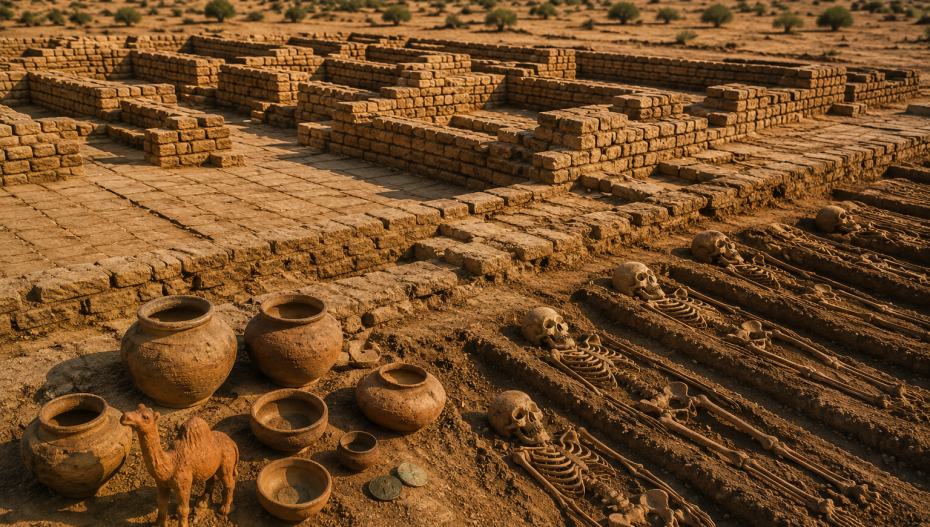
What was once believed to be nothing more than a deserted stretch of land near the India-Pakistan border in Gujarat’s Kutch district has now turned into one of the region’s most significant archaeological discoveries. A site that Border Security Force (BSF) personnel had informally named “Ujadagaon” (deserted village) has been identified as the remains of a large medieval settlement that may have flourished between the 11th and 14th centuries CE.
Archaeologists have provisionally named the settlement Barbadgaon, and investigations suggest it was once a thriving community with homes, trade, agriculture and a well-organised way of life.
Discovery Began With BSF Patrols
The site first came to light during routine BSF patrols in 2023-24 near the remote Indo-Pak border in Kutch. Security personnel noticed unusual structural remains scattered across the barren landscape and began referring to the place as “Ujadagaon,” meaning an abandoned village.
Their observations prompted researchers from Krantiguru Shyamji Krishna Verma Kachchh (KSKVK) University to conduct the first scientific reconnaissance with assistance from the BSF.
The discovery was later officially announced by KSKVK University in collaboration with the University of Oxford, following extensive archaeological investigations.
A Large Medieval Settlement Emerges
Detailed surveys revealed that the seemingly empty land was once home to a sizeable medieval settlement. Researchers uncovered extensive structural remains, including:
Brick enclosures
Paved surfaces
Domestic structures
Pottery fragments
Household artefacts
Based on preliminary findings, archaeologists believe the settlement was mainly occupied during the Soomra period, between the 11th and 14th centuries CE.
The temporary name Barbadgaon has been given to the site until its original historical identity can be established.
Experts Found Evidence of an Organised Community
The site was examined by experts from the Physical Research Laboratory (PRL), Birbal Sahni Institute of Palaeosciences, and Deccan College Post-Graduate and Research Institute.
According to Gaurav Chauhan, Assistant Professor at KSKVK University, the density of the structures, enclosure features and pottery quickly made it clear that this was not an isolated building but an important historical settlement.
Researchers say the archaeological evidence points to a settlement with a sizeable population and an organised lifestyle.
Pottery, Coins and Rare Artefacts Recovered
Excavations have uncovered several artefacts that provide insights into the everyday life of the people who once lived there. Among the discoveries are:
Terracotta rice hullers
Oil lamps
Storage jars
Domestic pottery
A copper coin
A terracotta camel figurine
Researchers compared the ceramics with material found in medieval settlements in lower Sindh, helping them estimate the settlement’s age.
According to Prabodh Shirvalkar of Deccan College Post-Graduate and Research Institute, the pottery and rice-processing tools place the settlement firmly within the broader medieval cultural landscape of the lower Indus region.
Rice Farming and Trade May Have Flourished
The discoveries also provide clues about the settlement’s economy.
The presence of rice-processing tools suggests that agriculture, particularly rice cultivation, may have played an important role in the local economy. Researchers believe seasonal flooding could have supported the cultivation of a local rice variety known as Garrha rice.
Large storage vessels and domestic artefacts indicate that the settlement was engaged in food production, storage and regular trade activities.
Around 100 Human Skeletons Discovered
One of the most striking discoveries at the site is a burial ground containing around 100 human skeletons.
Researchers believe the remains became exposed naturally following an earthquake. They also observed that the heads of all the skeletons are oriented towards the west.
The burial ground is expected to provide valuable information about the people who once inhabited the settlement.
Ancient Waterways May Explain the Settlement’s Importance
Researchers believe the location of Barbadgaon was strategically important.
The settlement stands on elevated ground in a landscape that has been repeatedly reshaped over centuries by shifting rivers, tidal movements, sediment deposits and tectonic activity.
Experts suggest the site may once have been located along an ancient maritime corridor that was separate from the better-known Kori River-Dhoro Puran-Nara route.
According to researchers, eastern distributaries of the lower Indus may once have flowed towards the Sir Creek region, creating navigable waterways connecting inland settlements with the Arabian Sea.
These waterways would have enabled the movement of people, agricultural products and other goods, making the region an active trade corridor.
Today, the landscape is divided by an international border, but archaeologists believe it once functioned as a single cultural and environmental zone.
International Collaboration to Continue Research
According to Ajay Yadav, a researcher at the University of Oxford, Barbadgaon offers a rare opportunity to study how the Indus River system, the Hakra river network, tidal creeks and ancient maritime routes interacted over thousands of years.
The excavation is now part of a multidisciplinary collaboration between KSKVK University and the University of Oxford.
Researchers plan to carry out further excavations and scientific dating to determine the settlement’s exact age, understand its economy, and uncover its role in the wider network of ancient and medieval trade.
A Forgotten Chapter of Kutch’s History
Although Barbadgaon is only a provisional name, archaeologists believe the discovery could rewrite an important chapter in the history of Kutch and the lower Indus region.
What began as a deserted landscape noticed by BSF patrol teams may eventually emerge as one of western India’s most important medieval archaeological sites, offering fresh insights into centuries-old settlements, trade routes and human civilisation.
Also Read: Sand Grains Hold Clues To Gujarat’s Ancient Tsunami History https://www.vibesofindia.com/sand-grains-hold-clues-to-gujarats-ancient-tsunami-history/