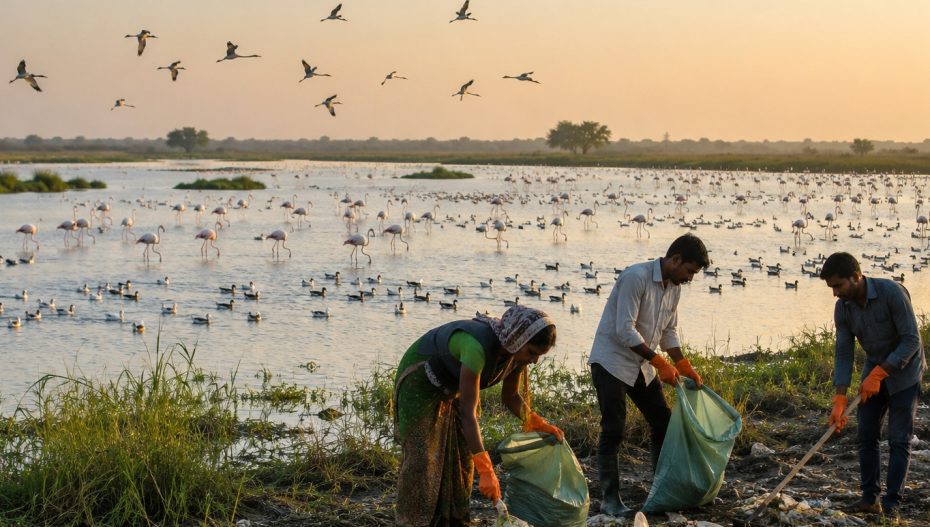
Gujarat is preparing a new plastic waste management project around Nal Sarovar, the state’s largest bird sanctuary, with a focus on keeping plastic away from the wetland and creating additional livelihood opportunities for people living in nearby villages.
Under the Project for Eco-Restoration in Gujarat (PERG), supported by the Japan International Cooperation Agency (JICA), residents of 14 villages located within a 2–4 km radius of Nal Sarovar will be encouraged to collect plastic waste. The collected waste will be processed and sent for recycling, while local residents will be paid for the plastic they collect.
The Rs 2.94-crore project is expected to begin within a month and is designed to address both environmental pollution and local employment.
Why Plastic Around Nal Sarovar Is a Concern
Nal Sarovar covers around 120 sq km and is located about 60 km from Ahmedabad. The wetland is an important destination for migratory birds that arrive during winter from regions including Central Asia, Siberia and Europe.
Although the sanctuary itself is a strictly plastic-free zone, plastic waste from nearby settlements can still reach areas used by birds.
Birds do not follow the official boundaries of a protected area. They often move between the wetland and surrounding villages, meaning plastic pollution outside the sanctuary can also become a threat to them.
The new project aims to reduce this risk by dealing with plastic waste before it reaches the wetland.
14 Villages to Be Covered
The Forest Department has identified 14 villages around Nal Sarovar for the waste collection programme.
The villages include areas such as Vekariya, Kayla, Shahpur, Dharji and Meni in Ahmedabad district, along with Nani Kathechi and Ranagadh in Surendranagar district.
A dedicated plastic waste collection centre has already been established at Kayla village in Viramgam taluka.
At least four of the identified villages are located along State Highway 136, which connects towards the Mandal-Becharaji Special Investment Region, around 65 km north. The region is also associated with Japanese investment in automobile manufacturing facilities.
Local Residents Will Be Paid for Collecting Plastic
One of the important features of the project is that plastic collection will also become a source of income for local residents.
People from the 14 villages will collect plastic waste and bring it to a Forest Department facility. The plastic will then be shredded and sold to a recycling company selected through a bidding process.
The Forest Department will pay residents for the plastic they collect.
Officials said the payment rate is expected to be higher than the existing market rate because the current rate of around Rs 10–12 per kg is not considered attractive enough to encourage ragpickers to collect plastic in the area.
The exact rate to be paid to villagers was still under discussion.
Waste Collection Infrastructure Already in Place
The project is not limited to simply asking residents to collect plastic.
Necessary infrastructure, including collection sheds, processing facilities and safety equipment, has already been arranged, according to project officials.
Waste collection bins are also being installed across the villages.
The Forest Department will systematically collect the plastic waste from the villages and transport it to the designated collection centre.
A detailed work study has also been carried out to plan the daily collection and transportation process.
‘Swachhta Praharis’ to Encourage Cleanliness
Local eco-development committees will play a role in implementing the project.
These committees will appoint volunteers known as “Swachhta Praharis” or cleanliness warriors. Their job will be to encourage villagers to separate dry plastic waste and dispose of it properly.
The idea is to make waste segregation and collection part of the regular community system rather than relying only on government workers.
This community participation is also expected to make the project more sustainable over the long term.
Supporting Livelihoods of the Padhar Community
The project also has a social and livelihood component.
The Padhar community, which is among Gujarat’s five Particularly Vulnerable Tribal Groups, lives in villages around Nal Sarovar and depends heavily on the wetland’s resources for daily livelihood.
A PERG report prepared in 2020 identified several challenges affecting the management of Nal Sarovar. These included solid waste pollution, uncontrolled growth of reeds and weeds, the spread of Prosopis juliflora along the fringes, bird poaching and a shortage of funds and staff for effective management.
By involving local residents in plastic collection, the new initiative aims to address one of these challenges while also creating an income opportunity.
Project Aims to Protect Nal Sarovar’s Biodiversity
The Forest Department expects the initiative to significantly reduce the amount of plastic entering Nal Sarovar every year.
This is particularly important because the wetland supports a large variety of bird species.
The 2025–26 bird census recorded 270 bird species at Nal Sarovar, with an estimated population of around 6.42 lakh birds.
The wetland has also recorded sightings of several rare and globally threatened birds, including:
Yellow-breasted Bunting
Sociable Lapwing
Indian Skimmer
Baer’s Pochard
Dalmatian Pelican
Saras Crane
The presence of these species highlights the importance of maintaining a clean and healthy habitat around the wetland.
Nal Sarovar’s Importance as a Ramsar Wetland
Nal Sarovar is not only an important bird sanctuary but also a wetland of international importance.
It was designated as the country’s 26th Ramsar site in 2012. Ramsar sites are wetlands recognised internationally for their ecological importance under the Ramsar Convention, an international agreement focused on the conservation and sustainable use of wetlands.
Gujarat currently has five designated Ramsar sites. Apart from Nal Sarovar, these are:
Thol Lake in Mehsana
Wadhvana in Vadodara
Khijadiya in Jamnagar
Chhari-Dhand in Kutch
All five are known for their importance as bird habitats and popular birding destinations.
Gujarat’s Wider Plastic Challenge
The Nal Sarovar initiative also comes against the backdrop of Gujarat’s wider efforts to control plastic waste.
A 2021 state notification imposed a complete ban on single-use plastic in Gujarat, with bags permitted only when they are thicker than 120 microns.
According to the latest available Central Pollution Control Board figures cited in the information, Gujarat generates around 2,48,400 metric tonnes of plastic waste, accounting for approximately 6% of India’s total plastic waste.
The project around Nal Sarovar therefore focuses on a particularly sensitive area where waste management has a direct connection with wildlife protection.
Environment Protection Alongside Employment
The proposed initiative brings together two objectives: protecting a major wetland and creating livelihood opportunities for nearby communities.
Instead of treating plastic waste only as a pollution problem, the project aims to give it an economic value by paying residents to collect and segregate it before it can reach the wetland.
With collection centres, bins, processing facilities, community volunteers and recycling arrangements being put in place, the programme is designed to create a more organised system for handling plastic waste around Nal Sarovar.
For a wetland visited by hundreds of thousands of birds every year, keeping plastic away from the surrounding landscape could be an important step towards protecting its biodiversity while ensuring that local communities also benefit from conservation efforts.
Also Read: Gujarat Plans Quantum Mission To Drive Next-Gen Technology https://www.vibesofindia.com/gujarat-quantum-mission-quantum-technology-development/