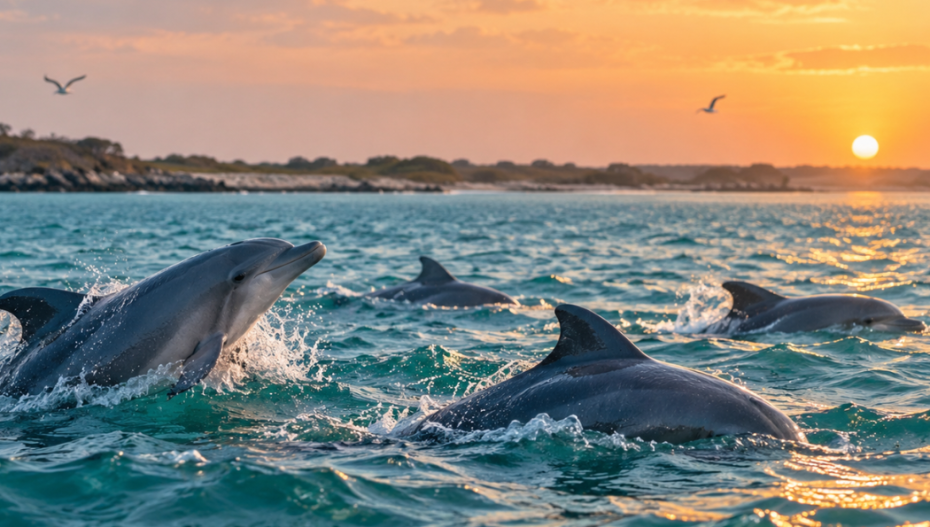
For dolphins in Gujarat’s Gulf of Kutch, the journey may not simply be about moving from one point to another.
Across islands, reef edges and coastal waters, researchers repeatedly came across dolphins during surveys carried out over more than a year. Some were seen moving with tidal currents, while others were observed feeding or travelling through deeper stretches of the reef system.
The observations have opened up a larger question about how the dolphins use the Gulf — and whether the waters serve as a regular habitat for at least some of them.
A survey by the Gujarat Ecological Education and Research (GEER) Foundation, conducted between October 2023 and February 2025, recorded 193 individual dolphins during 64 sightings in the Gulf of Kachchh.
The work covered Narara and nearby islands, including areas within the Marine National Park and Marine Sanctuary.
One Gulf, several dolphin hotspots
The sightings were not concentrated at a single location.
Narara Reef recorded 14 sightings involving 39 dolphins. At the Dedeka-Mundeka island complex, researchers recorded 12 sightings and 41 dolphins, while Pirotan Island accounted for 11 sightings involving 32 dolphins.
Dolphins were also recorded at Dhani Island, with nine sightings involving 28 individuals, and in the coastal waters of Sikka, where eight sightings involved 26 dolphins.
Another 10 sightings, involving 27 dolphins, came from the other areas covered during the survey.
The distribution gives a glimpse of how widely the animals were encountered across the surveyed section of the Gulf rather than being restricted to one particular island or reef.
The dolphins were seen through the year
The timing of the observations is another part of the survey that stands out.
Of the 64 dolphin sightings, 26 were recorded during winter, 21 after the monsoon and 17 during summer.
That spread does not by itself establish that the entire dolphin population remains in the Gulf throughout the year. However, repeated observations in different seasons provide useful evidence about the continued use of these waters.
Researchers also recorded groups of different sizes, with the largest group containing 16 dolphins.
What researchers saw in the water
The survey was not limited to counting dolphins.
During field observations, researchers noted coordinated swimming, repeated surfacing, movement along tidal currents and feeding activity.
The animals were encountered around tidal channels, open coastal waters, reef margins, island edges and seagrass areas.
In particular, repeated observations of dolphins around tidal channels and deeper reef margins point to the possible importance of these areas for both movement and feeding.
For a marine ecosystem as complex as the Gulf of Kutch, such observations can help build a better understanding of which habitats are being used by different marine mammals.
Dolphins were part of a much bigger marine picture
The survey also looked beyond dolphins.
Researchers recorded 177 sightings of marine megafauna, involving 342 individuals. Dolphins accounted for 36.2% of those sightings, making them the most frequently recorded marine mammal in the survey.
The dolphin sightings were therefore part of a broader assessment of marine life and habitats in the Gulf.
The survey confirmed the Indian Ocean humpback dolphin (Sousa plumbea). Researchers, however, noted that species-level identification was not possible for every sighting, meaning further systematic surveys will be needed to build a clearer picture of dolphin diversity in the region.
A starting point, not the final picture
The numbers from the survey are significant because they create a reference point for future work.
A record of 193 individual dolphins across 64 sightings can help researchers compare future observations and track changes in distribution, habitat use and population patterns.
It also underlines the need to keep an eye on the places dolphins appear to use regularly, particularly tidal channels and productive coastal habitats.
For now, the survey does not answer every question about the dolphins of the Gulf of Kutch.
But it does offer something equally important — a clearer first picture of where these animals are being found, how they are using the waters and how consistently they appear across different seasons.
And that could make the Gulf of Kutch not just a waterway dolphins pass through, but a marine landscape worth watching much more closely.
Also Read: Mount Everest In The Himalayas Is Melting: Human Urine Is The Reasons