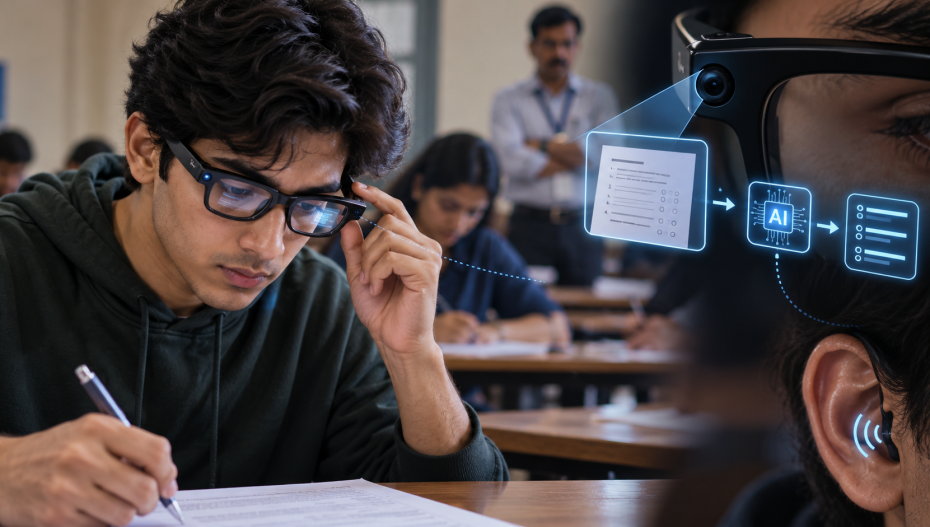
A camera hidden in a pair of spectacles, an AI system capable of generating answers and tiny speakers that can relay those answers to the wearer — technology that sounds more suited to a futuristic gadget than an examination hall has now surfaced in a cheating case in Surat.
A first-year BBA student at a college in Varachha was allegedly caught attempting to use AI-enabled Meta smart glasses during examinations held in March and April 2026. The case has emerged as the first reported incident of its kind in Gujarat and has added a new challenge for colleges already struggling to keep smartphones and other electronic devices out of examination halls.
The student has since been barred from appearing for examinations for one year and fined ₹10,000. He was also asked to submit a written apology, while his parents were called to the college.
The college is affiliated with Veer Narmad South Gujarat University (VNSGU).
A Pair Of Glasses That Drew Attention
The alleged use of the device came to light when members of VNSGU’s anti-cheating flying squad noticed the student handling his spectacles in an unusual manner.
The officials examined the glasses and found them to be AI-enabled Meta smart glasses, according to college sources.
The student was taken out of the examination hall and questioned in another room in the presence of the college principal and professors. During the inquiry, he reportedly demonstrated the functioning of the glasses to the college authorities.
Sources said the student admitted to attempting to use the device to cheat.
The alleged method was relatively simple. A camera fitted into the spectacles could capture an image of the question paper. The image could then be processed through AI, with the generated response delivered to the student through open-ear speakers integrated into the glasses.
The device therefore offered a way of receiving information without the student having to visibly operate a phone or computer.
What Happened After The Inquiry
Following the proceedings, the student was reportedly booked for copying and asked to pay a ₹10,000 penalty.
He was also told that he would not be permitted to take the examination for one year and was required to submit a written apology.
The student’s parents were called to the college.
The smart glasses were kept by the college authorities for several months and were reportedly returned to the student about a week before the incident became public, after the penalty was paid.
The college principal declined to comment on the matter.
VNSGU Vice Chancellor Dr K N Chavda confirmed that the university had come across such an incident involving one of its affiliated colleges but said he did not have further information about the particular case.
The Technology Behind The Attempt
Smart glasses are no longer limited to recording photographs or playing music.
Products such as Ray-Ban Meta, Rokid and Even Realities G1 can combine cameras, microphones and speakers within a conventional-looking spectacles frame. Some models also include a small display capable of presenting information in the user’s field of view.
Depending on the model, the glasses can communicate with a smartphone or the internet using Bluetooth or Wi-Fi. A camera can capture what the wearer is looking at, while an AI system can process the information and generate a response.
Audio-enabled models can then relay that response through speakers built into the frame. Some devices use bone-conduction technology, while other models use open-ear audio.
That combination is what makes the technology particularly difficult for examination authorities to police. A student does not necessarily need to hold a phone, look at a visible screen or use an obvious earpiece.
The glasses can continue to resemble ordinary prescription spectacles or sunglasses.
Meta’s AI-enabled glasses, developed with Ray-Ban, first became available in late 2023. The company has since released newer versions and reportedly sold around seven million pairs in 2025.
Surat Follows A Pune Case
The technology had already attracted attention in the Indian examination system earlier this year.
On May 19, two engineering students at Symbiosis Institute of Technology in Pune were found wearing Ray-Ban Meta smart glasses during an examination.
The institute subsequently debarred the students from that examination paper. A Symbiosis official said the glasses could potentially be used for activities such as accessing ChatGPT or taking photographs. However, the institute said there was no evidence that the students had actually used them for those purposes.
The Surat case has taken the issue a step further, with college sources saying the student admitted to attempting to use the glasses for cheating.
From Bluetooth Slippers To AI Eyewear
India has dealt with technology-assisted examination malpractice for years, although the devices involved have evolved rapidly.
In 2021, a candidate appearing for the Rajasthan Eligibility Examination for Teachers in Kishangarh, Ajmer, was reportedly caught with a Bluetooth device concealed inside footwear. Police said a mobile phone and transmitter hidden in the slippers were connected wirelessly to a small earpiece worn by the candidate.
Smart glasses bring several of those functions together in a device that can be worn openly.
This has forced examination authorities to think beyond conventional searches for phones, Bluetooth devices and electronic accessories.
In February 2026, the University Grants Commission circulated jammer guidelines to higher educational institutions. The guidelines, received from the Cabinet Secretariat in December 2025, allow statutory or government-recognised examination-conducting bodies to use low-powered or classroom jammers to prevent cheating and other examination malpractices, with the equipment to be leased through empanelled PSUs.
But blocking mobile connectivity may not by itself solve every problem posed by wearable AI devices.
The Concern Is Growing Beyond India
The debate around AI glasses in examination halls is already playing out internationally.
In South Korea, people taking English-proficiency tests were reportedly caught using smart glasses in May 2026. A separate case in Taiwan involved a student appearing for an examination for admission to a leading medical school. Proctors reportedly became suspicious after noticing unusual behaviour and subsequently found that the frame of the glasses was generating heat.
China also tightened scrutiny for smart glasses and similar devices ahead of the 2026 gaokao, its highly competitive college entrance examination.
In the United States, the College Board has prohibited smart glasses, including prescription versions, during SAT examinations. The devices have been placed alongside other wearable technologies restricted during the test.
In Britain, Ofqual chief regulator Sir Ian Bauckham warned in June that AI glasses and devices such as smart earpieces could make examination cheating more difficult to control.
A New Problem For Examination Halls
The challenge posed by AI glasses is not simply that they are capable of generating answers.
It is that the technology can fit into an object that is otherwise entirely ordinary.
For years, examination rules have focused on phones, written notes, calculators and other objects that can be identified and removed before a test begins. AI-enabled eyewear blurs that line.
The Surat case shows how quickly that problem can move from a technology discussion to an actual examination hall.
For colleges, the question now is no longer only what students are carrying into an exam — but also what their everyday-looking devices are capable of doing.
Also Read: Financial Evidence Missed? Canada Court Overturns Visitor Visa Refusal For 3 Indians