


Ahmedabad | November 5, 2026
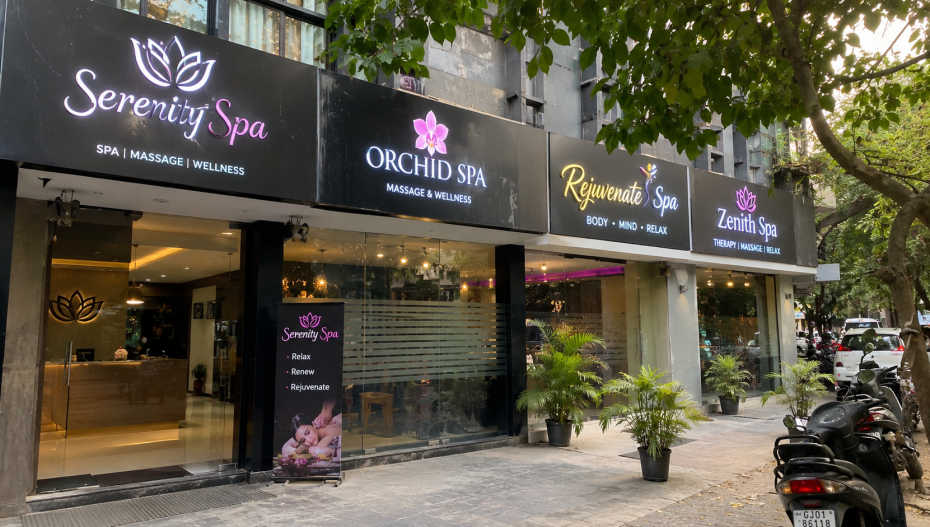
More than 2,000 spa and massage parlours reportedly operate in Ahmedabad. Yet nearly half have allegedly failed to comply with a basic police registration requirement that has been in force since 2023.
Three years. Repeated police notifications. Thousands of establishments. And still, around half reportedly remain outside the registration framework.
This is not merely an administrative lapse. It raises a much bigger question: Is the law being enforced, or has selective enforcement become a business in itself?
The law is clear. Why is compliance missing?
The Police Commissioner’s notification requires spa and massage parlour owners and managers to register with their local police stations.
They must submit their names, addresses, contact details and photographs. Every employee must also be documented.
Employees from other states must provide identity documents. Foreign nationals must submit passport and visa copies, along with their arrival and visa details. Police verification is valid for five years.
These requirements were introduced to prevent illegal activities operating under the cover of massage parlours, including alleged prostitution, drug use and other unlawful practices.
Yet, despite repeated notifications since 2023, nearly half the establishments reportedly remain unregistered.
An illegal business cannot flourish without somebody looking away
The notification itself identifies concerns about unauthorised establishments and the alleged use of spas as covers for prostitution, intoxicating substances and other unlawful activities.
If these concerns are serious enough to warrant repeated police orders, why has enforcement remained so weak?
Are the establishments operating with political protection? Are local police stations turning a blind eye? Are some officials benefiting from keeping these businesses outside the formal regulatory system?
There are allegations within police circles that registration and enforcement have become sources of illegal earnings for certain police stations and lower-level personnel.
These allegations have not been independently established. But they demand investigation, not silence.
Who profits from the enforcement failure?
An establishment operating illegally risks closure, penalties and prosecution. But if non-compliance can continue for years without consequences, it raises uncomfortable questions.
Does somebody collect money to ensure that the rules are ignored? Are political intermediaries protecting selected establishments? Are influential operators buying immunity? And why is there so little sustained public scrutiny of this alleged ecosystem?
The role of the political establishment and local administration deserves examination. So does the role of the media. When an industry of this scale operates under a cloud of alleged illegality, why is there so little sustained investigation into who owns these establishments, who protects them and who profits?
These are questions that require evidence and answers, not convenient assumptions.
Ahmedabad deserves answers
The Police Commissioner cannot issue notifications indefinitely while compliance remains optional in practice.
The authorities must disclose how many establishments have registered, how many have been inspected, how many have faced action, and whether complaints of bribery or political interference have been investigated.
The law must apply equally to everyone.
If illegal establishments are flourishing because enforcement can be negotiated, then the problem is bigger than the spa industry. It is a crisis of governance, accountability and public trust.
The real question is no longer whether the rules exist. It is who is making money while they are being ignored.