


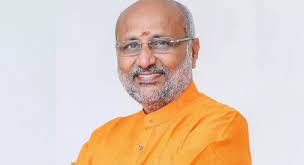
The BJP has announced Maharashtra Governor CP Radhakrishnan as the ruling NDA’s candidate for the vice-presidential election on September 9.
A former president of the party’s Tamil Nadu unit and RSS veteran, Radhakrishnan, who served as president of the party’s Tamil Nadu unit, is a pan-South Indian. He is an out-and-out Jan Sangh product. As reports aver, these attributes are in sharp contrast to his predecessor Jagdeep Dhankhar’s Jat-heavy, outsider identity.
While Dhankhar is perceived to be impulsive and forthright, reports described Radhakrishnan as less flamboyant and inclusive. In short, they are poles apart.
The choice of Radhakrishnan signals the BJP’s continued reliance on OBC social engineering and its expansion plans in the south—an area where, barring Karnataka, the party has yet to gain a firm foothold. Unlike Dhankhar, Radhakrishnan does not carry any political baggage and is seen as more of a possible consensus candidate, reports highlighted. While Dhankhar is viewed as narrowing politics to caste-region, Radhakrishnan broadens it to national inclusiveness.
Radhakrishnan has stronger ideological moorings with the BJP’s mentor organisation RSS than Dhankhar. He has had links with the RSS and Jan Sangh since he was 17 years old. Dhankhar, in contrast, came from a legal and political background and had no long association with the RSS.
He was considered more of a pragmatic political pick than an ideological insider.
Radhakrishnan has also subtly backed the Centre in the face of the DMK’s sharp criticism, most recently through a political outreach to Chief Minister MK Stalin. He spoke out against Udhayanidhi Stalin’s Sanatana dharma comments, dismissing him as a child.
In Maharashtra, he took an active role as well, including being petitioned by the opposition not to assent to the controversial Public Security Bill. But his interventions remained grounded in institutional experience and ideological alignment, unlike Dhankhar’s often controversial interference.
This time, the BJP has chosen someone temperamentally more suited to the constitutional role. It could be a sign that the Rajya Sabha now seeks balance, not aggression.
The smooth functioning of Parliament depends on a personality that can navigate storms. On this, Radhakrishnan is perceived as a better fit.
After a little over two years with Dhankhar—viewed by the Opposition as someone who ended the impartiality of the post—the contrast is clear.
Aggressive and outspoken, Dhankhar was known for his confrontationist style. He rose through the ranks after his stint as Governor of Bengal, where reported clashes with the Mamata Banerjee government routinely made news.
His rise to the Rajya Sabha was viewed as the BJP sending a “tough enforcer” to the Upper House. Soon, he was seen as a partisan figure by the Opposition.
As chairman, Dhankhar was known for sharp interventions, legalistic arguments, and confrontational stances. It made consensus difficult. His inclination for controversy and frequent interference stood in contrast to Radhakrishnan’s more measured style.
Dhankhar was picked in 2022 amid the Jat protests—a nod to Jat farmers, intended to signal that the Jats were part of the national power structure and were always heard.
Citing health concerns, he resigned on Day 1 of this parliament session, hours after accepting the Opposition’s proposal for impeachment of Justice Yashwant Varma without apprising the government.
Also Read: Over 500 AAP Leaders And Workers Join Congress in Gujarat Citing Disillusionment https://www.vibesofindia.com/over-500-aap-leaders-and-workers-join-congress-in-gujarat-citing-disillusionment/