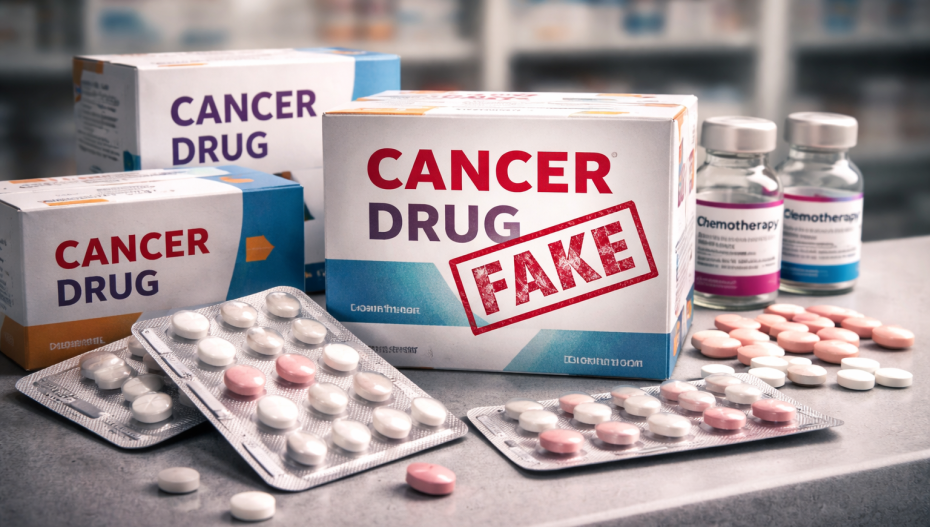
An expensive cancer drug became a flourishing business for black marketers in Delhi before the racket was busted.
Hospital pharmacists were collecting used Keytruda vials, claimed a report. They allegedly refilled them with antifungal medication. And then they sold them back to cancer patients at a lesser rate.
Twelve people are under arrest. The Enforcement Directorate has opened a money laundering case.
The racket was reportedly uncovered through an investigation in association with the International Consortium of Investigative Journalists (ICIJ). Over 12,500 pages of police and hospital records were examined. Oncologists and hospital staff were interviewed across cities.
The report elaborated that Keytruda is manufactured by US pharma major Merck & Co. It costs over Rs 1.5 lakh per 100 mg vial. The fakes were selling at Rs 90,000, a 40% cut. For families crushed by cancer costs, the discount was the trap.
The kingpin
Neeraj Chauhan, 38, was picked up in Gurugram in connection with the case. Police opened a cabinet at his home and found 46 filled vials, 165 unfilled vials, and 239 empty Keytruda boxes. He remains in judicial custody.
The vials were walking out of hospitals. On March 12, 2024, two pharmacists were reportedly stopped at the exit of the cytotoxic mixing unit at Rajiv Gandhi Cancer Institute and Research Centre in Delhi. It is one of the most secure pharmacy units in the country. CCTV runs round the clock.
Someone named Komal Tiwari, 39, had five semi-filled Keytruda vials in his bag. Abhinay, 30, had five more in his backpack. Both worked in the hospital’s oncology department. Both are out on bail.
The vials were headed to Parvez, 33. A former pharmacist at the same hospital, he had left in February 2022. He told police that a co-accused named Viphil had conceived the plan: collect used vials, refill them, sell them cheaper. Parvez recruited Komal and Abhinay.
He allegedly paid Rs 3,000 per empty vial and Rs 40,000 to Rs 50,000 for a filled one. Over eight to nine months, he received around 220 empty vials and 22 filled ones. Parvez remains in judicial custody.
Hospital records for September 2023 to March 2024 showed 84 patients had received Keytruda. Six batch numbers seized by police matched those given to patients.
The loophole was simple. No one was counting disposed vials. The hospital told police it wasn’t practically feasible. That one gap let a criminal network operate inside one of India’s most respected cancer hospitals.
RGCIRC Medical Director Dr Sudhir Rawal reportedly said the systems have since been overhauled. Keytruda is now prepared in front of patient attendants. Vial counts are matched against prescriptions. Labels are defaced before disposal. Storage is locked from 7 pm to 8 am every night.
Report emerged of Rohit Singh Bisht, 36, who ran the Onco Day Care unit at Venkateshwar Hospital in Dwarka as nursing team leader. He was responsible for making sure chemotherapy drugs were handled correctly.
Arrested March 14, 2024, Rohit told police Chauhan had offered him Rs 65,000 per vial. Rohit initially refused Chauhan’s offer before giving in. Over eight months, he allegedly supplied roughly 40 filled injections and 10 to 15 empty vials. Batch numbers from Chauhan’s haul matched vials given to 56 patients at Venkateshwar. He is out on bail.
The report also mentions Jitender, 33, a clinical pharmacist in Fortis Memorial Research Institute’s oncology department. He was intercepted the same day as Rohit, on his way to Chauhan’s home, carrying two filled Keytruda vials held back from a patient.
He told police he first met Chauhan at a job interview in late 2022. Over ten months, he supplied 15 to 16 filled vials and 15 to 20 empty ones. He earned Rs 5,000 per empty vial set and 40% of market rate for filled ones. WhatsApp chats recovered from his phone mapped the entire supply chain. He is out on bail.
Trust and betrayal
Behind every batch number is a patient who trusted the system.
A 56-year-old woman from a farming family near Chandigarh was on Keytruda for liver cancer at PGIMER. The family couldn’t afford the full price. A local medical store offered a discount. They bought 12 vials between September and December 2022. Spent around Rs 16 lakh. The packaging looked real. The vials were administered at the hospital.
They were full of antifungal medication. Delhi Police called months later. The family is still repaying loans. They have stopped treatment. They cannot afford to continue.
A 38-year-old housewife from Khajauli in Bihar noticed neck swelling and weight loss in January 2022. By March, she could barely swallow. RGCIRC diagnosed her with metastatic carcinoma. Four chemotherapy cycles later, the money was finished. Her family bought two Keytruda vials through an e-commerce platform at Rs 90,000 each.
After the second injection, she collapsed. She died September 11, 2022. Her family called it fate.
On April 17, 2024, Delhi Police called. It wasn’t.
Special Commissioner of Police Devesh Chandra Srivastva told the media outlet that the probe had exposed how cancer patients were being systematically targeted. People desperate for affordable treatment, with no way of knowing the risk. Police are tracking whether more networks are operating.
The ICIJ investigation found the problem runs deeper globally. The pharma company allegedly deployed tactics to inflate prescriptions and keep prices high through lobbying. It worked to block cheaper versions of Keytruda from reaching patients. Counterfeit networks linked to the drug have been found from Nepal to Mexico.
Also Read: Fake Degrees, Real Risks: Gujarat’s Bogus Doctor Racket Exposed https://www.vibesofindia.com/fake-degrees-real-risks-gujarats-bogus-doctor-racket-exposed/