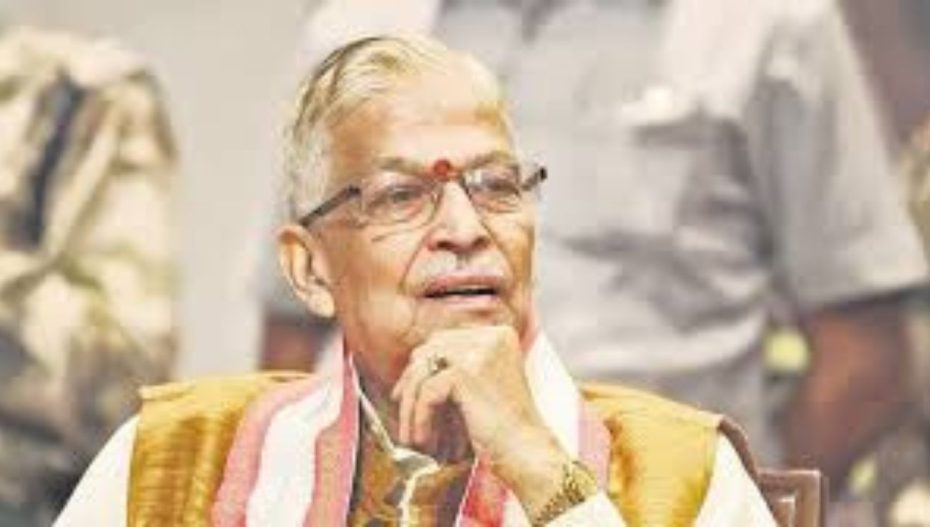
Two developments, one in Bengal’s Matua heartland and the other within the ideological core of the RSS in Delhi, indicate discontent in the BJP’s support structure.
According to a national daily, things have come to such a pass that in Delhi, that veteran BJP leader Murli Manohar Joshi reportedly questioned the government’s growth-centric model. He highlighted rising inequality, social distress, and environmental neglect.
Joshi’s leading point, quoting economist Amartya Sen and others, was that economic growth cannot be the sole objective of a country.
He showed around 70 slides during the ‘Sangh’s Arth Samooh’ meeting. He spoke about income inequality and India’s low per capita GDP. This happened at a time when the Narendra Modi government is highlighting India’s rise as the world’s third largest economy.
Quoting Amartya Sen, Joshi reportedly said: “If the economic success of a nation is only judged by income, the important goal of well-being is missed.”
He was quoted as saying: “I prefer to position the Hindu view of the world as an integrative anchor in order to understand, develop and challenge the scholarly field of spirituality.”
On wealth inequality, Joshi reminded that in 2021, the wealthiest 10% of India’s population owned 65% of the total household wealth.
India’s per capita GDP stood at $2,878.5. Joshi compared this to Japan’s $33,955.7. For the record, India surpassed Japan to become the world’s fourth largest economy.
He spoke about Bharatiya Jana Sangh founder Deendayal Upadhyay’s concept of ‘Integral Humanism’. Joshi said India was over-dependent on foreign nations. He believed introducing ‘Degrowth’ would mean using fewer natural resources and organising society around “sharing”, “simplicity”, “conviviality”, “care”, and the “commons”.
Quoting Upadhyay, Joshi said: “We plan to obtain what we do not have, but we do not plan to protect what we have. We failed to focus on agriculture and indigenous industries, while welcoming foreign collaborations that undermine our interests and prestige.”
Additionally, he also spoke about the drug problem, student suicides, and natural disasters. He mentioned climate change and said, “The stability of roads” in the Himalayas was more crucial than simply “widening” them.
Furthermore, Joshi mentioned that15.8 million children aged 10 to 17 years are addicted to narcotics. He cited an AIIMS study showing that one-third of Delhi’s street children use drugs and alcohol. On this, he quoted Union Home Minister Amit Shah, who said 7% of Indians are trapped in narcotics.
The news report cited Joshi as saying that total suicides in India had increased from 1.34 lakh in 2018 to 1.70 lakh in 2022. A startling data here. As many as 35,950 students had taken their own lives between 2019 and 2021.
From 2018 to 2023, 98 students reportedly died by suicide at IITs, IIMs, and Central universities.
He also touched upon education and employment, two critical areas of India’s growth narrative.
India’s gross enrolment ratio at the college level stood at 32.7%. This was up from 5.5% in 1995. But Joshi said it was still far behind Poland’s 75.3% and Japan’s 64.6%.
India’s economy employed 43.5% of its workforce in agriculture. Joshi compared this with 7.6% in Poland and 3% in Japan. In 2023, 25.03% of India’s workforce was in the industrial sector, and 31.5% in services. Japan’s figures were 73.3% and Poland’s 62.8%.
Only 23.9% of India’s employed population are salaried employees. In Poland, the number is 80.1%. In Japan, it is 90.5%.
On this, Joshi also warned that the emergence of Artificial Intelligence could worsen societal inequalities.
Additionally, he referred to disasters in Uttarakhand, Jammu, and Himachal Pradesh. He warned of a “climate emergency”. He said Assam, Bihar and the Sundarbans could become hotspots for climate-induced migration.
Meanwhile, in West Bengal, a section of the influential Matua community, long courted by the ruling party over promises of citizenship under the CAA, reportedly fears disenfranchisement.
A 24-member Matua delegation met Congress leader Rahul Gandhi. A potential shift in allegiance?
The BJP is especially alarmed that Tapan Haldar, one of its local workers, led the Matua delegation to Bihar.
The BJP’s Bongaon district president Bikash Ghosh said Haldar would be asked to explain himself.
The BJP had a good presence in Bengal in 2019, winning 18 of 42 Lok Sabha seats. This was due to Matua support based on the promise of enacting the Citizenship (Amendment) Act, 2019.
For the BJP, the path to power in Bengal depends on building a pan-Hindu vote with Matuas at the core. It cannot afford a third party to rise.
The BJP claimed the Congress misled the Matua delegation. MP Shantanu Thakur said, “They were told they were being escorted to an ashram in Patna. The Congress paid their fare and promised to give them money. It is desperate to gain a foothold among Matuas, but they will not succeed.”
Congress spokesperson Ketan Jaiswal dismissed this. He accompanied the delegation. He was quoted as saying, “What Shantanu Thakur is claiming is baseless … Matuas are fed up with the BJP and TMC’s false promises. The BJP is panicking that Matua support might be shifting towards the Congress.”
Also Read: SDA School Of Ahmedabad Releases CCTV Footage: Student Stabbing Incident https://www.vibesofindia.com/ahmedabad-school-releases-cctv-footage-student-stabbing-incident/