


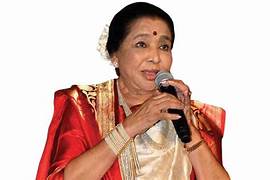
Legendary playback singer Asha Bhosle has passed away at the age of 92 in Mumbai after prolonged illness marked by cardiac and respiratory complications. She had been unwell for several months and was admitted to Breach Candy Hospital in critical condition, where she was placed in the ICU. Her son Anand Bhosle confirmed her passing. The last rites will be held on Monday.
Born in 1933 into the illustrious Mangeshkar family, Asha Bhosle began her musical journey at the age of nine, stepping into playback singing at a time when the industry was still finding its voice. While her elder sister Lata Mangeshkar quickly rose to dominance, Asha carved out a parallel, fiercely independent identity—one built not just on talent, but on adaptability.
Her early years in Bollywood were marked by typecasting. She became the go-to voice for cabaret numbers and dance tracks, often associated with performances picturised on Helen. Songs like Piya Tu Ab To Aaja and Yeh Mera Dil became cultural staples. But to reduce Asha Bhosle to just that genre would be a grave misreading of her legacy.
She broke that mould decisively. Her hauntingly nuanced ghazals in Umrao Jaan and the evocative minimalism of Mera Kuch Saamaan from Ijaazat demonstrated a range that few singers could match. These performances earned her two National Film Awards, alongside multiple Filmfare Awards, reinforcing her position as one of the most versatile singers in Indian music history.
Her collaborations, particularly with composer Rahul Dev Burman, redefined the soundscape of Hindi cinema. Together, they experimented with Western influences, jazz, pop, and folk, creating a body of work that remains timeless. Their partnership—both personal and professional—produced some of Bollywood’s most memorable music until Burman’s death in 1994.
Asha’s personal life, however, was far from smooth. She married Ganpatrao Bhosle at the age of 16 against her family’s wishes, a marriage that ended in separation after years of reported hardship. Her later marriage to Burman faced its own share of resistance but endured as one of the most creatively fruitful partnerships in Indian music.
In her later years, she remained deeply engaged with music, though increasingly distanced from contemporary Bollywood. She often spoke about her preference for classical traditions, frequently listening to stalwarts like Bhimsen Joshi to refine her own sensibilities.
Over a career spanning more than seven decades, Asha Bhosle recorded thousands of songs in multiple languages, making her one of the most recorded artists in the world. Her voice traversed eras—from black-and-white cinema to the digital age—adapting, evolving, and yet remaining unmistakably her own.
With her passing, Indian music loses not just a singer, but an institution. Alongside legends like Lata Mangeshkar, Mohammed Rafi, and Kishore Kumar, Asha Bhosle belonged to a generation that didn’t just sing songs—they shaped the emotional memory of a nation.
An era does not end often. Today, it does.
Also Read: Centre To Release Commemorative Stamp In Honour Of Veteran Singer Lata Mangeshkar https://www.vibesofindia.com/centre-to-release-commemorative-stamp-in-honour-of-veteran-singer-lata-mangeshkar/