

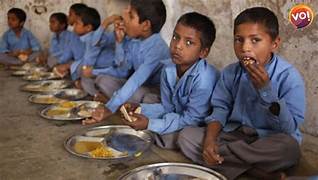
Gujarat has a child malnutrition problem. It has had one for years. Now, the state government has decided to cut the quantity of snacks served to schoolchildren under the PM Poshan scheme.
The government has reduced the daily snack quantity from 50 grams to a weekly average of 46.8 grams. According to reports, every Monday children will now receive only 38 grams of snacks, well below the earlier 50-gram norm.
As reported by the Vibes of India, earlier this week, the government also scrapped sukhdi, a traditional jaggery and wheat snack that was part of the school meal programme. The move is expected to save the state around Rs 30 crore.
More than 5.70 lakh children in Gujarat are malnourished, a figure the state government itself placed before the Gujarat Assembly in February 2024. Of those, 4.38 lakh are underweight. Another 1.31 lakh are severely underweight.
Four in ten children under five in Gujarat are stunted. That figure has improved, from 53.6% in 2022 to 40.8% now. Nearly the same proportion (39.7%) are underweight, barely changed from 39.3% in the previous national survey. Wasting climbed from 8.1% in 2022 to 8.9% in 2023 before easing slightly to 7.8% in 2024.
Then there is the anaemia crisis. Nearly four in five young children, 79.7% of those aged 6 to 59 months, are anaemic. That figure was 62.6% in the previous national survey. A jump of 17 percentage points. It is one of the sharpest rises recorded anywhere in the country. Among women aged 15 to 49, 65% are anaemic. Among pregnant women in the same age group, the figure is 62.5%.
Despite being one of India’s wealthiest states, Gujarat ranked 25th out of 36 states and union territories on the hunger index in NITI Aayog’s SDG report for 2023 to 24.
The district-level picture is grimmer still. In a single year, Kheda district alone added 9,634 malnourished children, the highest increase in the state.
Ahmedabad followed with 3,516 new cases, then Bharuch with 1,584 and Valsad with 1,335. The districts with the highest proportion of underweight children were The Dangs at 53.1%, Dahod at 53%, and Narmada at 52.8%.
Better-performing districts included Jamnagar at 28.9%, Junagadh at 26.4%, and Porbandar at 25.5%.
Over three years, the Centre sent Gujarat Rs 2,879.3 crore under the Poshan Abhiyaan. This includes Rs 839.86 crore in 2021 to 22, Rs 912.64 crore in 2022 to 23, and Rs 1,126.8 crore in 2023 to 24.
The state has also announced a Nutrition Mission under the Viksit Gujarat Fund, setting aside Rs 75 crore for 2025 to 26.
While the funds have grown, the reach has shrunk. The number of beneficiaries under the programme has fallen from 4.287 million in 2021 to 22 to 3.782 million by March 2024.
Nutritionists warn that cutting the quantity of food will push children deeper into deficiency. Children need protein, iron, and micronutrients to grow properly. Sweets and reduced snack portions do not deliver those.
Then there is an older argument that keeps resurfacing every time Gujarat’s child nutrition numbers make headlines. It is about eggs.
The National Institute of Nutrition recommends them. Tamil Nadu, the state that first inspired Gujarat to launch its own Mid-Day Meal programme, has been serving them for years. The science is not in dispute.
What is in dispute is whether a boiled egg belongs on a Gujarat schoolchild’s plate. Decades on, the answer remains no.
Activists with the Right to Food campaign have been blunt about it. In states like Gujarat and Rajasthan, they say, you cannot even raise the subject without risking accusations of offending upper-caste Hindu sentiments.
This is not a recent development. In the mid-1990s and early 2000s, Dalit and Muslim mothers in Gujarat were reportedly warned not to pack a boiled egg in their children’s school tiffin.
Gujarat was a pioneer. When Chief Minister Madhavsinh Solanki launched the Mid-Day Meal Scheme in 1984, the state became only the second in India, after Tamil Nadu, to do so.
Decades later, the state that once led is cutting snacks, scrapping sukhdi, and still will not talk about eggs.
Opposition leaders have accused the government of compromising children’s health for the sake of cost-cutting. Activists and child welfare groups are demanding a rollback and the restoration of protein-rich components.
The impact, they warn, will be felt most sharply in rural and tribal districts where children depend most heavily on school meals.
Also Read: Gujarat Drops Sukhdi from School Meals, Affecting 38.5 Lakh Students Across 32,230 Govt Schools https://www.vibesofindia.com/gujarat-drops-sukhdi-from-school-meals-affecting-38-5-lakh-students-across-32230-govt-schools/