


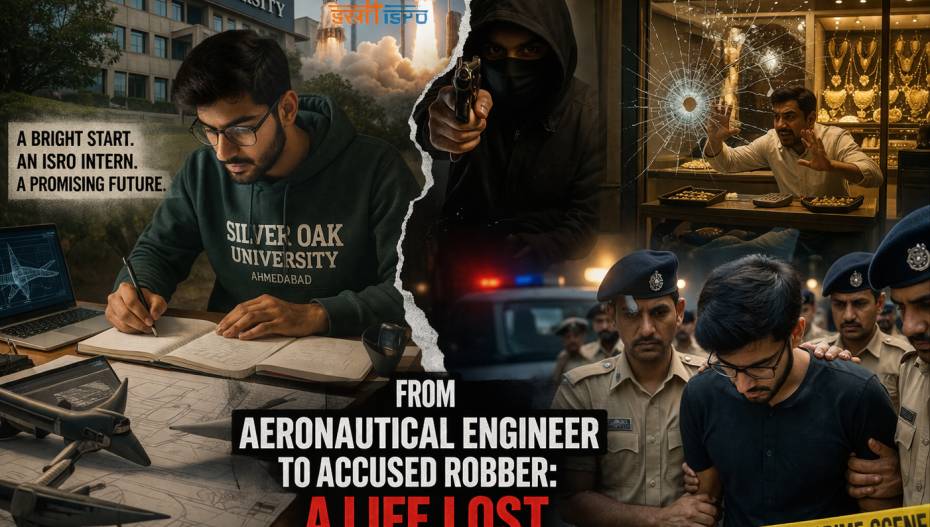
In a stark reminder of how a single wrong turn can derail a promising life, a 25-year-old aeronautical engineer from Gujarat now finds himself behind bars after a failed robbery attempt at a jewellery store in Navsari.
Umang Vachhani, once a student of Silver Oak University in Ahmedabad, had what many would consider a head start. He completed his aeronautical engineering and even secured a seven-month internship with the Indian Space Research Organisation—a credential that signals both capability and discipline. But somewhere along the way, that trajectory veered sharply off course.
Vachhani was arrested along with Rajnikant Makwana, 39, and Manoj Survyavanshi, 23, both from Valsad, following the attempted robbery at Chanchal Jewellers. When shop owner Ashok Katariya resisted, he was shot twice. He survived, but the incident has shaken the local community—and raised uncomfortable questions about how a technically trained young man ended up here.
Investigators say this was no impulsive act. The robbery had allegedly been planned over nearly two months. Vachhani and Makwana had surveyed the shop in advance. A firearm was procured. Masks and gloves were ordered online. Police suspect the plan may even have drawn cues from stylised crime dramas that blur the line between fiction and consequence.
On the day of the crime, the roles were clearly defined: Vachhani and Makwana would enter the store, while Survyavanshi waited outside as the getaway driver. But the plan unravelled when Katariya resisted and raised an alarm. As the accused fled, Vachhani allegedly fired at him before escaping.
What followed was a methodical police operation. Teams tracked the suspects using footage from nearly 300 CCTV cameras across Navsari. The abandoned getaway car in Chikhli became the first breakthrough. Despite attempts to erase their trail—removing number plates, discarding evidence, changing clothes, and switching vehicles—the three were eventually traced back to Valsad and arrested.
Yet, beyond the crime itself, the deeper story lies in the contradictions of Vachhani’s life. After completing his studies, he reportedly worked with a private aerospace firm. But police say his brush with crime dates back years. During his student days, he was allegedly linked to multiple vehicle theft cases across Ahmedabad and had even been detained under the PASA Act.
This is where the narrative turns more unsettling than dramatic. It is easy to frame this as a fall from grace—but the signs, it appears, were always there. Talent and education can open doors, but they do not insulate against poor judgment, bad company, or the slow normalisation of risk-taking behaviour.
Young lives are rarely defined by a single decision; they are shaped incrementally—by peer circles, influences, choices made in moments of impulse or ambition. In Vachhani’s case, those choices seem to have compounded over time. What began as alleged petty crimes may have escalated into something far more serious, culminating in an act of armed violence.
Police say Vachhani has been giving inconsistent statements, and the motive remains unclear. Whether it was financial pressure, thrill-seeking, or the influence of media and peers is still under investigation. Authorities are also probing whether there was any prior connection between the accused and the victim.
For now, three men sit in custody, and a shop owner recovers from gunshot wounds. But the larger question lingers: how does a young engineer with an Indian Space Research Organisation internship end up planning a robbery?
The answer may lie not in a single moment of failure, but in a pattern of choices—each one nudging a life further away from its potential, until the distance becomes irreversible.
Also Read: Acche Din At Home, But America At Any Cost: The Gujarat Illegal Imigration Paradox https://www.vibesofindia.com/acche-din-at-home-but-america-at-any-cost-the-gujarat-illegal-imigration-paradox/