

In a nation already battling poverty, political isolation, and climate-induced disasters, Afghanistan now finds itself reeling from a series of devastating earthquakes that have left thousands dead and the humanitarian situation at a critical tipping point.
On Friday morning, the country was struck by a fresh wave of tremors—four earthquakes in quick succession, measuring 4.5, 4.9, 5.2, and 4.6 in magnitude—shaking the Hindukush mountain region near the Pakistan border. These follow two earlier catastrophic quakes earlier in the week, bringing the total number of seismic events in just 24 hours to seven.
The quakes—most recently a 5.4-magnitude tremor recorded in the southeast—come on the heels of a powerful 6.0-magnitude earthquake that struck just before midnight on Sunday, one of Afghanistan’s deadliest in years.
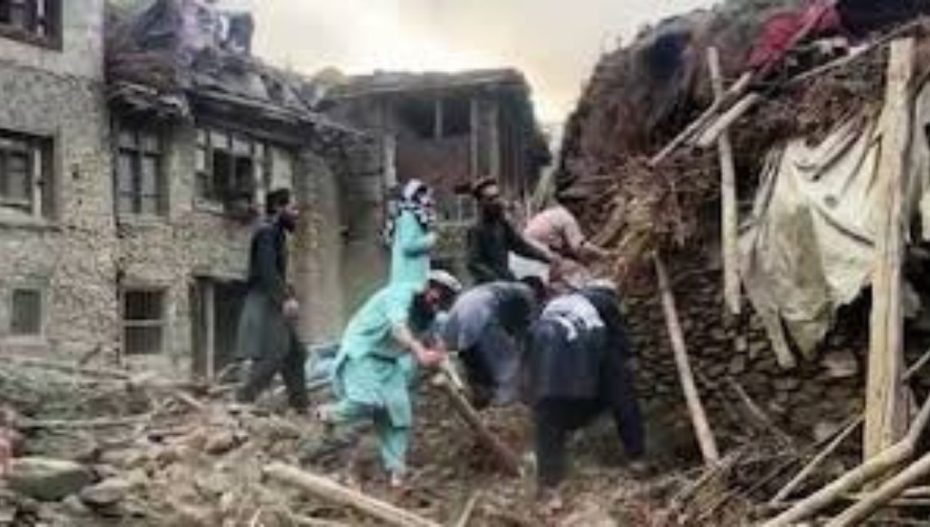
Over 2,200 people had lost their lives and more than 3,600 were injured. At least 6,700 homes have been destroyed, with entire villages flattened in the provinces of Nangarhar and Kunar.
The situation is made worse by the country’s underlying fragility. Many of the communities affected were already grappling with the aftermath of recent flash floods, ongoing drought, and a collapsing healthcare system. Survivors, terrified of further aftershocks, have opted to sleep in the open air rather than return to homes built from mud, stone, and timber—many of which now lie in ruins.
Landslides and rugged terrain have blocked key roads, complicating rescue and relief operations. In remote areas, access is so limited that aid workers have been forced to walk miles on foot to reach those in need.
“We’re seeing homes reduced to rubble, roads destroyed, landslides everywhere, and tragically, lives lost,” Harald Mannhardt, regional director for the World Food Programme (WFP), has been quoted in the section of the media. WFP has dispatched emergency aid to the worst-hit regions.
The United Nations has released $10 million in emergency funds, and the WFP has begun distributing food supplies and high-energy biscuits to affected communities. Additional aid flights are planned to bring in personnel and medical support.
India has also stepped forward, airlifting 21 tonnes of relief materials to Kabul, including tents, blankets, hygiene kits, water purifiers, essential medicines, and other vital supplies.
Humanitarian agencies, however, warn that much more is needed and that too on an urgent basis. The World Health Organization (WHO) says a $4 million funding gap is already hampering its ability to provide essential healthcare and disease surveillance. The risks of waterborne disease outbreaks are growing in overcrowded shelters where access to clean water and sanitation is limited.
Kate Carey, deputy head of the UN Office for the Coordination of Humanitarian Affairs (OCHA) in Afghanistan, told section off the media, “We have some seed funding, but we are looking to make a flash appeal.”
Since the Taliban takeover in 2021, Afghanistan has largely been sidelined by the international community. Billions in foreign aid were cut off, and while some countries have sent emergency support, global engagement remains minimal compared to the scale of the disaster.
Adding to the complexity is the influx of Afghans deported from Pakistan and Iran, further straining the already collapsing infrastructure and healthcare services. This latest disaster has only deepened the suffering of a population long accustomed to hardship, but now increasingly isolated from global support networks.
Afghanistan’s geography—a convergence point of the Indian and Eurasian tectonic plates—makes it particularly vulnerable to seismic activity. But the true disaster lies not just beneath the earth’s crust, but above it—in the fragile structures of governance, infrastructure, and international aid.
Also Read: New GST Rates: Cars To Cost Less https://www.vibesofindia.com/new-gst-rates-cars-to-cost-less/