


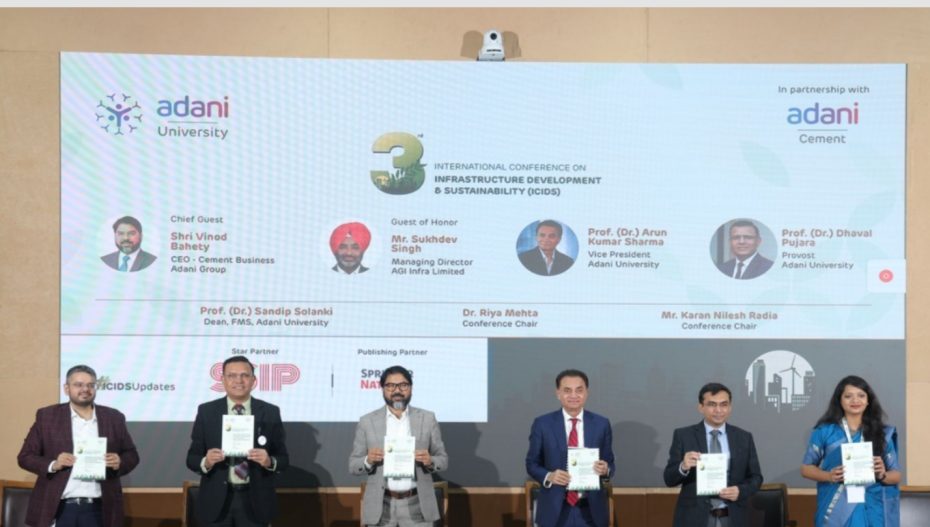
Adani University hosted the 3rd International Conference on Infrastructure Development and Sustainability (ICIDS 2025) at its campus in Shantigram, Ahmedabad on December 18 and 19, reinforcing its commitment to advancing dialogue on future-ready, resilient and sustainable infrastructure.
Jointly hosted by Adani University and Adani Cement, the two-day international conference brought together policymakers, industry leaders, academics, researchers and students from India and abroad.
Anchored in the theme “Rethinking Infrastructure: Innovation, Sustainability, and the Future of Global Skill Development,” ICIDS 2025 positioned infrastructure as an integrated socio-technical ecosystem—central to economic growth, environmental responsibility and human capital development.
The inaugural session was graced by Mr Vinod Bahety, Chief Guest and Chief Executive Officer – Cement Business, Adani Group, and Mr Sukhdev Singh, Guest of Honour and Managing Director, AGI Infra Limited, along with senior leadership from Adani University. A key highlight was the release of the ICIDS 2025 Book of Abstracts and the Proceedings of ICIDS 2024, along with the showcase of “Cement Chalisa” by Adani Cement.
Addressing the conference, Mr Bahety highlighted the strong linkage between infrastructure development and economic growth, emphasising the need to embed decarbonisation, digitalisation and green finance into infrastructure planning. He underlined the importance of enabling policies such as carbon markets and regulatory reforms, while stressing that future-ready skills and industry–academia collaboration would be critical to meeting evolving infrastructure demands.
The technical programme opened with Plenary Session–1 by Mr Nayan Parikh, Chief Executive Officer, Nayan Parikh & Consultancy, who emphasised that the future of infrastructure lies not in building more assets, but in building smarter, resource-efficient and sustainable systems. Citing Indore Smart City, he demonstrated how effective policy frameworks, technology adoption and citizen participation can deliver outcomes such as 100% waste segregation, zero landfill operations and improved environmental quality.
The first day also featured a fireside chat on “The Road to Net-Zero: Integrating Clean Energy into Tomorrow’s Infrastructure,” moderated by Dr Namita Pragya of Adani University. The discussion brought together Professor Tarun Gupta (IIT Kanpur), Mr Rajeev
Pal (Adani Group) and Mr Vaneet Kumar (Adani New Industries Ltd.), emphasised the need for systemic integration of clean energy across transport, buildings, logistics and urban ecosystems, supported by policy coherence and interdisciplinary skills.
The second and the concluding day focused on execution excellence, with a technical briefing and guided site visit to the Vishv Umiya Dham project near Ahmedabad, recognised in the Golden Book of World Records for the world’s largest raft foundation. Led by Mr Umesh Soni (Adani Cement) and Mr Jaimin Patel (PSP Projects Ltd.), the session showcased large-scale project planning, logistics coordination, quality control and safety management.
The academic programme concluded with panels on future-ready mobility, skills for the infrastructure workforce, and smart city real estate transformation. Speaking on skills, Robin Bhowmik, Chief Executive Officer – Skills & Education, Adani Group, highlighted the growing demand for capabilities in automation, digitalisation, renewable energy and green technologies.
ICIDS 2025 concluded with a clear message: India’s infrastructure future depends on integrating sustainability, technology, skills and execution at scale, driven through collaboration between academia, industry and policymakers.