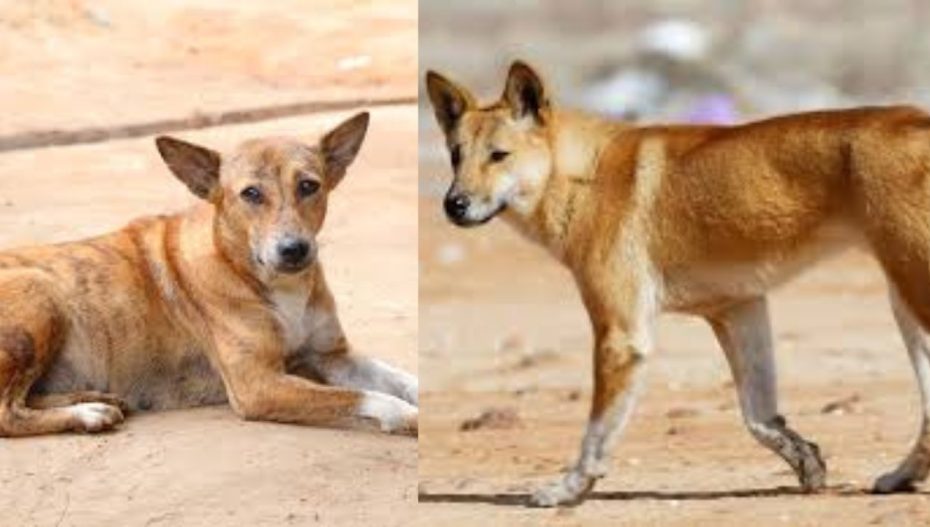
Some findings that India’s desi dogs are ancestors of Australia’s dingo comes amid renewed focus on street dogs in India. Just last week, the Supreme Court revised an order on strays in Delhi-NCR.
It ruled that vaccinated and dewormed street dogs must be returned to their original locations. Animal welfare groups supported the decision. The court also said that aggressive or rabid dogs should be kept in shelters.
The order aimed to strike a balance between public safety and animal rights.
Meanwhile, on International Dog Day, an interesting link between Indian street dogs and Australia’s wild dingoes has come to light once again.
New genetic and archaeological findings point to Indian origins for the dingo. This dates around 4,000 years.
This runs counter to the belief that non-native animals first reached Australia with European settlers.
For years, it was held that foreign species arrived in 1788. That was when Arthur Phillip landed at Botany Bay with the First Fleet, along with pets and livestock.
But Indian dogs — called Pariah or Indies — had crossed the seas much earlier. Their journey predates colonial contact by centuries.
Genetic studies published in the Proceedings of the National Academy of Sciences (PNAS) have added to a growing body of evidence that links desi dogs with the Australian dingo.
The study, titled ‘Genome-wide data substantiate Holocene gene flow from India to Australia’, reported the presence of Indian genetic material in both Aboriginal populations and their dogs, suggesting a wave of migration from the Indian subcontinent roughly 4,000 years ago.
The media this day has cited researchers who wrote that they had detected a significant gene flow from Indian populations to Australia well before European contact.
This genetic link aligns with the dingo’s sudden entry into Australia’s fossil record around 3,500 to 4,000 years ago.
Archaeological data showed no sign of dingoes earlier, according to reports.
Unlike marsupials, which evolved in isolation over millions of years, dingoes appeared abruptly. Did they come from elsewhere?
Dingo DNA shows links to Southeast Asia. However, researchers claim that morphologically, the dingo resembles India’s semi-feral street dogs. Curled tails and pricked ears are their features. These similarities suggest a common ancestry.
Lead author Irina Pugach, of the Max Planck Institute for Evolutionary Anthropology in Germany, told a certain section of the media that the exact route of migration remains uncertain. She suggested that the introduction of the dingo could have involved a very small group of people.
Furthermore, reports quoted Alan Cooper, director of the Australian Centre for Ancient DNA at the University of Adelaide, as saying that the genetic evidence does not necessarily prove direct contact with mainland India. He believed the dogs could have arrived via intermediary populations whose origins were Indian.
Another argument is that Indian migrants may have introduced the dingo to Australia during this ancient movement of people and animals across the seas.
The arrival of the dingo had lasting ecological and cultural consequences. According to another report, dingoes became apex predators, reshaping Australia’s native ecosystems.
It is also said that dingoes were adopted by many Indigenous communities. They treated them as camp companions. They featured in oral traditions, artwork, and were sometimes buried with human ancestors.
Unlike domesticated European breeds, dingoes maintained a dual identity—living alongside humans while remaining semi-wild. Much like India’s street dogs, they occupied a space between tame and wild, forging deep bonds with human communities.
Breeds like the Shih Tzu, German Shepherd, Doberman, and Siberian Husky are common pets in India today. But it’s the desi dog that has made the most remarkable journey.
From the streets of India, its bloodline stretches all the way to the Australian wilderness. The dingo, often viewed as a symbol of wild Australia, actually carries a South Asian legacy.
Every footprint it leaves in the outback points to a migration that began thousands of years ago.
It marks a deep, historic bond between two distant lands.
Also Read: SC Collegium Recommends Two Judges for Elevation; Justice Nagarathna Issues Strong Dissent on Patna HC Chief Justice Vipul Pancholi https://www.vibesofindia.com/recommends-two-judges-for-elevation-justice-nagarathna-issues-strong-dissent-on-patna-hc-chief-justice-vipul-pancholi/