

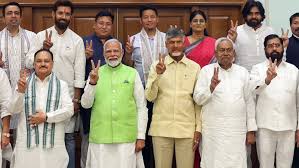
The National Democratic Alliance (NDA) held a meeting in Parliament House on the morning of Tuesday (August 5), a date which has grave historical recall because in 2019 the Government of India revoked the special status, or autonomy, granted under Article 370 of the Indian constitution to Jammu and Kashmir.
This day is also a scar on the heart of pluralistic India because exactly a year later, Prime Minister Narendra Modi personally performed Hindu rituals for the bhoomi pujan of the Ram temple in Ayodhya, although an elaborate Shilanyas ceremony was carried out on November 9, 1989.
Just as the ceremony on that day in the temple town was performed by Modi to affix his personal signature on the Ram temple, which was accorded greater permanence when he consecrated the child deity’s idol in the partially constructed temple on January 22, 2024, the NDA meeting on Tuesday was convened primarily to laud the PM’s “unwavering resolve, visionary statesmanship and resolute command”.
Praise was also lavished upon him for having “ignited [sic] a renewed spirit of unity [sic] and pride in the hearts of all Indians”.
Only the second meeting of NDA’s parliamentary party after 2024 Lok Sabha elections
This meeting, where the resolution containing such eulogies was passed, was significantly only the second meeting of the coalition’s parliamentary party after the last Lok Sabha polls – the first was held on June 7, 2024, that too solely to formally elect Modi as its leader so he could be invited by President Droupadi Murmu to take oath as prime minister.
The NDA, it may be recalled, existed in comatose state between 2014, when Modi rose to power and became PM, and till late 2023, when feeling the increasing twin dangers of a new opposition conglomerate under the INDIA banner, and a withering political narrative, the BJP suddenly began to feel the need to ingratiate itself again with its long-marginalised allies.
Almost from when he became PM, the NDA ceased to be of any value in the imagination of Modi and hardcore loyalists within the party. This was most starkly established when the 25th anniversary of the alliance was missed by oversight and the day was not commemorated with any function or statement on May 15, 2023.
For the event-driven Modi, this miss made it amply clear that he viewed the government as a coalition only in name and not spirit.
Eventually in July 2023, Modi and his aides suddenly cobbled up 39 alliance partners, several largely unknown and of insignificant electoral relevance, and blew the electoral bugle under his leadership.
Once again, after making little mention of it over the past year, save in Modi’s references to the government as “NDA sarkar”, Union minister Kiren Rijiju after Tuesday’s meeting, when speaking to journalists, drew attention to the NDA crossing its silver jubilee two years and two months earlier.
That the NDA is recalled intermittently and its meetings are few and far in between underscore that instinctively, Modi and the BJP feel little need to treat alliance partners with respect and do not consider collective decision-making as a necessity.
Instead of functioning as a unit within a cohesive group, Modi prefers to be on his own, answerable to none. This is the way he governed Gujarat for almost 13 years and there has been little change in the past 14 months.
In contrast to the existence of a convenor in the years when Atal Bihari Vajpayee headed the first NDA government, the BJP appointed no one to that office (neither did it pave way for a selection from another party), and did not even ask all parties to nominate a leader each and be part of a coordination committee.
It is not that Modi has just given little respect to the NDA. He has even put an end to the BJP’s collegial style of functioning, for which it was known from the time of its inception in April 1980.
In contrast to the time when Vajpayee was PM and he would preside over meetings of the BJP parliamentary party, held without fail every week in parliament before the House was called to order, there have been no such meetings since the results were declared on June 4, 2024.
Most shockingly, underscoring the complete abandonment of democratic conventions, norms and practices within the BJP, Modi was not even ‘formally’ elected as leader of the BJP parliamentary party last year.
Not just that, no meeting of the BJP parliamentary board, a crucial intra-party body, has been held after the results were declared.
In contrast to the party’s consultative style of decision-making, almost overnight the BJP adopted the Congress system of everything being decided by the High Command, which more often than not means the whims and fancies of a single individual.
This style of functioning was silently accepted by the entire political fraternity that is symbiotically connected with the BJP till the time Modi was the undisputed king with public support, enough to provide a parliamentary majority.
It is well known that the BJP has traditionally not been its own master and that there were frequent consultations with and even diktats from its ideological fountainhead, the Rashtriya Swayamsevak Sangh (RSS) and the other 40-odd affiliates who collectively comprise the Sangh parivar.
Besides its ideological positioning, the saffron brotherhood always put the sangathan (organisation) over the vyakti (individual), a tenet Modi followed in violation from when he became Gujarat CM.
he RSS leadership, after initial efforts to ‘correct’ him, accepted Modi’s ways because he delivered electorally, as well as ideologically and programmatically, first in the state, and after 2014, at the national level.
But once the 2024 campaign’s central slogan – Modi ki guarantee – did not seem to be working, the RSS leadership quietly refrained from directing its cadre to actively turn out and seek votes for the BJP’s candidates.
Coupled with other factors, including voters’ choice being driven by their primary concerns over the absence of jobs and fears of bleak futures, the Modi-fied BJP fell short of majority.
This provided the opening for the RSS leadership to return to vimarsh and charcha, the ways of yore, and even after seeming to accepting it, as it appeared by Modi’s humble manner during his visit to Nagpur, for the first time after becoming PM, in late March this year and addressing a public gathering jointly with sarsanghchalak Mohan Bhagwat.
But soon, especially after the Pahalgam attack, which provided him the opportunity to return to his aggressive ways and claim a return to popular backing, Modi began making it evident that he was not yet ready to give up his functional autonomy that has been his template since 2001.
That the RSS is also not bowing out without a fight is clear from Modi’s failure to appoint a new party president to replace J.P. Nadda, whose tenure ended embarrassingly long ago.
The decision to convene the NDA parliamentary party after having put it in cold storage for a year and get it to pass resolutions lauding Modi and the government’s ‘success’ in protecting ‘national interests’ is essentially also a message to the RSS leadership, besides shoring up party morale, that he has support beyond the Sangh parivar, and is not dependent on it – or has not “needed it”, as Nadda infamously remarked in May last year.
An oblique message to the RSS
Without making any reference to them, the oblique message is to Messrs Bhagwat and Co, that they allow him to continue functioning unilaterally as is his wont since 2001, but more importantly from 2014 onwards, because his mass support remains intact.
This certainly makes the Modi vs Sangh-leadership tussle that has been waged since early 2024 more captivating, and will greatly determine the nature of India’s polity – will it continue its ceaseless drift away from democratic conventions and the weakening of state institutions, or will there surface a system where checks and balances are put on the government?
Inexplicably however, the non-BJP coalition partners in the NDA have completely failed to meet the expectations of the people. With the BJP down to 240 seats in the Lok Sabha, people opined last year that it would not be a Modi 3.0 government but an NDA 1.0 regime instead.
Their sense has been belied with the larger NDA partners not leveraging their crucial numerical strength and instead settling for small ‘settlements’.
These coalition partners are overlooking the BJP’s track record in poaching the social and electoral bases of its allies and eventually rendering them weaker on the electoral field.
This has happened already to the Shiv Sena in Maharashtra, and the unravelling of the Janata Dal (United) in Bihar has started.
That however, should be a subject for another occasion.
(The article is written by Nilanjan Mukhopadhyay, a journalist and author. His books include Narendra Modi: The Man, The Times and The RSS: Icons of the Indian Right.)
Also Read: Modi Slams Opposition For ‘Self-Harm’ Over Operation Sindoor Debate https://www.vibesofindia.com/modi-slams-opposition-for-self-harm-over-operation-sindoor-debate/