


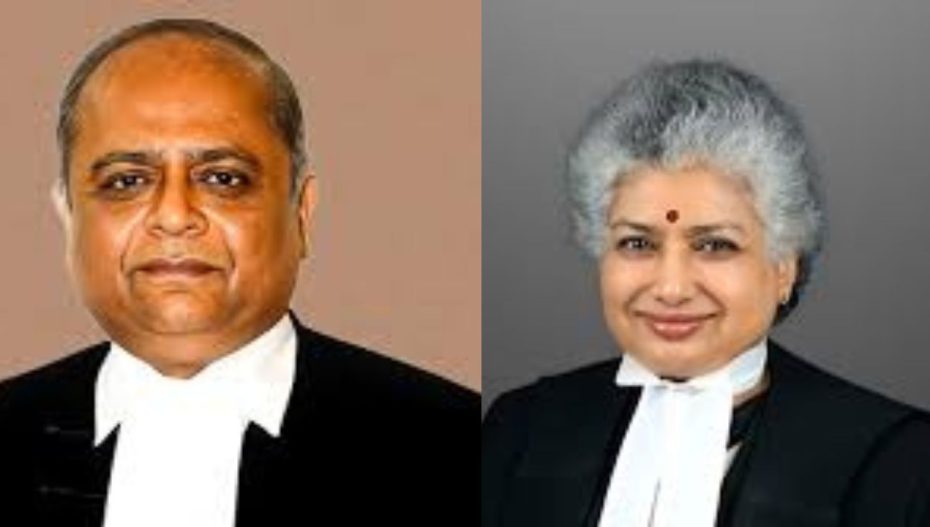
The Supreme Court collegium has recommended the elevation of Bombay High Court Chief Justice Alok Aradhe and Patna High Court Chief Justice Vipul M. Pancholi to the Supreme Court.
Born in Ahmedabad on May 28, 1968, Justice Pancholi was confirmed as a Permanent Judge of the Gujarat High Court in 2016. He was transferred to Patna High Court in July 2023 and was appointed its Chief Justice on July 21, 2025.
The proposal, which came on Monday, to elevate Justice Pancholi drew a strong dissenting note from Justice B.V. Nagarathna, who warned that his appointment could be counterproductive to the administration of justice and might undermine the credibility of the collegium system itself.
Justice Nagarathna’s objections stemmed from the circumstances surrounding Justice Pancholi’s transfer from the Gujarat High Court to the Patna High Court. She argued it was not a routine administrative move but one that followed careful deliberation at the highest judicial levels.
The five-member collegium, consisting of Chief Justice of India D.Y. Chandrachud and Justices Surya Kant, Vikram Nath, J.K. Maheshwari, and B.V. Nagarathna, arrived at the decision with a 4-1 majority. Justice Nagarathna, the only woman judge currently serving on the Supreme Court, issued a rare and detailed written dissent opposing Justice Pancholi’s elevation.
According to those in the know of the developments, Justice Nagarathna’s reservations date back to May 2025, when Justice Pancholi’s potential elevation was first discussed. At that time, she, along with another member of the collegium, had expressed clear concerns. Instead of Justice Pancholi, the collegium elevated Justice N.V. Anjaria—then senior to Pancholi in the Gujarat High Court and a candidate whose elevation ensured Gujarat continued to have representation on the Supreme Court following Justice Bela M. Trivedi’s retirement in June.
Justice Nagarathna had assumed the proposal for Justice Pancholi’s elevation had been shelved, making its reappearance within just three months both unexpected and troubling to her. This prompted her to formally document her dissent.
Justice Nagarathna’s dissent placed significant emphasis on Justice Pancholi’s transfer from the Gujarat High Court to the Patna High Court in July 2023. Her note argued that the move was not merely an administrative reshuffling but the result of substantive consultation involving multiple senior judges. She highlighted that opinions were sought from various judges, all of whom reportedly agreed with the need for his transfer.
To strengthen her argument, Justice Nagarathna called for the confidential minutes from the 2023 transfer discussions to be brought before the collegium for review and consideration before proceeding with his elevation.
Her note also addressed broader concerns about Justice Pancholi’s placement in the all-India seniority list, where he ranks 57th among current high court judges. Justice Nagarathna contended that several more senior and meritorious judges remain available for consideration across various high courts.
Moreover, the note highlighted potential imbalances in high court representation at the Supreme Court level. The Gujarat High Court is already represented by Justices J.B. Pardiwala and N.V. Anjaria. Justice Pardiwala is also in line to become the Chief Justice of India between May 2028 and August 2030. Adding a third judge from the same high court, Justice Nagarathna warned, would skew regional balance—especially at a time when several high courts remain unrepresented or under-represented on the Supreme Court bench.
According to sources knowing the developments, the note cautioned that going ahead with Justice Pancholi’s elevation in spite of these concerns would have a negative impact on the judicial system. It would not only be detrimental to the functioning and credibility of the Supreme Court but would also damage public confidence in the already-criticized collegium system.
She also pointed out that if Justice Pancholi is appointed at this time, he would be in line to serve as Chief Justice of India between October 2031 and May 2033—a tenure lasting approximately one year and eight months. In her assessment, such a development would not be in the long-term interest of the institution and would only reinforce the very issues she raised in her dissent.
She further requested that her note of dissent be uploaded to the official website of the Supreme Court. This, she argued, would be in keeping with the recent institutional emphasis on transparency and public disclosure of collegium deliberations.
Justice Nagarathna’s dissent also comes against a backdrop of ongoing gender disparity within the judiciary. Following the retirement of Justice Bela M. Trivedi on June 9, Justice Nagarathna has remained the only woman on the Supreme Court bench. Since then, three appointments have been made and two more recommended, with none of them being women—a point that further underscores concerns about inclusion and diversity at the highest level of the judiciary.
About Justice Alok Aradhe:
Born in 1964, Justice Aradhe has served in multiple high courts throughout his judicial career. He began his legal practice primarily in civil, constitutional, arbitration, and company matters before the Madhya Pradesh High Court in Jabalpur and was designated a senior advocate in April 2007. He entered the judiciary as an additional judge of the Madhya Pradesh High Court in December 2009 and became a permanent judge in February 2011.
In September 2016, Justice Aradhe was transferred to the Jammu and Kashmir High Court, where he also served as acting chief justice. He was later moved to the Karnataka High Court in November 2018 and served as acting chief justice between July and October 2022. In July 2023, he was appointed Chief Justice of the Telangana High Court. Most recently, in January 2025, he was transferred as Chief Justice of the Bombay High Court.
Also Read: US Embraces Chinese Students While Indian Applicants Face Rejections https://www.vibesofindia.com/us-embraces-chinese-students-while-indian-applicants-face-rejections/