

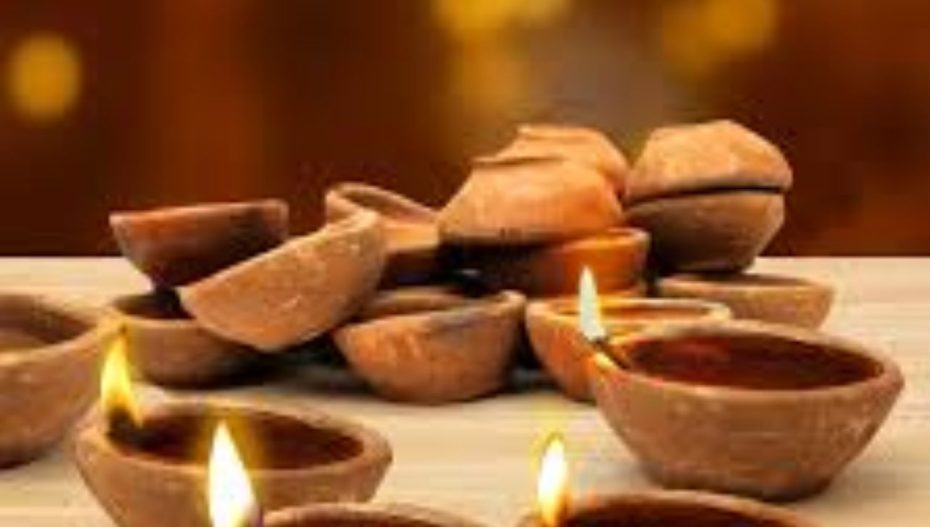
As dusk falls this Diwali and families gather to light rows of flickering clay lamps, hardly a few would perhaps know that they are taking part in a tradition that is as old as civilisation itself.
Long before electric bulbs spread brightness in homes, before streets were strung with LED lights, the humble earthen diya was the beacon of light — and of life. And in Gujarat, this tiny lamp carries the weight of a 5,000-year-old legacy.
According to a report in a section of the media, archaeological findings from the ancient Harappan city of Dholavira, located in the Rann of Kutch, tell us that even back then, people lit terracotta lamps to illuminate their homes and perhaps, their hopes. “These early lamps were functional, unadorned, and made with local clay,” Dr Y S Rawat, former Director General of the Archaeological Survey of India, has been quoted saying in a national English daily. He was part of the Dholavira excavation team. “But even in their simplicity, they reflect a deep human need — to push back the dark.”
Over time, lamps evolved with society. By the 1st to 4th centuries CE, as towns like Vadnagar thrived, lamps became more intricate and imaginative. Archaeologists have discovered hand-shaped lamps, two-piece designs with separately made tops and bases, and wheel-thrown or moulded varieties — a testament to the craftsmanship of ancient potters.
Different styles also emerged based on how the lamps were fired and finished. Some bear a red slip, others are grey or deep red — variations that not only speak to technique but also regional preferences and access to materials.
Interestingly, many of these lamps bear uncanny similarities to Roman and Greek artifacts, suggesting there was more than just trade between ancient India and the West — there was also a sharing of ideas.
According to a report, by the 18th and 19th centuries, Gujarat’s lamps were not just utilitarian but works of art. Art historian D G Kelkar, in his acclaimed book Lamps of India, described stunning bronze lamps from the region, adorned with peacocks or images of goddesses like Gaja Lakshmi and Deepa Lakshmi — motifs still associated with prosperity and light during Diwali.
The symbolism of light runs deep in Gujarat’s festive calendar. Professor Ramji Savaliya, former director of the BJ Institute of Learning and Research, has been quoted, “We see the lamp right from Navratri, where the ‘garbo’—a lamp placed inside an earthen pot—becomes the focus of devotion. And it culminates in Diwali, with diyas placed on every threshold.”
Then there’s Rupal ni Palli, a village tradition where massive flaming torches are carried through the streets, a dramatic expression of devotion through light.
Lamps also form part of sacred architecture. Stone lamps built into temple walls, and deepmala towers similar to those in South India, once lit entire temple complexes — a tradition reflected in ancient paintings, like the 18th-century depiction of Raga Deepak in the NC Mehta Collection at Ahmedabad’s LD Museum.
Even today, as electric lights and digital displays dazzle the eyes, the soft glow of the earthen diya continues to capture hearts. Across Gujarat and much of India, homes, temples, and public spaces still honour this quiet symbol of light triumphing over darkness.
This Diwali, when you strike a match to light your diya, remember — you’re not just upholding a tradition. You’re reviving a connection to thousands of years of human history, ingenuity, and spirit.
Also Read: Happy Diwali 2023: Best wishes, messages, greetings and quotes to share with your loved ones on Deepavali https://www.vibesofindia.com/happy-diwali-2023-best-wishes-messages-greetings-and-quotes-to-share/