


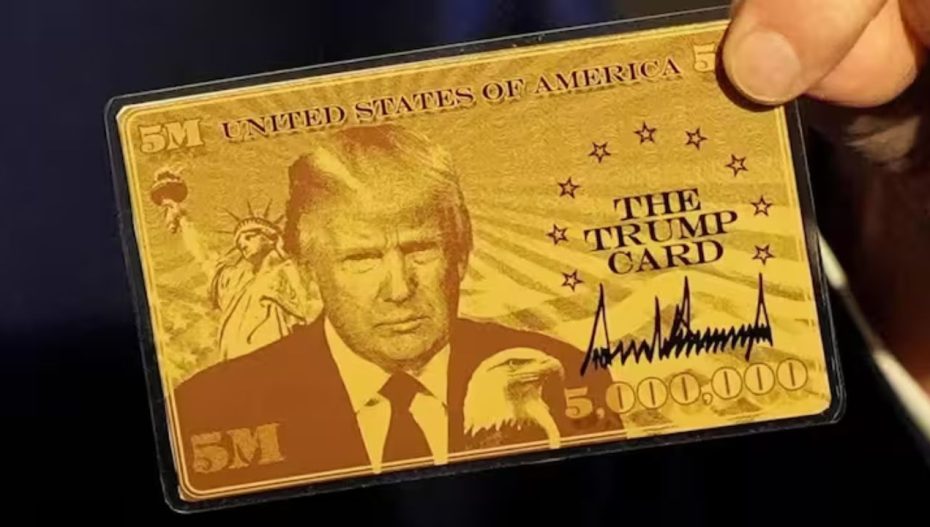
A new chapter in high-stakes immigration has arrived, and it reportedly comes with a glittering price tag. The Donald Trump Gold Card promises a golden ticket to life in America.
The website shouts: “Unlock life in America. Apply now.” But for Indians eyeing permanent residency, the sheen of gold quickly fades: “apply now” does not translate into getting a permanent residency now.
For them, the promise means paying millions of dollars while remaining trapped in the same overburdened queues for years. Or even decades. The programme demands a $1 million donation ($2 million for corporate sponsorship) to the US treasury, plus a $15,000 Department of Homeland Security (DHS) processing fee for each applicant.
Too harsh
The Gold Card website, recently updated, delivers an even harsher reality. An industry observer and expert told a national daily that each family member, whether a spouse or a child under 21, must also pay their own $1 million donation and the $15,000 processing fee.
The official guidance is very forthright on this: “If an individual applicant or corporate sponsor wishes for a spouse or unmarried children (under 21 years old) to join the cardholder in the US, then each such family member should be included as part of the initial application. This will ensure that these family members receive all of the privileges conferred by the Gold Card Programme, including expedited processing. Each family member is subject to an additional $15,000 DHS processing fee and $1 million gift.”
In practice, a family of four faces a minimum outlay of $4 million before legal and documentation fees are considered.
No separate classification
Yet despite this eye-watering investment, the programme reportedly does not create a new immigration category, nor does it reserve visas or confer any priority. Gold Card applicants must file under existing green card pathways: EB-1A (Extraordinary Ability) or EB2 NIW (National Interest Waiver). There is no separate Gold Card classification.
The harsh arithmetic of US immigration laws compounds the problem. Employment-based green cards (the category into which Gold Cards fall) are capped at 140,000 annually, plus any unused family-sponsored visas, with a per-country ceiling of 7%. With India producing a large number of high-skilled applicants, the backlog stretches years.
The general apprehension is that Indians considering the Trump Gold Card could remain stuck in the EB-1 or EB-2 backlogs for years or even decades, paying $1 million or more without ever actually receiving their green card.
Applicants must meet standard eligibility: lawful permanent resident status, admissibility to the US, and visa availability. “A small number of countries may have wait times of up to a year or more based on visa (aka green card) availability,” the site warns.
For Indian-born applicants, this is the crux: the Gold Card offers no relief from green card backlogs.
Here’s how the backlog works: the priority date is the day USCIS receives the green-card application. Individuals cannot apply for a change of status until this date is current. Indian applicants frequently face much longer waits than others.
As per the December 2025 Visa Bulletin, the EB-1 India category has a priority date around April 15, 2023, while EB-2 India lags on May 15, 2013. Even after filing for adjustment of status, applicants must endure another wait, and the million-dollar donation under the Gold Card program does nothing to expedite this queue.
Full burden
Applicants also face the full evidentiary burden of EB-1A or EB-2 NIW. The executive order establishing the Gold Card Programme does not indicate whether the donation alone suffices. These are rigorous, evidence-heavy standards.
For EB-1A, applicants must demonstrate sustained national or international acclaim, through major awards, high-impact publications, original contributions, and peer recognition. USCIS must be convinced the applicant is among the “top few percent” in their domain.
Even the EB-2 “exceptional ability” threshold (the baseline for NIW evaluation) requires satisfying at least three stringent criteria, such as professional recognition, high salary relative to peers, or significant contributions. NIW further demands proof that work has substantial merit and national importance.
After processing, Gold Card applicants will likely need to appear at the US consulate in their home country for an in-person interview before their immigrant visa is approved.
It remains unclear whether foreign nationals already in the US may use the USCIS adjustment of status process under the Gold Card programme.
Also Read: Trump Unveils “Gold Card” Scheme Offering Residency And Citizenship Path For $1 Million https://www.vibesofindia.com/trump-unveils-gold-card-scheme-offering-residency-and-citizenship-path-for-1-million/