


Volcanoes are undoubtedly the most powerful forces of nature. They remain dormant for ages. When they erupt, they do so with so much fury that humankind has barely any time to react.
That is exactly what happened on Sunday.
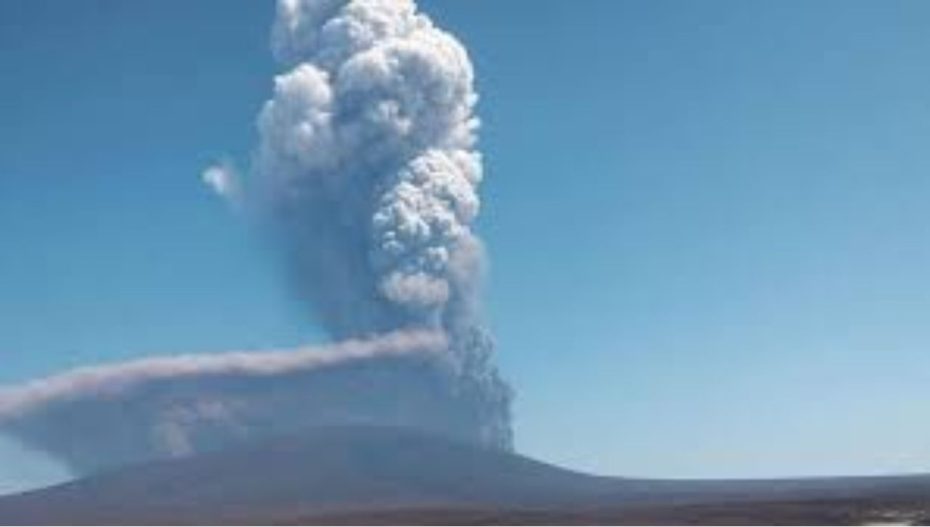
Satellite images show Ethiopia’s Hayli Gubbi volcano erupting for the first time in nearly 10,000 years. The eruption reportedly sent ash and sulphur dioxide high into the atmosphere.
Clouds reached up to 45,000 feet above the northeastern Afar region, according to reports.
The volcanic plume moved across the Red Sea, Yemen, Oman, and the Arabian Sea. It then entered Indian airspace and is drifting toward China. IMD Director General Mrutyunjay Mohapatra said the ash clouds are “drifting towards China” and will clear Indian skies by 7:30 pm on Tuesday.
The ash reportedly reached Gujarat, Rajasthan, Delhi-NCR, Punjab, Haryana, and parts of Maharashtra. It continued toward the Himalayas, Nepal, and China. High-altitude winds carried the plume from Ethiopia across West Asia to northern India.
The plume entered India through western Rajasthan. “The ash cloud has now entered the Indian subcontinent from the Jodhpur-Jaisalmer region and is moving northeast at 120-130 kmph,” said the India Met Sky Weather alert. By late evening, it stretched over Rajasthan, Haryana, and Delhi.
Trailing segments were expected to brush Gujarat. Punjab, western Uttar Pradesh foothills, and parts of Himachal Pradesh could see impacts overnight.
Most of the ash remained between 25,000 and 45,000 feet. Health risks on the ground are minimal. Light ashfall and unusual sunrise colours are possible. Air quality could remain poor.
Satellite images from the European Space Agency’s Sentinel-2 and the Toulouse Volcanic Ash Advisory Center showed the plume spreading over thousands of kilometres. The volcano had been dormant for nearly 10,000 years, with no activity recorded during the Holocene epoch.
The eruption reportedly caused flight disruptions on Monday. Cochin International Airport cancelled IndiGo’s Cochin-Dubai flight (6E1475) and Akasa Air’s Cochin-Jeddah flight (QP550). KLM cancelled Amsterdam-Delhi (KL 871) and Delhi-Amsterdam (KL 872) services.
Air India said on X: “Following the volcanic eruption in Ethiopia, ash clouds have been observed over certain geographical regions. We are closely monitoring the situation and remain in constant touch with our operating crew. There is no major impact on Air India flights at this time.”
IndiGo said it was “closely tracking the situation” and was “fully prepared with all necessary precautions to ensure safe and reliable operations.” SpiceJet warned that volcanic ash over parts of the Arabian Peninsula “may impact flight operations for aircraft flying through these regions.”
Akasa Air confirmed it was tracking the eruption in line with international aviation advisories.
The Directorate General of Civil Aviation (DGCA) issued urgent advisories for all Indian carriers.
“Strict avoidance of volcanic ash-affected areas and flight levels is mandatory,” it said. Airlines were instructed to revise routing, brief crews on ash procedures, and report unusual engine behaviour or cabin odour.
Although the cloud is high-altitude and unlikely to affect takeoffs or landings, officials noted its evolving path over West Asia required caution. IMD and Volcanic Ash Advisory Centres are monitoring satellite data and issuing advisories for public safety and air traffic management.
The Hayli Gubbi eruption is a rare event. It highlights the geological volatility of the Afar Rift region. Satellite monitoring has helped provide timely warnings and manage impacts across multiple countries.
Also Read: Tsunami Warning Issued After Tonga Underwater Volcano Eruption https://www.vibesofindia.com/tsunami-warning-issued-after-tonga-underwater-volcano-eruption/