


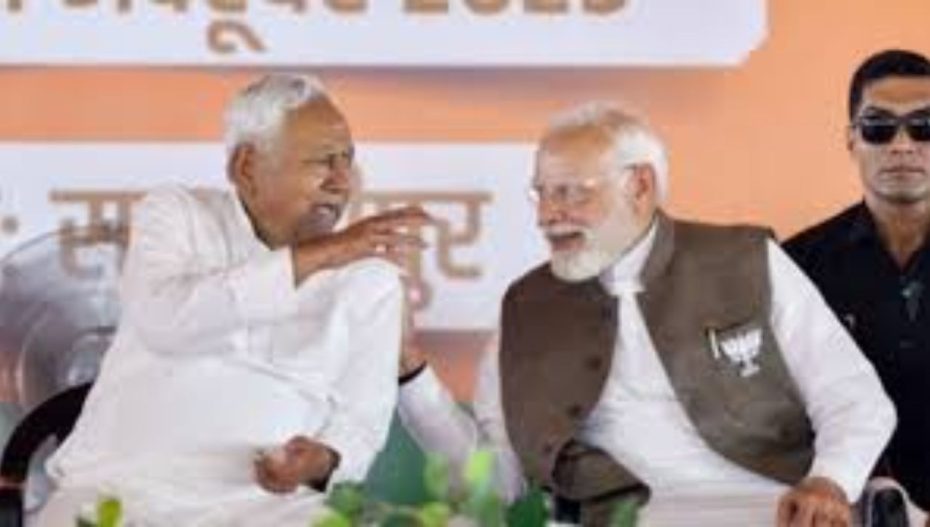
The NDA had an edge in Bihar elections but the results came as a Tsunami even for them.
Some time back, Union Home Minister Amit Shah — the BJP’s chief strategist — told reporters at MP Anil Baluni’s Igas festival that the NDA was likely to secure 160 seats. The final count shot up to 202, underscoring how even the top leadership anticipated a wave rather than a political tsunami.
Contrary to the notion that Bihar’s entrenched caste politics had suddenly evaporated, the vote-share patterns revealed continuity. The BJP, Rashtriya Janata Dal (RJD), Congress, Lok Janshakti Party (Ram Vilas), and others recorded figures broadly similar to the 2020 Assembly election. Nitish Kumar’s Janata Dal (United) was the lone exception, marking a rise of around four percentage points from its 2020 numbers — a shift significant but not transformational enough to suggest a wholesale ideological reset.
In fact, the real churn had unfolded a year earlier. Analysts point to the 2024 Lok Sabha election as the moment when consolidation within the NDA became unmistakable. Chirag Paswan’s return further strengthened the coalition’s social arithmetic, improving vote-transfer efficiency and knitting together a formidable alliance of extremely backward classes, non-Yadav OBCs, Dalits, and upper castes. Data cited by a leading English language daily on party-wise vote shares across the 2020 Assembly, 2024 Lok Sabha, and 2025 Assembly elections depicts this clearly:
BJP: 42.6% (2020) → 49.3% (2024) → 48.6% (2025)
JD(U): 32.8% (2020) → 46.7% (2024) → 46.3% (2025)
RJD: 39% (2020) → 39.7% (2024) → 38.9% (2025)
Chirag Paswan’s role in consolidation
With Paswan back in the NDA fold, the coalition reaped the benefits of unified support bases across constituencies. This consolidation, which had already delivered dividends in the Lok Sabha polls, translated even more effectively into Assembly seats. The NDA’s expanded caste coalition ultimately paved the way for the emphatic victory.
Why analysts still missed the landslide
Political observers cite a mix of confirmation bias and overreliance on perception-based cues. Nitish Kumar’s long tenure, public gaffes, and a sense of administrative fatigue led to a widespread expectation that anti-incumbency would drag down the NDA. Poll strategist Prashant Kishor’s pronouncements — including his longstanding assertion that he would quit political consultancy if the BJP crossed 100 seats in West Bengal — reinforced assumptions that Bihar’s ruling alliance was headed for a setback.
On the ground, public responses reflected a mixed sentiment: general approval for Nitish’s social coalition, economic measures, and schemes like the Rs 10,000 transfer, but also recognition of governance shortcomings. Many interpreted this as enough to keep the NDA afloat, not to propel it to a landslide.
The takeaway: A template for 2025 state polls?
The Bihar verdict adds to a pattern repeatedly visible in recent state elections. From Madhya Pradesh (2023) to Haryana (2024) and Maharashtra (2024), the BJP has delivered spectacular results despite anti-incumbency:
Madhya Pradesh: 163 of 230 seats
Haryana: 48 of 90 seats
Maharashtra: BJP’s all-time high of 132 seats (NDA total 232 of 288)
Delhi: 48 of 70 seats — though the outcome is jointly attributed to the BJP and Arvind Kejriwal
Across these states, one factor stands out: the introduction of large-scale, poll-eve cash transfer schemes for women, including Ladli Behna (MP), Lado Laxmi (Haryana), Majhi Ladki Bahin (Maharashtra), and Mahila Rozgar Yojana (Bihar). These schemes have emerged as a consistent vote-mobilising tool.
Gujarat, however, remains an exception. The BJP secured a record 156 of 182 seats in 2022 without relying on freebie politics — a continuation of an electoral pattern that has persisted since Narendra Modi became chief minister in 2001. Amit Shah even remarked after that victory that voters had rejected parties offering giveaways.
As West Bengal, Assam, Tamil Nadu, Kerala, and Puducherry gear up for elections early next year, political observers are now assessing how the BJP’s evolving strategy — combining social coalitions, targeted welfare, and organisational machinery — might shape the next round of contests. Bihar, far from being an anomaly, appears to reinforce a larger electoral formula the party has refined over recent cycles.
Also Read: From Cricket To Controversy: Rameez Nemat Khan At The Heart Of Bihar’s Political Storm https://www.vibesofindia.com/from-cricket-to-controversy-rameez-nemat-khan-at-the-heart-of-bihars-political-storm/