Why should Bhagwat’s comment matter beyond ideological posturing? Because it signals intent, and actions follow.
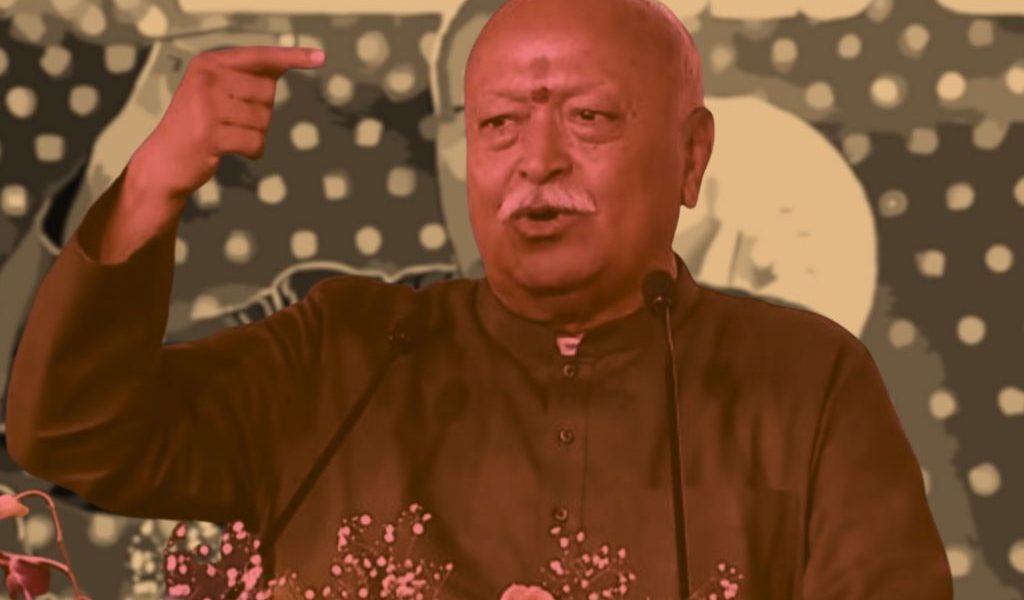
At a Rashtriya Swayamsevak Sangh (RSS) centenary event in Kolkata on December 21, Sarsanghchalak Mohan Bhagwat made a declaration that crystallises the ideological project now driving Indian state policy. He said that India was already a “Hindu nation.”
Speaking at the ‘100 Vyakhyan Mala’ (100 Lecture Series) programme marking 100 years of the RSS, Bhagwat invoked a telling analogy.
“The Sun rises in the east; we don’t know since when this has been happening. So, do we need constitutional approval for that too? Hindustan is a Hindu nation. Whoever considers India their motherland appreciates Indian culture. As long as there is even one person alive on the land of Hindustan who believes in and cherishes the glory of Indian ancestors, India is a Hindu nation. This is the ideology of the Sangh.”
He then made explicit what his organisation truly thinks of India’s foundational secular framework. Formal recognition in the constitution was, according to Bhagwat, immaterial to the RSS. The organisation describes itself as the “world’s largest NGO” according to prime minister Narendra Modi, yet it remains unregistered and has been banned at least three times since Independence.
“If parliament ever decides to amend the constitution and add that word, whether they do it or not, it’s fine. We don’t care about that word because we are Hindus, and our nation is a Hindu nation. That is the truth,” Bhagwat said, his contempt for the constitutional settlement barely concealed.
This brazenly dismisses what India’s founding document actually says. The Preamble of the Indian Constitution explicitly invokes the word “secular,” making clear that India belongs to people of all faiths, not one. Article 14 further enshrines this principle by stating that “the State shall not deny to any person equality before the law or the equal protection of the laws within the territory of India.”
But why should Bhagwat’s comment matter beyond ideological posturing? Because it signals intent, and because actions follow.
The erosion of constitutional pluralism
When the RSS leadership declares that India is inherently a “Hindu nation” while dismissing 76 years of constitutional development, they are not making a casual observation. They are shrinking the intellectual and political space for pluralism itself. This rhetoric stokes genuine fears among all those who do not profess the Hindu faith. That fear is not hypothetical.
Attacks against Christians have intensified recently, particularly during Christmas. What once appeared as scattered incidents across Gujarat in 1998-99 and Madhya Pradesh, Chhattisgarh, and other parts of central India when BJP governments held power has gone national. This year alone, attacks have been numerous and reported from many places in north and western India. Christians constitute only 2.3% of India’s population, yet they represent a significant and prominent religious minority under sustained pressure.
According to the United Christian Forum, attacks on Christians have increased nearly eightfold in just 11 years. That acceleration coincides directly with the rise of RSS-affiliated governance.
State-backed discrimination
The pattern extends beyond sporadic mob violence. There is now systematic pressure on minority groups, amplified by loud rhetorical aggression from ruling party chief ministers, especially Himanta Biswa Sarma in Assam and Adityanath in Uttar Pradesh. These statements are followed by discriminatory behaviour by state arms like the police and municipal authorities, who apply the law selectively and conduct demolitions that explicitly target minority citizens. These actions meet virtually no pushback from the party’s central leadership. The message is clear: discriminatory governance has been sanctioned from above.
Polarisation as electoral strategy
Modi himself weaponised religious polarisation during the 2024 elections with unmistakable intensity. According to Human Rights Watch, 110 out of 173 of Modi’s campaign speeches contained significant Islamophobic content once the model code of conduct began in March. This was not accidental rhetoric. It was strategy.
More recently, in the Bihar elections on November 3, Modi escalated further. Addressing an election rally in Katihar, a city with a large Muslim population, he accused the RJD and Congress of hatching a “dangerous conspiracy” to upset demographic balance by encouraging infiltration in the Seemanchal region. Opposition leaders criticised his remarks as hate speech. Modi’s language –deliberate accusations of conspiracy aimed at destabilising the nation through religious demographics – has become his standard political toolkit.
Rewriting India’s character and laws
The government’s push to redefine India as fundamentally Hindu rather than plural is reflected across multiple domains. Recent laws, attempts to rewrite history through educational curricula, and notably, the fact that for the first time in independent India’s history, there is no Muslim minister in the cabinet, all point in one direction. Muslims constitute approximately 14 percent of India’s population according to 2011 Census figures. Nearly 25% of India’s population belongs to religious minorities. When Bhagwat and his allies amplify the message that India is a Hindu nation, they are signaling to these populations that they are not truly of this land.
India’s diplomatic isolation
This ideological hardening also damages India’s standing on the world stage at precisely the wrong moment. Bangladesh currently finds itself navigating between competing pressures from Islamist movements and concerns for Hindu minority protection. Two Hindu Bangladeshis have been lynched in recent weeks. India has moral standing to call on Bangladesh to be “inclusive” and mindful of minority rights only if its own conduct reflects what it demands of neighbors.
To lecture Bangladesh as a “Hindu nation” carries no credibility whatsoever. Worse, it risks inflaming communal passions. India’s continued official rhetoric painting so-called Bangladeshis (usually Bengali-speaking Muslims, some undocumented) as “infiltrators” undermines any appeal to minority protection principles. In 2018, when Amit Shah served as BJP president, he called Bangladeshi immigrants “termites,” a dehumanising slur that reveals the movement’s actual disposition toward religious minorities regardless of nationality.
The RSS network and its reach
Understanding why Bhagwat’s statement matters requires grasping the structure of RSS power. The RSS functions as the ideological fount from which the BJP and numerous affiliated organisations have emerged. The Bajrang Dal, the VHP, and other groups openly state that they work for the Sangh. Modi himself was a pracharak (RSS full-time cadre), as are many of his cabinet ministers, chief ministers, and state governors. This is not a parallel movement. It is the operational backbone of the current Indian regime.
The constitutionally guaranteed pluralism that once defined Indian democratic practice is being systematically dismantled by this regime, not through direct constitutional amendment, but through state action, mob violence, discriminatory law enforcement, and relentless rhetorical delegitimisation of minorities. Bhagwat’s words provide both context and direction to this destructive project.
When the top leader of the RSS ladder speaks, his words carry immense weight. Bhagwat’s statement is not a casual affirmation of RSS core ideology that “India is for Hindus alone.” It signals something more dangerous. It reflects a growing desperation to push all those who do not align with the Sangh’s vision to abandon the public sphere entirely, to withdraw from participation under relentless pressure on the actual, lived reality of India.
Also Read:
Food, Faith and Fascism in New India https://www.vibesofindia.com/food-faith-and-fascism-in-new-india/