


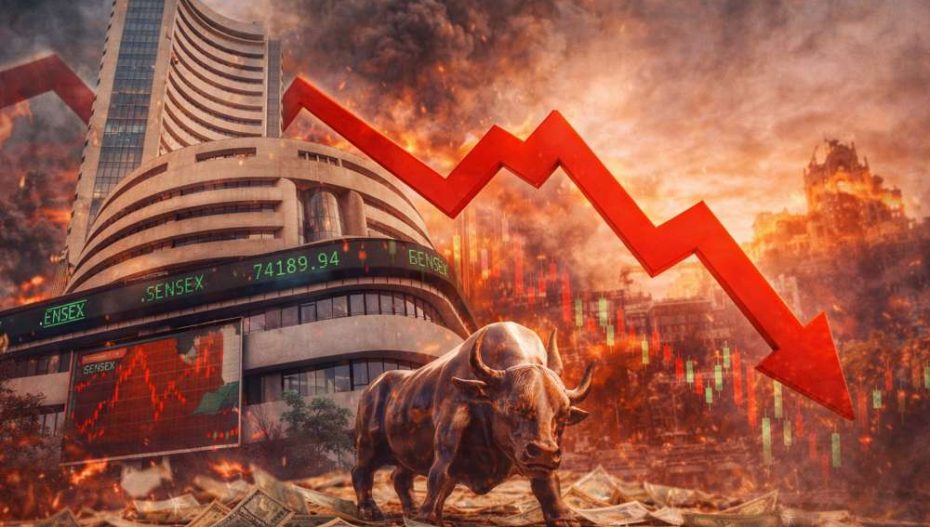
Indian equity markets opened sharply lower on Monday, tracking a global sell-off triggered by soaring crude oil prices, escalating geopolitical tensions in the Middle East and a weakening rupee.
The BSE Sensex plunged more than 2,400 points in early trade, while the Nifty 50 dropped over 700 points, reflecting broad-based selling across sectors.
The sharp decline comes as global markets tumble and crude oil prices surge to their highest levels since 2022.
1. Oil prices spike amid Middle East conflict
The biggest trigger for the market slide is the sharp jump in crude oil prices after tensions between the United States–Israel and Iran escalated.
Brent crude surged more than 25% to around $116 per barrel, while the US benchmark West Texas Intermediate rose above $114 per barrel.
Energy markets have been rattled by fears of supply disruptions across the Middle East. Tanker traffic through the Strait of Hormuz — a vital route that carries nearly 20% of global oil supply — has largely stalled, raising concerns of prolonged disruption.
Supply worries have intensified after Iraq and Kuwait cut oil output, while earlier reductions in liquefied natural gas supplies from Qatar have added to fears of a broader energy shock.
2. India’s heavy dependence on imported crude
India is particularly vulnerable to rising oil prices as it imports more than 85% of its crude oil requirements.
Market expert Ajay Bagga told ANI that the oil shock could have a significant impact on the economy.
“The oil price hit to India’s GDP, current account deficit and inflation will be huge given that India meets more than 85% of its crude oil requirements from imports.”
Higher crude prices are expected to push up petrol, diesel, LPG and aviation fuel costs, raising input costs for businesses and households.
This raises concerns about inflation, fiscal pressure and slower economic growth, factors that typically weigh on equity markets.
3. Rupee slides near record low
The Indian rupee also came under heavy pressure, deepening investor concerns. The currency fell 46 paise to around 92.28 against the US dollar, close to its intra-day record low of 92.35 touched earlier this month.
Forex traders attributed the decline to rising crude oil prices, a stronger US dollar, foreign investor outflows and weak domestic equities.
The dollar index rose about 0.66%, reflecting global demand for the US currency as investors move toward safer assets amid uncertainty.
Analysts warn that the rupee could weaken further toward 93 per dollar if crude prices remain above $100 per barrel.
4. Global markets plunge
Indian markets are also reacting to a sharp risk-off sentiment across global markets.
Asian equities tumbled on Monday as investors rushed toward safer assets amid geopolitical uncertainty. Major declines included:
- Japan’s Nikkei 225: down about 7%
- South Korea’s Kospi: down more than 7%
- Taiwan’s benchmark index: down nearly 6%
- Hong Kong’s Hang Seng: down over 2%
(All figures as of 10:30 am IST)
Meanwhile, Wall Street had already ended lower on Friday, with the S&P 500 falling 1.33% and the Nasdaq declining 1.53%.
When global markets weaken sharply, foreign investors typically pull money out of emerging markets like India, intensifying the sell-off.
5. Heavy FII selling and weak sentiment
Another major factor behind the market fall is continued selling by foreign institutional investors (FIIs).
Exchange data shows that foreign investors sold equities worth ₹6,030 crore on Friday.
According to Sunil Gurjar, SEBI-registered analyst and founder of Alphamojo Financial Services, technical weakness had already begun to emerge in the markets.
“The fall was mainly driven by heavy FII selling, a weakening rupee and ongoing global war tensions, which hurt market sentiment,” he told ANI.
The Nifty also slipped below its key 200-day exponential moving average, a technical indicator often viewed as a signal of a bearish trend.
Broad-based sectoral selling
The decline in Indian markets was widespread, with all major sectoral indices opening in the red.
Among the worst-hit sectors:
- PSU Banks: down about 4%
- Auto: down 2.9%
- Media: down 2.36%
- Consumer Durables: down 2%
- IT: down 1.29%
- FMCG: down 1.38%
(All figures as of 10:30 am IST)
Sectors heavily dependent on oil derivatives — including aviation, paints, chemicals, tyres and automobiles — are expected to remain under pressure if crude prices stay elevated.
What investors are watching next
Market direction will largely depend on how the Middle East conflict evolves and whether crude oil prices stabilise.
According to analysts, 23,850 on the Nifty is a crucial support level. A decisive break below this could trigger further downside. On the upside, a sustained move above 24,646 could indicate a return of bullish momentum.
For now, investors remain cautious as the combination of surging oil prices, a weakening rupee, global market turmoil and geopolitical tensions continues to weigh heavily on market sentiment.
Also Read: What The US-Israel War On Iran Means For Indian Stock Market https://www.vibesofindia.com/what-the-us-israel-war-on-iran-means-for-indian-stock-market/