comScore mobile-details - Vibes Of India

Gujarat News, Gujarati News, Latest Gujarati News, Gujarat Breaking News, Gujarat Samachar.

Latest Gujarati News, Breaking News in Gujarati, Gujarat Samachar, ગુજરાતી સમાચાર, Gujarati News Live, Gujarati News Channel, Gujarati News Today, National Gujarati News, International Gujarati News, Sports Gujarati News, Exclusive Gujarati News, Coronavirus Gujarati News, Entertainment Gujarati News, Business Gujarati News, Technology Gujarati News, Automobile Gujarati News, Elections 2022 Gujarati News, Viral Social News in Gujarati, Indian Politics News in Gujarati, Gujarati News Headlines, World News In Gujarati, Cricket News In Gujarati

Vibes Of India
Vibes Of India

A payment of Rs 5,100 crore has bought the promoters of Sterling Biotech Ltd something courts rarely offer — a clean slate on criminal charges. But the numbers tell a harder story.

Documents filed before the Supreme Court reveal that secured lender banks are owed Rs 19,283.77 crore by the Sterling Biotech group. Against this, the Rs 5,100 crore accepted as “full and final payment based on consensus” represents barely a quarter of the total dues. The ED, meanwhile, had attached assets worth Rs 27,757 crore, a figure that dwarfs the settlement amount.

The promoters, brothers Nitin and Chetan Sandesara, had been accused by the CBI and Enforcement Directorate of bank loan fraud, money laundering and diverting funds through shell companies and fake transactions, according to reports.

They are believed to be in Nigeria or Albania. Extradition requests against them remain pending, and Red Corner Notices are still active.

On November 19 last year, the Supreme Court agreed to drop criminal proceedings against them, subject to the deposit of Rs 5,100 crore. The court said the quashing would take effect on deposit of the amount on or before December 17, 2025.

The Rs 5,100 crore was not the group’s first offer. The Sandesaras had earlier told the court they had already deposited Rs 3,507.63 crore under various heads, with another Rs 1,192 crore recovered by banks through insolvency proceedings. They placed their remaining liability at Rs 2,061.37 crore.

They also pointed out that they had originally entered into a one-time settlement of Rs 6,761 crore with the consortium of banks covering both Indian and foreign entities. Probe agencies opposed the liability figure proposed by the group. After consultations between the agencies and the lender banks, a revised figure of Rs 5,100 crore was proposed and accepted by the group.

The Sandesaras had first approached the Supreme Court in 2020, seeking quashing of CBI and ED cases. They said their dues arose from genuine business losses, not deliberate fraud, and that they had made all reasonable efforts to repay.

The secured lender banks have since filed a joint application before the court seeking directions for distributing the deposited amount among themselves. The banks said they had arrived at a distribution formula by consensus. Five foreign entities with combined dues of Rs 463.12 crore are to receive Rs 120.8 crore under this formula.

When the matter was heard on March 16 by a bench of Justices J K Maheswari and A S Chandurkar, counsel for the Sandesaras flagged that SEBI proceedings against the company were continuing despite the Supreme Court order.

The bench asked why SEBI was coming in the way after its order. The matter will be heard again on March 23.

Also Read: Global Scamsters Saving Modi: Cong Over Lalit Modi’s Tweets https://www.vibesofindia.com/global-scamsters-saving-modi-cong-over-lalit-modis-tweets/

A woman inheriting property, a couple filing for divorce, or love birds registering a live-in relationship. Each belongs to a different religion. They must walk a different legal path in Gujarat.

One bill wants to give them all the same road.

The Gujarat government has introduced the Gujarat Uniform Civil Code (UCC) Bill in the state legislative Assembly. The bill proposes a common legal framework governing marriage, divorce, succession and live-in relationships. It would be applicable to all residents, irrespective of religion.

The UCC is a simple idea with a complicated history: that the law should see citizens before it sees their faith. Gujarat’s move places it at the front of a conversation that has simmered in Indian public life for decades and is now, finally, being legislated.

The bill also proposes tighter rules around marriage registration, signalling that the state intends not just to unify personal law but to enforce it with greater rigour.

Among other things, it provides for registration of live-in relationships, as well as their termination through a formal declaration.

The Bill was reportedly signed by Deputy Chief Minister Harsh Sanghavi. It was made public a day after a state-appointed panel submitted its final report on implementation of the UCC in the state to Chief Minister Bhupendra Patel.

“The UCC Bill has been introduced in the Assembly. Further discussion will take place in the House. Everyone is welcome to share their views. The UCC Bill is a very important legislation. Our government has decided to bring this Bill to ensure that every citizen gets equal rights,” Agriculture Minister and government spokesperson Jitu Vaghani told mediapersons after a Cabinet meeting.

The people of Gujarat were waiting for such a legislation and it will benefit everyone, he said.

THE UCC has been proposed nearly a month after the Gujarat government proposed amendments to the Gujarat Registration of Marriages Act, 2006. These amendments made parents’ consent compulsory for registering marriages. This was done in the beginning of the Budget session of the Gujarat Assembly, citing “love jihad”.

While the Bill document was published on the official website of the Assembly on Wednesday, it will be taken up for discussion and passage on March 24. This is a day before the ongoing Budget session ends, said Assembly secretary C B Pandya.

Asked about moving the Bill on a day before the Budget Session concludes, legislative Assembly

Speaker Shankar Chaudhary told a section of the media that there will be ‘sufficient’ time and opportunity given to the legislators for discussion.

The exemptions

Titled the ‘Gujarat Uniform Civil Code, 2026’, the proposed law will extend to the entire state. It will also apply to residents of Gujarat living outside its territorial limits.

However, it will not apply to members of Scheduled Tribes and certain groups whose customary rights are protected under the Constitution.

The Bill aims at creating a uniform legal framework, said its ‘Objects and Reasons’ statement.

“The present Bill seeks to give effect to these recommendations by providing a uniform legal framework governing civil matters for all citizens of the State, irrespective of religion, caste, creed, or gender. It aims to uphold the principles of secularism, gender justice, and thereby strengthening the unity and integrity of society,” the Bill document said.

The Bill defines key terms such as child, spouse, estate, will and live-in relationship. It recognises children born within or outside marriage. This includes those born through assisted reproductive technologies, as well as adopted ones, on an equal footing.

Uniform conditions

A major component of the Bill relates to marriage and divorce. It lays down uniform conditions for a valid marriage. This includes prohibition of bigamy. It also sets the minimum age at 21 years for men and 18 years for women.

Marriages may be solemnised as per customary or religious ceremonies. Their registration will be compulsory. Non-registration will not invalidate a marriage. The Bill prescribes penalties for failure to register or for furnishing false information.

The Bill says a person cannot enter into a second marriage while their spouse is alive. “A marriage is considered valid under the Code only if neither party has a living spouse at the time of marriage,” it says.

The proposed law also standardises provisions relating to matrimonial disputes. It covers restitution of conjugal rights, judicial separation and annulment of void or voidable marriages.

It specifies a range of grounds for divorce. These include cruelty, desertion, adultery, conversion, mental disorder, communicable diseases, renunciation and presumption of death. It also allows divorce by mutual consent.

Specific grounds for divorce

Additional grounds have been provided for women in certain circumstances. The Bill also covers maintenance, interim and permanent alimony, and custody and welfare of children. It recognises the legitimacy of children from void or voidable marriages.

It specifies a range of grounds for divorce. These include cruelty, desertion, adultery, conversion, mental disorder, communicable diseases, renunciation and presumption of death. It also allows divorce by mutual consent.

Additional grounds have been provided for women in certain circumstances. The Bill also covers maintenance, interim and permanent alimony, and custody and welfare of children. It recognises the legitimacy of children from void or voidable marriages.

The Bill introduces uniform rules for distribution of property in cases of intestate succession. It classifies heirs and recognises the rights of unborn children.

It removes disqualifications based on physical or mental disability. It bars certain categories such as individuals responsible for the death of the deceased.

The legislation also governs testamentary succession. It enables individuals to dispose of property through wills. It lays down provisions on execution, validity, alteration and revocation of such wills.

It provides for probate, letters of administration, appointment of executors and administrators, and issuance of succession certificates by courts.

The Bill brings live-in relationships within a legal framework. It defines such relationships as those “in the nature of marriage”. It provides for their registration through a prescribed procedure. This includes submission of a joint statement by partners.

The legislation allows termination of such relationships through a formal declaration. It also lays down conditions under which registration may be denied.

It recognises the rights of children born out of live-in relationships. It provides for maintenance. It also prescribes penalties for violations of the provisions.

Also Read: Food, Faith and Fascism in New India https://www.vibesofindia.com/food-faith-and-fascism-in-new-india/

Mutual funds allow investors to participate in financial markets without directly managing individual securities. The pooled money is managed by an Asset Management Company (AMC), which oversees how the fund’s portfolio is constructed, monitored, and adjusted over time. Understanding how an AMC manages mutual funds investment can help investors better interpret how decisions are made within a professionally managed fund structure.

What Is an Asset Management Company?

An Asset Management Company is a financial institution that manages pooled investments on behalf of investors. In mutual funds, the AMC collects contributions from multiple investors and allocates them across assets such as equities, debt instruments, or other securities based on the scheme’s stated objective. 

Each fund follows a defined strategy, and the AMC manages the portfolio in accordance with this mandate. AMCs also operate within regulatory frameworks and follow disclosure requirements intended to maintain transparency and accountability in how investor money is managed.

Pooling Investor Money

A key function of an Asset Management Company is to pool money from multiple investors into a single mutual fund scheme. Instead of individuals purchasing securities independently, their contributions are combined and invested as part of a larger portfolio. 

This structure allows the fund to allocate money across different securities, sectors, or asset classes in line with the scheme’s stated objective. Such diversification may help spread exposure across investments, although market-linked investments can still experience fluctuations. 

By managing pooled capital, the AMC seeks to maintain the portfolio in accordance with the fund’s investment mandate.

Role of Fund Managers

Fund managers within an Asset Management Company are responsible for managing the portfolio of a mutual fund scheme. Their role typically involves analysing market conditions, reviewing company fundamentals, and assessing economic factors that may influence investment decisions. 

Based on this research, fund managers may adjust the portfolio by selecting, holding, or reducing exposure to certain securities in line with the fund’s stated objective. These decisions aim to maintain alignment with the scheme’s strategy, although market movements can vary and investment outcomes remain uncertain.

Research and Analysis

Research plays an important role in how an Asset Management Company manages mutual fund portfolios. Investment teams review economic indicators, company financial statements, sector developments, and broader market trends before making portfolio decisions. 

This analysis helps fund managers assess potential risks and opportunities associated with different securities. While a research-based approach may support more informed decision-making, financial markets can change over time and uncertainty remains. 

Such evaluation helps guide decisions related to mutual funds investment, particularly when selecting or reviewing securities within a portfolio.

Portfolio Diversification

Portfolio diversification is an important part of mutual fund management. An Asset Management Company typically allocates investments across different securities, sectors, or asset classes such as equities and debt instruments, depending on the fund’s objective.

Spreading investments across multiple assets may help reduce the impact of fluctuations linked to any single security. This approach can help distribute risk within the portfolio, although it does not eliminate market-related uncertainty. 

Diversification therefore aims to maintain balance in the portfolio while remaining aligned with the scheme’s investment strategy.

Monitoring and Adjusting the Portfolio

Financial markets are dynamic, and investment portfolios often require periodic review. An AMC generally monitors market developments, economic changes, and company-specific factors that could influence investments.

Based on these observations, the portfolio may be adjusted over time. This could involve increasing exposure to certain sectors, reducing positions in others, or rebalancing the portfolio to remain aligned with the scheme’s objective.

Such adjustments are intended to maintain consistency with the investment mandate of the fund rather than to guarantee a specific outcome.

Regulatory Compliance and Transparency

Mutual funds and AMCs operate within a regulatory framework designed to safeguard investor interests. Regulatory bodies require AMCs to disclose information about fund performance, portfolio holdings, and expenses on a regular basis.

These disclosures allow investors to review how their mutual funds investment is being managed. Transparency also helps investors understand the investment approach, portfolio composition, and overall strategy followed by the fund.

Regulatory oversight does not eliminate investment risk but aims to create a structured environment for managing investor funds.

Conclusion

An Asset Management Company manages mutual funds investment by pooling investor money, conducting research, and monitoring portfolios within regulatory frameworks. While professional management and diversification structure the investment process, market-linked outcomes can vary. Investors may benefit from reviewing scheme details and understanding associated risks before making decisions.

Mutual Fund investments are subject to market risks, read all scheme related documents carefully.

This document should not be treated as endorsement of the views/opinions or as investment advice. This document should not be construed as a research report or a recommendation to buy or sell any security. This document is for information purpose only and should not be construed as a promise on minimum returns or safeguard of capital. This document alone is not sufficient and should not be used for the development or implementation of an investment strategy. The recipient should note and understand that the information provided above may not contain all the material aspects relevant for making an investment decision. Investors are advised to consult their own investment advisor before making any investment decision in light of their risk appetite, investment goals and horizon. This information is subject to change without any prior notice. 

The content herein has been prepared on the basis of publicly available information believed to be reliable. However, Bajaj Finserv Asset Management Limited does not guarantee the accuracy of such information, assure its completeness or warrant such information will not be changed. The tax information (if any) in this article is based on prevailing laws at the time of publishing the article and is subject to change. Please consult a tax professional or refer to the latest regulations for up-to-date information.

In a development that may rattle investor sentiment, HDFC Bank chairman Atanu Chakraborty has resigned with immediate effect, citing governance practices that conflicted with his personal values—triggering a sharp reaction in overseas markets.

In his resignation letter dated March 17, Chakraborty wrote that “certain happenings and practices” within the bank over the past two years were “not in congruence” with his ethical framework. He emphasized that there were no other material reasons behind his decision.

The Reserve Bank of India has approved the appointment of Keki Mistry—former vice-chairman of HDFC Ltd—as interim part-time chairman for a period of three months starting March 19.

Market reaction: 7% fall signals investor unease

The immediate market response was negative. HDFC Bank’s US-listed ADRs fell over 7% overnight, reflecting investor concern over the abrupt leadership exit and the nature of the issues flagged. Although ADRs recovered marginally in extended trading, the signal for domestic markets is one of caution.

The stock, already under pressure, had closed at ₹842—near its 52-week low of ₹812—and is down about 8% over the past month. Brokerage firm JPMorgan has maintained a “neutral” rating, warning that the stock could remain weak in the near term, with the resignation compounding broader macro and geopolitical uncertainties. However, today morning there was a marginal change only.

Governance shadow over a systemically important bank

Chakraborty’s exit is particularly significant given his explicit reference to governance and ethical concerns—without elaborating on specifics. While the bank has maintained that there are no additional reasons beyond those cited, reports indicate that differences over functioning at the board level may have been simmering for some time.

Despite the abrupt exit, Chakraborty struck a conciliatory note, thanking the board, independent directors, and senior management for their cooperation and support during his tenure.

Gujarat cadre IAS: Policy, finance, and reform

Before transitioning to banking, Chakraborty had a distinguished career as a 1985-batch IAS officer of the Gujarat cadre. In the state government, he held key leadership roles including Secretary (Finance), where he oversaw fiscal management and worked on private sector investment frameworks during Gujarat’s high-growth years.

At the Union level, he served in the Ministry of Finance across critical portfolios. As Secretary, Department of Economic Affairs (2019–20), he coordinated macroeconomic policy across ministries and played a central role in Union Budget formulation and parliamentary processes. Earlier, as Joint Secretary in the Department of Expenditure, he handled infrastructure project appraisals, subsidy frameworks, and contributed to modernising government financial and procurement rules.

Oversaw landmark HDFC merger

Chakraborty joined the HDFC Bank board in May 2021 and presided over one of the most consequential developments in Indian banking—the merger with HDFC Ltd. The deal created a financial conglomerate and positioned the bank as the second-largest in India by market capitalisation.

In his letter, he described the merger as a “momentous event” but acknowledged that the full benefits of the integration are yet to fully fructify, a key concern for investors tracking post-merger synergies.

What next

With leadership transition now underway, the focus shifts to two variables: clarity on the governance issues flagged and execution of post-merger integration. Given HDFC Bank’s weight in benchmark indices and its systemic importance, even marginal shifts in investor confidence could have broader market implications in the near term.

Also Read: Higher Capital Requirement For SBI, HDFC From FY25, Says RBI https://www.vibesofindia.com/higher-capital-requirement-for-sbi-hdfc-from-fy25-says-rbi/

As public sector Northern Coalfields Limited pushes ahead with plans to expand its opencast mining project in Uttar Pradesh’s Sonbhadra district, 400 rural residents have signed a detailed ‘suggestions and objections letter’, raising questions about the government’s environmental compliance, compensation and rehabilitation plans.

'Mining Blasts Are Cracking Our Homes': Sonbhadra Villagers Oppose Bina Coal Mine Expansion

Bina opencast coal mine in the background | Cracked homes of residents. Photo: Special Arrangement.

 The controversy surrounding the expansion of the Bina opencast coal project in Sonbhadra has intensified. Residents have raised serious concerns about the transparency of public hearings, compliance with environmental clearance terms and the rising pollution.

New Delhi: The controversy surrounding the expansion of the proposed Bina opencast coal mining project in Sonbhadra district, Uttar Pradesh, has intensified. Affected villagers are voicing their opposition to the expansion, pointing out that existing mining operations have already polluted the land, water and air of the region and that further expansion will exacerbate the crisis.PlayNextMute

However, Northern Coalfields Limited (NCL), a subsidiary of Coal India Limited, a central government enterprise, is swiftly advancing with the expansion plan.

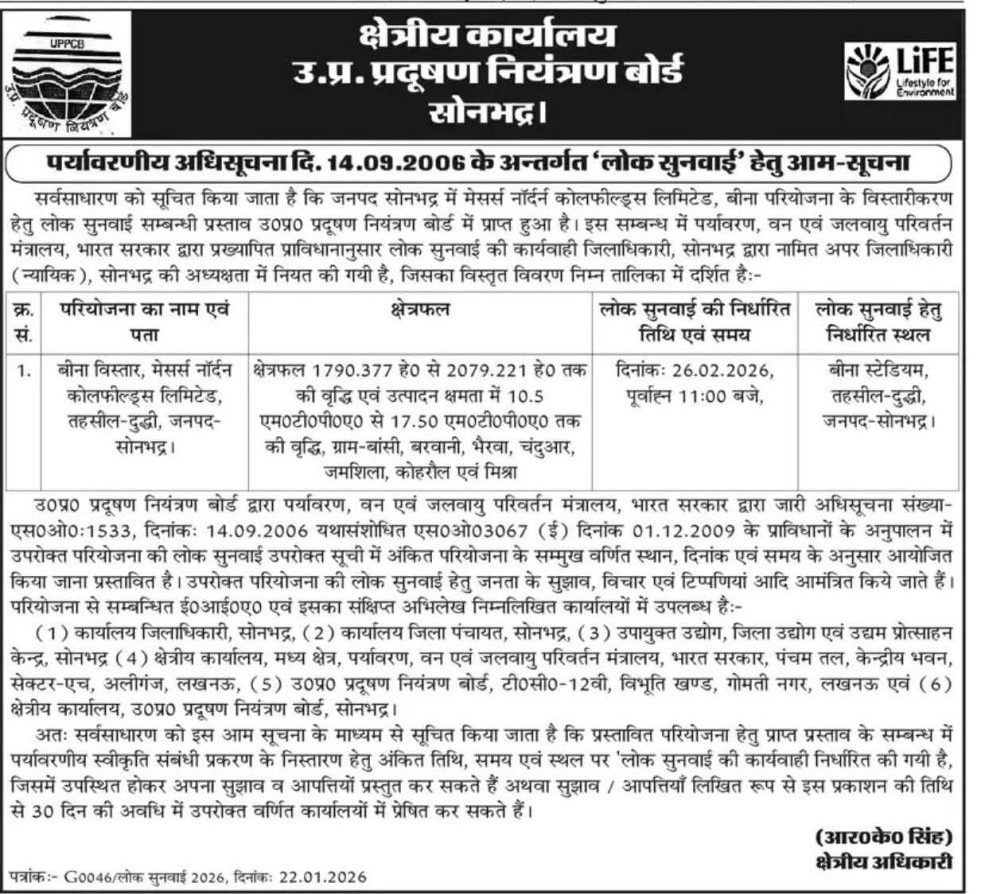
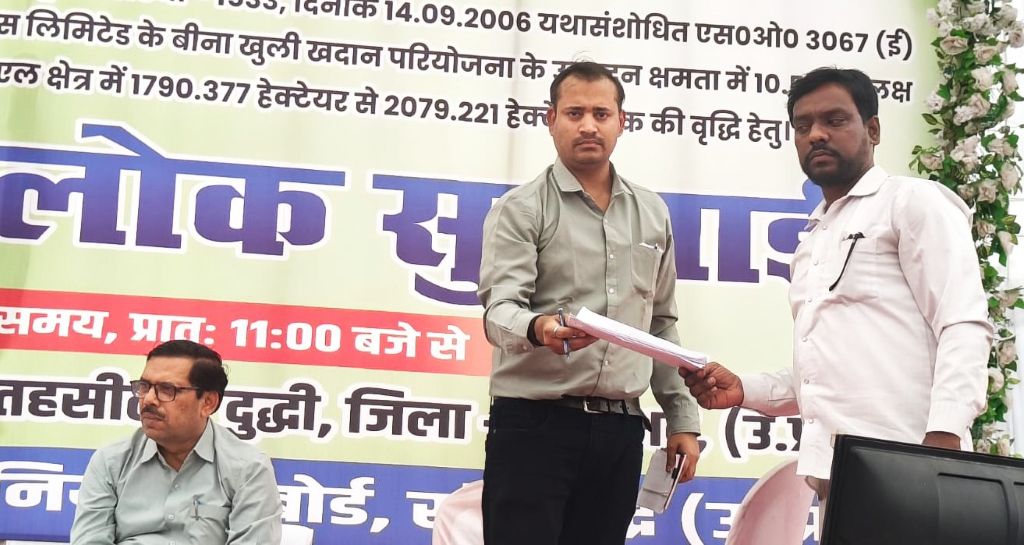
On March 17, the public hearing required for environmental clearance was held at Bina Stadium in Sonbhadra, attended by over 400 people.

Additional District Magistrate (ADM) Ramesh Chandra and the Regional Officer of the Uttar Pradesh Pollution Control Board (UPPCB), R.K. Singh, appeared on behalf of the government at the hearing. Speaking to The Wire Hindi, Deendayal Bharti, an affected resident of Chanduar village, said, “We don’t want this mine to expand. Our water is already polluted. The air is polluted. The explosions from the mines are causing cracks in our homes.”

Deendayal submits the ‘suggestion and objection letter’ to ADM Ramesh Chandra. Photo: Special Arrangement.

Deendayal handed over a “suggestion and objection letter” signed by 300 people from Chanduar to ADM Chandra. However, the officer refused to give him a receipt.

What is in the ‘suggestion and objection letter’?

The ‘suggestions and objections letter’ submitted by the villagers serves not just as a formal document of local people’s objections, but as a comprehensive statement of the deep apprehensions, distrust and lived experiences of the local community regarding the expansion of the proposed Bina Opencast Project.

The letter opens with a critical question: on what grounds is the public hearing being conducted when the complete Environmental Impact Assessment (EIA) report is not available on public platforms, such as the State Pollution Control Board’s website or the Parivesh portal? This objection directly calls into question the transparency and legality of the public consultation process.

The letter repeatedly cites the stipulations of the Environmental Clearance (EC) granted in 2022 and asks whether those conditions have been met on the ground. For instance, it seeks clear answers on the current status of commitments, such as the installation of solar lights, the provision of drinking water pipelines and RO systems for purifying water in the rural areas as well as the construction and widening of roads. This suggests that the past commitments are seen as unfulfilled by locals, leading to a lack of trust in the new expansion.

The matter of employment and compensation – based on the project’s claims of economic benefits – is also pivotal to the letter. The villagers want to know how many people will receive permanent and contractual jobs as a result of the proposed expansion and how many of them will be from local or displaced families. In addition, questions have been raised about the status of compensation for land acquisition, the potential disparities in it between different social classes and the concrete plans for rehabilitation.

Health and safety concerns are also highlighted in the letter. Responses are sought on issues such as a 24-hour helpline, ambulance service and prevention of damage caused by blasting. In particular, concerning the risk of cracks and structural damage to homes due to the explosions, the villagers have demanded clarity on minimum distance requirements, compensation and relief measures.

Villagers claim that such cracks in their homes have been caused by explosions in the coal mine. (Photo: Special Arrangement)

Villagers claim that such cracks in their homes have been caused by explosions in the coal mine. Photo: Special Arrangement.

On the environmental front, serious concerns have been raised about the use of additional forest land, the impact on biodiversity and the socio-economic consequences of changes in land use. The letter also highlights the contradiction that while the EIA summary claims the absence of endangered species in the vicinity, it simultaneously acknowledges the “adverse impacts” associated with land use change.

The villagers want to know what concrete plans are in place to mitigate these impacts and whether any baseline studies were actually conducted.

Moreover, questions have been raised about the lack of information regarding issues such as comprehensive impact assessment, hydrological and groundwater studies and the relocation of schools within the project area. There is particular concern about the absence of a clear public plan regarding the relocation of schools and its impact on children.

Overall, the “suggestions and objections letter” reflects that the local community is concerned not only about environmental hazards but also about procedural transparency, adherence to previous commitments and their socio-economic prospects as a result of the expanding project. This document suggests that the public perception about the hearings conducted by the government is that they are merely a formality, with the local community’s fundamental concerns and objections yet to be satisfactorily addressed.

To obtain the government’s perspective on this issue, The Wire has sent questions to R.K. Singh, the Regional Officer of the UPPCB. This report will be updated when a response is received.

What is the project?

The NCL opencast coal mining project in Bina is located in the Duddhi Tehsil of Sonbhadra district of the state. It operates in the Singrauli coalfield area, which is located in Madhya Pradesh.

According to the plan, the proposed project area is to be expanded from 1790.377 hectares to 2079.221 hectares. The production capacity is planned to be increased from 10.5 million tons annually to 17.5 million tons annually.

This expansion is anticipated to impact several villages. These include Mishra, Kohraul, Chanduar, Barwani, Bhairava, Jamshila and Bansi.

Public hearing postponed without a reason

According to a public notice issued by the regional office of UPPCB at Sonbhadra, the public hearing for the project was scheduled to be held on February 26, 2026, at 11 am, at Bina Stadium. However, the hearing was rescheduled a day earlier.

A public notice for a public hearing was issued in the local edition of a prominent newspaper.

At first, the notice for a public hearing on the expansion of the project, issued in the local edition of the prominent Dainik Bhaskar newspaper, set the date at February 26, 2026. This was postponed a day before the meeting.

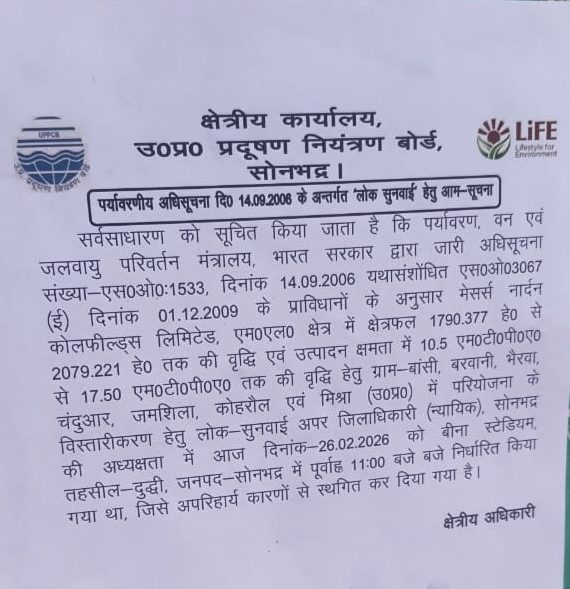
On February 25, the villagers were suddenly notified that the public hearing had been postponed. A notice was posted in the village informing them of the change. However, according to the villagers, the notice was not signed by any official.

The notice of postponement was marked up to ‘regional officer’ of the UPPCL but it was not signed. The reason for this was simply said to be “unavoidable”.

It was not stated why the hearing had been postponed, nor was any official clarification provided. The villagers have claimed that such lack of information raises questions about the transparency of the entire process.

Translated by Naushin Rehman. This article, originally published on The Wire Hindi, can be read here

Also Read: Food, Faith and Fascism in New Indiahttps://www.vibesofindia.com/food-faith-and-fascism-in-new-india/