


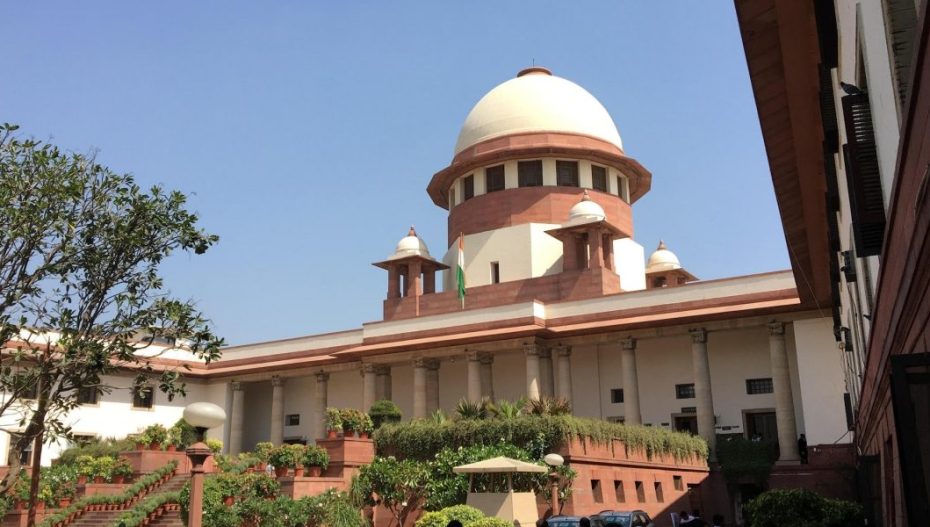
The Supreme Court has ruled that Aadhaar cannot be accepted as proof of age, specifying that other official documents, such as School Leaving Certificates, should be used instead. The decision, issued on Thursday, has sparked questions around Aadhaar’s intended purpose as a “universal identity infrastructure,” as promoted by the Unique Identification Authority of India (UIDAI).
The ruling came as part of a case regarding compensation following a motor accident. A Supreme Court bench, led by Justices Sanjay Karol and Ujjal Bhuyan, was reviewing a claim brought by the family of Sika Ram, a man who tragically lost his life in a motorcycle accident. The Motor Accident Claims Tribunal in Rohtak, Haryana, had previously awarded the family compensation of Rs 19,35,400, based on Sika Ram’s income, age, and number of dependants.
However, the Punjab and Haryana High Court later reduced the compensation to Rs 9,22,336, accepting an Aadhaar-recorded age of 47 for Sika Ram, which lowered the age multiplier used to calculate compensation. His family appealed, arguing that his age was actually 45 according to his School Leaving Certificate, which would allow for a higher multiplier. The Supreme Court agreed with the family’s claim, stating that Aadhaar was not intended for age verification.
The ruling referenced Section 94 of the Juvenile Justice (Care and Protection of Children) Act, 2015, which names the matriculation certificate from the relevant examination board as the preferred document for verifying age. The court also highlighted a 2018 Supreme Court judgement describing Aadhaar as primarily “proof of identity,” citing a UIDAI circular clarifying that Aadhaar is not a valid date-of-birth document. Upholding the use of the higher age multiplier, the court awarded the family ₹15 lakh in compensation.
Aadhaar was initially conceived by the UPA government as a means to provide unique IDs for below-poverty-line families accessing government benefits. Following the BJP’s rise to power in 2016, Aadhaar’s mandate expanded, and the Aadhaar Bill was introduced as a money bill, permitting it to bypass the Rajya Sabha. In 2018, the Supreme Court ruled that Aadhaar could not be compulsory for bank accounts, SIM cards, or education enrolments. However, it upheld Aadhaar’s mandatory linkage with PAN cards for income tax filing and approved its use in verifying beneficiaries for government schemes.
Aadhaar verification is now crucial for various government services and has even been adopted by private companies for identity verification. As of January 2024, Aadhaar is mandatory for rural workers seeking jobs under the Mahatma Gandhi National Rural Employment Guarantee Scheme.
The Supreme Court’s recent ruling reinforces that Aadhaar, while pivotal for identity verification, is not a catch-all solution for documentation, particularly in verifying an individual’s age, which remains the domain of educational and other official certificates.
Also Read: Stroke Cases Rising Among Younger Population, Warns Gujarat’s Medical Community