

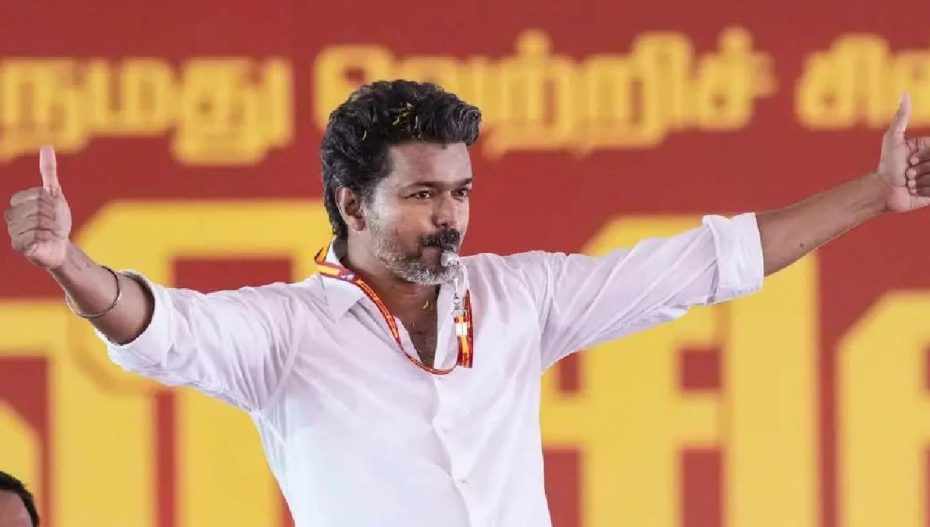
Tamil Nadu is witnessing one of the most dramatic political transitions in its post-Independence history, with actor-turned-politician Vijay emerging as the central figure in an intense and fast-moving battle for government formation. His Tamilaga Vettri Kazhagam stunned the state by winning 108 seats in its electoral debut, ending the decades-long dominance of the DMK-AIADMK binary and transforming the state into a fluid coalition arena.
But the numbers are still incomplete. With the majority mark fixed at 118 in the 234-member Assembly, TVK remains 10 seats short, forcing Vijay into complex negotiations with nearly every significant non-BJP political formation in the state. What has now emerged is not merely coalition-building, but a full-scale restructuring of Tamil Nadu’s political equations.
The first major breakthrough came from the Indian National Congress. The Congress leadership publicly extended support to Vijay, adding five MLAs to the TVK camp. However, the support came with an important ideological caveat: Congress insisted that no “communal forces” should be accommodated within the alliance framework — an unmistakable signal directed at the BJP and NDA ecosystem. Congress leaders have also reportedly sought representation in the new government, including two cabinet berths, while simultaneously projecting the alliance as a long-term secular partnership extending beyond this election cycle.
For the Congress, the move is both strategic and survival-oriented. After the collapse of the Dravida Munnetra Kazhagam alliance’s electoral dominance, the party appears keen to remain politically relevant by aligning early with the state’s new power centre rather than being trapped in a weakened opposition bloc.
Vijay’s outreach has also extended to Left parties, including the Communist Party of India and the Communist Party of India (Marxist). Both parties are internally divided. Sections of the leadership reportedly view Vijay as politically inexperienced and ideologically undefined, while others see supporting TVK as the only viable way to prevent the BJP from gaining indirect influence in Tamil Nadu politics. If the CPI and CPM formally back TVK, Vijay’s coalition would likely cross the majority mark comfortably.
Another critical player is the Viduthalai Chiruthaigal Katchi led by Thol. Thirumavalavan. The VCK’s support is being closely watched because of its influence among Dalit voters and its ideological emphasis on social justice politics. While the party has historically aligned with the DMK-led secular front, there is growing speculation that the changing political landscape may force a tactical recalibration. Sources suggest VCK leaders are weighing whether remaining tied to a weakened DMK could marginalise them in the new power structure emerging around Vijay.
Meanwhile, the most politically explosive development has been TVK’s reported backchannel engagement with the All India Anna Dravida Munnetra Kazhagam. Senior TVK functionaries are believed to have met AIADMK chief Edappadi K. Palaniswami in Chennai. Though neither side has officially acknowledged formal negotiations, the meeting has triggered speculation about whether AIADMK may eventually offer outside support or adopt a neutral position during a confidence vote.
Such an arrangement would dramatically reshape Tamil Nadu politics. AIADMK’s current association with the BJP-led NDA makes any understanding with Vijay highly sensitive, especially given Congress’s conditions. However, some observers believe sections within AIADMK may see Vijay as a future anti-DMK pole around whom a broader non-Stalin political coalition could eventually consolidate.
The BJP itself occupies an unusual position in this new landscape. Despite aggressive campaigning and attempts to expand in Tamil Nadu, the party remains peripheral in the immediate government formation arithmetic. Yet it continues to hover in the background as a factor influencing negotiations. Congress and Left parties are using anti-BJP positioning as a key condition for supporting TVK, while AIADMK’s NDA ties complicate any overt alignment with Vijay.
For Vijay, this balancing act is becoming his first major political test. During the campaign, he carefully avoided being boxed into rigid ideological labels, instead positioning TVK as a governance-first movement focused on youth, corruption-free administration and welfare politics. That ambiguity helped him attract support across caste and class lines during the election. But coalition negotiations now require ideological clarity, especially when dealing simultaneously with Congress, Left parties, VCK and channels linked to AIADMK.
The outgoing Chief Minister M. K. Stalin has meanwhile adopted a surprisingly restrained posture. In remarks widely interpreted as an acknowledgment of public anger against the DMK government, Stalin said his party would not attempt to destabilise a Vijay-led administration for six months if it comes to power. Even while criticising the practicality of TVK’s welfare promises — particularly the proposed ₹2,500 monthly assistance for women — Stalin avoided direct personal attacks on Vijay.
Political analysts believe the DMK is now entering a period of strategic recalibration after suffering one of the worst setbacks in its recent history. The party’s internal focus is likely shifting from immediate confrontation to long-term survival in a political environment no longer defined solely by Dravidian binaries.
At the heart of this upheaval lies a deeper transformation. Tamil Nadu’s voters appear to have broken from old certainties. Vijay’s rise is not just about celebrity politics; it reflects growing impatience with entrenched political structures, dynastic leadership models and familiar coalition arithmetic. The election has effectively created a post-duopoly phase in Tamil Nadu politics — and every major party is now scrambling to redefine its place within it.
All eyes are now on Rajendra Vishwanath Arlekar and the rapidly evolving negotiations in Chennai. Whether Vijay succeeds in stitching together the numbers or not, Tamil Nadu politics has already crossed a historic threshold.
Also Read: Bengal Crimes! BJP Leader Suvendu Adhikari’s PA Shot Dead, Political Tension Rises In WB https://www.vibesofindia.com/bjp-leader-suvendu-adhikaris-pa-shot-dead-political-tension-rises-in-wb/