

On June 12, 2025, an Air India flight from Ahmedabad to London Gatwick crashed just minutes after take-off, killing 241 of the 242 people on board and several people on the ground. For one family in Banaskantha, Gujarat, life stopped that day. They lost their son Kamlesh and his newly married wife Dhapuben. But out of this unimaginable tragedy came an unexpected bond—one that proves humanity can cross borders, languages, and religions.
A phone call every single day
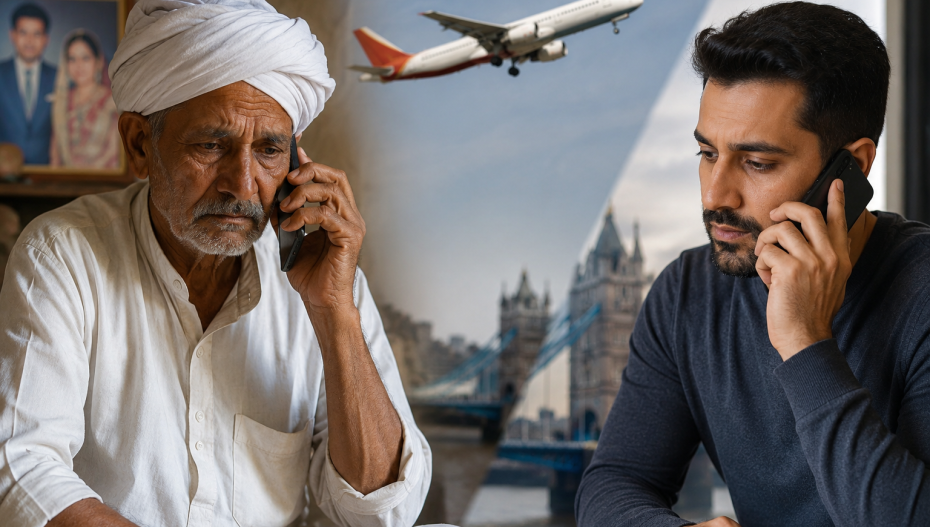
Every afternoon, around 3 pm, Savdhanbhai Chaudhary, a farmer from Thavar village in Banaskantha, waits for his phone to ring. On the other end is Omar Ali, a Pakistani man living in London. The conversation always begins with the same simple words, “Kaise ho aap? Theek ho?” (How are you? Are you okay?)
For the past year, Omar has not missed a day. Sometimes they talk for a few minutes, sometimes only exchange a voice message, but they connect every day.
They were not even close friends
Ironically, Omar and Kamlesh were not best friends. They worked together at a fancy goods store in London. Omar was the senior sales manager, while Kamlesh worked in another section of the shop. When Omar heard that Kamlesh and his wife had died in the crash, he broke down. He recalled crying loudly as his colleagues rushed to comfort him.
Their employer, known as “Tannibhai,” asked Omar to contact Kamlesh’s family in Gujarat. After getting Savdhanbhai’s number, Omar finally reached him a few days later. The first words he heard from the grieving father were, “Mera beta chala gaya” (My son is gone.)
Omar did not know what to say. He simply replied that Kamlesh was not only their son but also like a brother to them, and promised he would call again. He kept that promise and has continued calling every day for an entire year.
A relationship beyond borders
Omar says he lost his own father, brother, and later his mother within a short period between 2022 and 2023. Perhaps because of those losses, he felt deeply connected to Savdhanbhai. He says this relationship feels like something God created, with Kamlesh becoming the reason they met. According to Omar, speaking to the family gives him peace, while reassuring them gives him comfort too.
Language never became a barrier
In the beginning, Savdhanbhai struggled to speak Hindi and would often switch to Gujarati, Omar patiently listened. The two men discovered that grief does not need perfect language. They simply needed someone to listen.
Over time, their conversations became ordinary, about food, health, weather, and everyday life. Sometimes Omar asks about vegetables Savdhanbhai has eaten for lunch. Sometimes they discuss small health problems. These simple conversations have become part of their daily routine.
Memories that still hurt
The family had gone to Ahmedabad airport to see Kamlesh and Dhapuben off. Savdhanbhai says he rarely records videos, but that day he filmed them because it was his daughter-in-law’s first flight. Months later, the family travelled back to Ahmedabad to collect belongings recovered from the crash site at Air India’s Family Returns Centre.
More than a news story
Savdhanbhai says his life ended the day he lost his son and daughter-in-law. Yet every afternoon, one phone call reminds him that kindness still exists. One man in a village in Gujarat and another man in London, separated by countries, religion, and language, have become family through shared grief.
Sometimes, healing does not come from grand gestures. It begins with a simple question: “Kaise ho aap?”
Also Read: A Promise Kept Beyond Death: How Ahmedabad Plane Crash Victim Changed His Family’s Fate https://www.vibesofindia.com/a-promise-kept-beyond-death-how-ahmedabad-plane-crash-victim-changed-his-familys-fate/