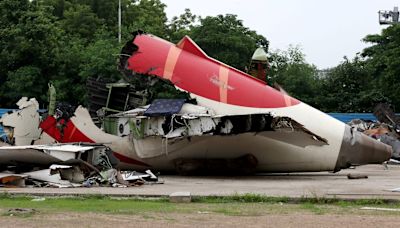
American aerospace giant GE Aerospace has submitted its long-awaited engine analysis reports to Indian investigators probing the crash of Air India Flight AI-171, a Boeing 787 Dreamliner that crashed in Ahmedabad on June 12, killing 260 people.
The engine reports were among the final critical pieces of evidence awaited by the Aircraft Accident Investigation Bureau (AAIB) as it prepares its final report on one of India’s deadliest aviation disasters in recent years. According to sources familiar with the investigation, all major inputs required for the final analysis have now been received.
“The engines were sent to the United States for analysis by GE, and their reports are now in. All awaited inputs have been received. The AAIB will now analyze all factors, establish the sequence of events, and the final report should be ready in about two months,” a person aware of the investigation said.
Final Report Under Global Scrutiny
With the submission of the engine analysis, attention now shifts to the AAIB’s final conclusions. Aviation experts say the report will be closely scrutinized not only in India but across the world, as its findings could have implications for airlines, aircraft manufacturers, regulators, and even legal proceedings in multiple countries.
The investigation’s primary challenge is identifying exactly what caused the aircraft to lose power and crash. While investigators have established certain facts, significant questions remain unanswered.
Engines Stopped Due to Fuel Supply Cut
According to experts involved in aviation accident investigations, current evidence suggests that both engines stopped functioning after they were deprived of fuel.
“What we know is that the engines had stopped owing to fuel supply cut. What we don’t know is why this happened. Air accident investigations have to eliminate all possibilities and identify exactly what occurred. The final report should not resort to indirectly blaming someone or something if the precise cause is not established,” said an aviation expert with decades of experience investigating air crashes.
Investigators are therefore focusing not only on what happened but also on the chain of events that led to the fuel interruption.
Controversy Over Preliminary Report
Expectations surrounding the final report are influenced by the controversy generated by AAIB’s preliminary findings released in July.
One of the most debated observations in the preliminary report came from cockpit voice recorder data. According to the report, one pilot was heard asking the other why he had cut off the fuel supply. The second pilot reportedly responded that he had not done so.
The statement triggered widespread debate within the aviation community, with many questioning whether the preliminary findings unfairly hinted at pilot error before all evidence had been fully analyzed.
As a result, investigators now face pressure to ensure that the final report is supported by strong technical evidence and provides a clear explanation of events.
Engine Analysis May Clear the Engines
Senior investigators familiar with the probe reportedly believe the GE engine analysis is likely to conclude that there was nothing mechanically wrong with the engines themselves.
According to officials, the engines appear to have stopped because they were starved of fuel rather than because of any internal defect or failure. However, the reason why fuel stopped reaching the engines remains unknown.
This distinction is considered crucial because it could shift the focus of the investigation toward operational, system-related, procedural, or other factors rather than an engine malfunction.
Investigators Warn Against Rushing to Conclusions
Some aviation experts have cautioned against assigning blame prematurely, particularly to individuals who are no longer alive to explain their actions.
“It would be easy to blame a deceased pilot who cannot defend himself. The AAIB must have very strong technical grounds for any conclusions it reaches in the final report. Whether investigators possess the technical capability to conduct a probe of this scale will become clear soon,” another experienced investigator said.
The comments reflect concerns within sections of the aviation industry that the final report must be based entirely on verifiable evidence rather than assumptions.
Key Finding From Preliminary Investigation
The preliminary AAIB report had revealed a critical sequence of events shortly before the aircraft lost altitude.
According to the report, the fuel cutoff switches for Engine 1 and Engine 2 moved from the RUN position to the CUTOFF position one after another, with a gap of approximately one second.
This action effectively stopped fuel flow to both engines, causing a rapid loss of thrust and leading the aircraft to lose altitude quickly.
Investigators are now attempting to determine the reason behind the movement of these switches and whether the event resulted from human action, a system malfunction, or another factor.
Two Months Until Answers
With GE Aerospace’s technical analysis now submitted and all major evidence reportedly in the hands of investigators, the AAIB is expected to spend the coming weeks reconstructing the sequence of events and examining every possible cause.
The final report, expected within the next two months, is anticipated to provide the most comprehensive explanation yet of the Ahmedabad AI-171 tragedy, including why fuel supply to both engines was interrupted and whether any mechanical, operational, or human factors contributed to the crash that claimed 260 lives.
Also Read: Ram Temple Trust Ignored Audit Red Flags For 6 Years, Now Faces Donation Misappropriation Storm https://www.vibesofindia.com/ram-temple-trust-audit-warnings-donation-misappropriation-allegations/