


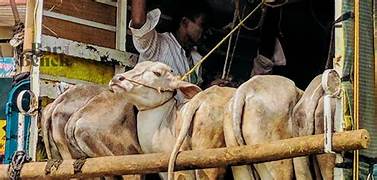
“Cows would go extinct if those responsible are not punished in accordance with the law.” This was the observation made by a court in Gujarat’s Gandhinagar district while sentencing three men to rigorous life imprisonment in a cow slaughter case.
Gujarat being the first state in India to make cow slaughter a crime punishable with life imprisonment, the court delivered its verdict on Monday, referring to Hindu religious scriptures, particularly the Manusmriti.
In the 76-page judgment, Additional Sessions Judge B.R. Rajput, citing the Manusmriti, said that the scripture describes cows and cattle not merely as animals but as pillars of religion.
He also mentioned that the scripture describes the protection of cows as a primary duty of the Vaishya class. The court also referred to the importance of cows and bulls in the traditional form of marriage known as Arsha Vivah.
Apart from this, the court also cited the Vedas and Rigveda while delivering the verdict.
The court observed that failing to take strict action against those involved in cow slaughter could put the survival of cows at risk. The judgment also underlined the need to enforce the law against those found guilty of the offence.
The case dates back to August 22, 2024, when an alleged incident of cow slaughter was reported from Jamla village in Gandhinagar district. According to the prosecution, the accused had slaughtered cows for money.
During the investigation, police recovered around 277 kg of meat along with other materials connected to the slaughter. The evidence collected during the investigation subsequently became part of the prosecution’s case against the accused.
The three men convicted in the case have been identified as 34-year-old Vasim, 28-year-old Mohammad Rafiq and 19-year-old Asfak alias Salman. All three are residents of Ahmedabad.
The court sentenced each of them to rigorous life imprisonment under Section 8(2) of the Gujarat Animal Preservation Act and imposed a fine of Rs 2 lakh. Apart from that, they were also sentenced to 10 years of rigorous imprisonment under Section 8(4), along with an additional fine of Rs 1 lakh each.
Both prison sentences will run concurrently, meaning the 10-year sentence will run alongside the life imprisonment rather than being added after it. Each convict will therefore have to pay a total fine of Rs 3 lakh.
The court also rejected the defence’s request to grant the accused probation, maintaining that the nature of the offence did not warrant such relief.
During the trial, the defence questioned several aspects of the investigation, including the handling of meat samples, the forensic examination process and discrepancies concerning the quantity of meat recovered by police.
However, the court did not accept these arguments as sufficient grounds to discredit the prosecution’s case.
The judgment also referred to the evidence presented during the proceedings before arriving at the decision to convict the three men.
Alongside the three convicts, two other accused were acquitted because the prosecution could not establish sufficient evidence against them, while another accused died during the trial.
Gujarat has some of the country’s strictest laws concerning cow slaughter and the possession and transportation of beef.
The Gujarat Animal Preservation Act, 1954, was amended in 2011 to introduce a complete ban on cow slaughter in the state. The legislation was further strengthened in 2017, when the state government introduced tougher punishments, including life imprisonment for cow slaughter.
Under the strengthened provisions, cow slaughter can attract life imprisonment. Meanwhile, the possession, sale, storage and transportation of beef can invite imprisonment ranging from seven to 10 years, along with fines between Rs 1 lakh and Rs 5 lakh.
These provisions are aimed at preventing cow slaughter and regulating activities involving beef within the state.
Gujarat Deputy Chief Minister Harsh Sanghavi welcomed the court’s decision, describing it as a strong message against cow slaughter.
The verdict comes amid the state’s continued enforcement of its stringent animal preservation legislation, under which those convicted of cow slaughter can face some of the harshest criminal penalties prescribed under state law.
Also Read: Garba Is Gujarat’s Pride, Let It Be A Source Of Dignity, Not Humiliation