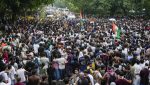
A protest march organised by the Cockroach Janata Party (CJP) in Delhi turned chaotic on Monday after thousands of demonstrators attempted to march towards Parliament, leading to clashes with police and security personnel. Protesters reportedly breached barricades, prompting police to use lathi-charge and tear gas shells to disperse the crowd and restore order.
The march was organised to demand the resignation of Union Education Minister Dharmendra Pradhan over issues related to the education system. What began as a large demonstration at Jantar Mantar soon escalated into one of the biggest protest-related confrontations in the capital in recent months.
Protest March Escalates Into Violence
Thousands of protesters had gathered at Jantar Mantar overnight ahead of the Parliament march. As the crowd grew by late morning, many demonstrators moved towards Parliament despite heavy police barricading.
According to police, protesters broke through security barricades and tried to continue their march, forcing security personnel to intervene. Lathi-charge and tear gas shells were used to push back the crowd as the situation turned tense.
The Cockroach Janata Party, however, alleged that police used excessive force against peaceful protesters. Police, on the other hand, claimed that the demonstrators turned violent after breaching barricades, leaving officers with no option but to use force to control the situation.
Several Injured During Clashes
The confrontation left both protesters and police personnel injured. According to Delhi Police, 118 police personnel and 60 protesters suffered injuries during the clashes.
Police also said an FIR is being registered against those involved on charges including rioting, assault on public servants and damage to public property.
The violence also disrupted traffic across central Delhi, with roads around Jantar Mantar and nearby areas witnessing heavy congestion as crowds spilled onto adjoining streets.
By late evening, following discussions with the government, CJP leaders appealed to protesters to return to Jantar Mantar, where the protest stage had already been dismantled earlier in the day.
Protests Spread to Gujarat
The demonstrations were not limited to Delhi. Supporters gathered in several cities, including Ahmedabad, Surat, Junagadh and Bhavnagar, to express solidarity with activist Sonam Wangchuk and raise concerns over the education system.
In Ahmedabad, around 150 protesters were briefly detained after assembling without permission and marching from MJ Library towards Nehru Bridge crossroads.
The demonstrators included students, parents, children and senior citizens. Many carried handwritten placards and banners demanding education reforms, accountability and action over repeated paper leaks.
Several protesters also raised slogans against the Union government and Education Minister Dharmendra Pradhan while expressing support for Wangchuk’s ongoing fast. Police later released all those detained.
Similar demonstrations were also reported from Surat, Junagadh and Bhavnagar.
Delhi High Court Seeks Wangchuk’s Medical Reports
Even as protests continued, the Delhi High Court focused on the health of activist Sonam Wangchuk, who remains on a fast.
A bench headed by Chief Justice D.K. Upadhyaya and Justice Tejas Karia directed AIIMS and Safdarjung Hospital to submit Wangchuk’s pathological reports and daily health bulletins.
The court observed that its immediate concern was to ensure Wangchuk’s health and said it would first examine his medical reports before deciding on a plea seeking his transfer to a private hospital.
The judges also asked the AIIMS Director in-charge, the emergency doctor treating Wangchuk and the doctor who had earlier treated him to remain present before the court.
The bench said it wanted to review blood and urine test reports before taking any decision on his treatment.
Wife Challenges Hospitalisation
Wangchuk’s wife, Gitanjali Angmo, challenged an earlier court order that refused to interfere with his treatment at Safdarjung Hospital.
She argued that her husband had effectively been confined to the government hospital without being formally arrested and that neither she nor Wangchuk had any say in deciding his treatment.
The Centre defended its decision, with Solicitor General Tushar Mehta telling the court that Wangchuk’s condition could have wider public implications because he was leading a public protest.
He argued that the government could not treat the case like that of an ordinary individual refusing medical treatment at home, as any deterioration in Wangchuk’s health during a public protest could have broader consequences.
Protest Ends, But Questions Remain
Although the protest was eventually called off and demonstrators returned to Jantar Mantar, Monday’s events highlighted the growing tension surrounding the movement.
With clashes leaving dozens injured, legal action initiated by police, and the Delhi High Court closely monitoring Sonam Wangchuk’s health, both the protests and the legal proceedings are expected to remain in focus in the coming days.
Also Read: 18 Police Firings In 15 Months: Gujarat Sees Sharp Increase In Police Shootings https://www.vibesofindia.com/gujarat-police-firing-cases-rise-18-incidents-in-15-months/