


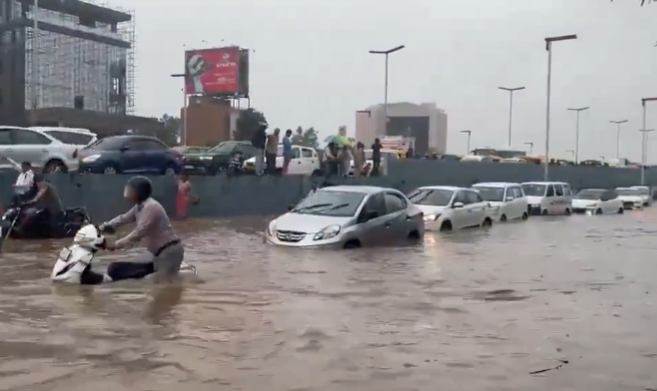
Ahmedabad witnessed one of the most intense rain events in its recorded history as relentless showers battered the city, leaving roads submerged, residential areas flooded and normal life severely disrupted. According to the India Meteorological Department (IMD), the city received 294.6 mm of rainfall in just 24 hours, making it the fourth-highest single-day rainfall recorded in nearly 100 years.
The unprecedented downpour caused widespread waterlogging, traffic chaos and emergency rescue operations, while authorities warned that more heavy rainfall is expected over the coming days.
Fourth-Highest Rainfall Ever Recorded in Ahmedabad
The IMD confirmed that the rainfall recorded on July 24 has entered Ahmedabad’s history books. The city received 294.6 mm of rain, surpassing the 288.1 mm rainfall recorded during the devastating floods of July 2014.
The rainfall recorded on July 24, 2026, has become one of the most significant weather events in Ahmedabad’s history. According to the India Meteorological Department (IMD), the city received 294.6 mm of rainfall in 24 hours, making it the fourth-highest single-day rainfall recorded in nearly a century.
Only three rainfall events have surpassed this mark—414.8 mm on July 27, 1927, 325.9 mm on July 14, 2000, and 322.3 mm on July 29, 1967. The latest downpour also exceeded the 288.1 mm rainfall recorded during the devastating floods of July 30, 2014, pushing that event to fifth place in the city’s rainfall records. The unprecedented rainfall once again exposed Ahmedabad’s vulnerability to extreme weather, with large parts of the city experiencing severe flooding, waterlogging and disruption to normal life.
Flooded Roads Bring Ahmedabad to a Halt
The heavy rain quickly overwhelmed Ahmedabad’s drainage system. Major roads turned into streams, underpasses were submerged and several neighbourhoods remained under water for hours.
The flooding led to severe traffic congestion across the city as vehicles struggled to move through waterlogged roads. Many residents found themselves stranded, while several low-lying residential and commercial areas were inundated.
Emergency teams, including the Army, were deployed in some of the worst-hit locations to rescue people trapped in industrial estates and residential societies. More than 200 people were reportedly rescued from flooded industrial parks and bungalow areas.
Why Did the City Flood So Quickly?
Meteorologists explained that flooding occurs when rainfall falls faster than the city’s drainage system can carry away the water.
According to IMD Gujarat Director Ashok Kumar Das, several weather systems came together to produce the exceptionally heavy rainfall. An existing shear zone, a cyclonic circulation over Gujarat, and a moisture-rich trough combined to create conditions for extremely heavy rain over Ahmedabad and several other parts of the state.
Experts also pointed out that the extent of flooding depends not only on rainfall intensity but also on factors such as stormwater drainage capacity, drainage infrastructure, open spaces that absorb rainwater, percolation wells and rainwater harvesting systems.
Some Parts of Ahmedabad Received More Than 500 mm Rain
Rainfall was not uniform across the city. Several localities received much heavier rain than the city average.
The highest rainfall was recorded in Bopal, which received 504.3 mm. Other heavily affected areas included:
Sarkhej – 469.5 mm
Jodhpur – 447 mm
Thaltej – 439 mm
Bodakdev – 439 mm
Science City – 425 mm
Maktampura – 419 mm
Danapith – 391 mm
Gota – 368 mm
Navrangpura – 364 mm
Chandlodiya – 345 mm
Motera – 345 mm
Maninagar – 316 mm
Naroda – 296 mm
Chandkheda – 292 mm
The extremely high rainfall in western parts of the city was one of the major reasons for widespread flooding.
Gujarat’s Rainfall Deficit Wiped Out in Just Three Days
The recent spell of heavy rain has dramatically changed Gujarat’s monsoon picture.
Only a few days ago, on July 21, the state was facing a 31% seasonal rainfall deficit. However, continuous heavy rainfall over the last three days has completely erased that shortfall.
Out of the 304 mm of rainfall Gujarat has received this monsoon so far, nearly 130 mm fell during these three days alone, showing just how intense the rainfall has been.
South Gujarat Sees Exceptionally Heavy Monsoon
Data from the State Emergency Operations Centre (SEOC) shows that seven talukas in South Gujarat have already received their entire average seasonal rainfall, even though the monsoon season is still underway.
The data also revealed that 27 talukas have crossed the 1,000 mm rainfall mark this season. At the same time last year, only 20 talukas had crossed that level despite Gujarat experiencing above-normal rainfall from the beginning of the monsoon.
Experts say this indicates that rainfall this year has been highly uneven, with some regions receiving extremely intense spells while others have seen comparatively less rain.
More Heavy Rain Likely
The IMD has warned that the wet spell is far from over. Heavy to very heavy rainfall is likely over the next three days across Central Gujarat, South Gujarat and parts of Saurashtra.
Authorities have advised residents to remain alert, avoid waterlogged roads whenever possible and follow official weather updates as more rain is expected.
A Historic Rainfall Event
The July 24 downpour will be remembered as one of Ahmedabad’s most significant rainfall events in the last century. While the rain has helped Gujarat overcome its seasonal rainfall deficit, it has also exposed the challenges posed by extreme weather, especially in urban areas where drainage systems struggle to cope with sudden cloudbursts.
With more rain forecast, disaster response teams and civic authorities remain on high alert as the state continues to deal with one of its most intense monsoon spells in recent years.
Also Read: Gujarat Under Water: 1,300 mm Of Rain In Just 48 Hours, 38,000+ Evacuated https://www.vibesofindia.com/gujarat-floods-record-rainfall-umbergaon-mass-evacuations-red-alert/