


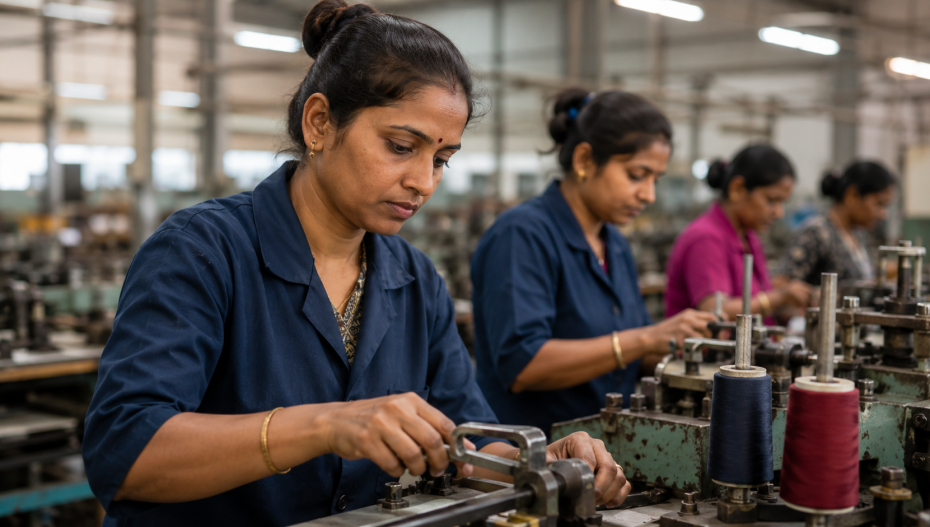
Gujarat’s women-owned manufacturing micro, small and medium enterprises (MSMEs) are showing a mixed picture. New registrations surged to an unusual high in 2023-24, but have fallen sharply in the two years since. At the same time, the number of women-owned manufacturing MSMEs reported as closed on the Udyam Registration Portal has steadily increased.
The latest figures show that registrations fell from a peak of 1,02,694 in 2023-24 to 49,955 in 2025-26, a decline of 51.4%. During the same five-year period, portal-reported closures increased from 38 to 287, making the latest figure more than 7.5 times the level recorded in 2021-22.
However, the data does not establish that the businesses reported as closed were the same enterprises registered during the corresponding years. Therefore, the figures cannot be used to calculate a conventional business failure rate.
Registrations Surge, Then Fall Sharply
The five-year registration figures show a dramatic rise followed by a significant slowdown. Gujarat recorded:
22,892 registrations in 2021-22
27,183 registrations in 2022-23
1,02,694 registrations in 2023-24
60,857 registrations in 2024-25
49,955 registrations in 2025-26
The biggest jump came in 2023-24, when registrations rose to 1,02,694, far above the previous year’s 27,183. But that growth was not sustained.
Registrations dropped by 40.7% in 2024-25, followed by another 17.9% decline in 2025-26. Compared with the five-year peak, the latest figure is down by 51.4%.
Across the five years, Gujarat recorded a total of 2,63,581 women-owned manufacturing MSME registrations.
Closures Move in the Opposite Direction
While new registrations declined after 2023-24, the number of enterprises shown as closed on the Udyam portal continued to rise. The reported closure figures were:
38 in 2021-22
56 in 2022-23
160 in 2023-24
207 in 2024-25
287 in 2025-26
The latest figure of 287 is the highest in the five-year series and is more than seven and a half times the 2021-22 figure. In total, the portal recorded 748 closures over the five years.
But these numbers need to be read carefully. The government data does not link the 287 enterprises reported closed in 2025-26 to the businesses registered during that same year. They are annual portal counts, not a tracking of one group of businesses from registration to closure.
Therefore, it would be incorrect to simply subtract closures from registrations or describe the difference as the number of businesses that survived.
Credit Support Has Expanded Sharply
The picture becomes more complicated when financing support is considered.
Under the Credit Guarantee Scheme implemented through CGTMSE, the number of guarantees approved for women-led micro and small enterprises (MSEs) in Gujarat increased substantially.
Guarantees rose from 3,977 in 2021-22 to 18,155 in 2025-26 — an increase of nearly 4.6 times.
The value of these guarantees grew even faster, from ₹531 crore in 2021-22 to ₹5,512 crore in 2025-26, which is more than a tenfold increase.
Gujarat also continued to account for a significant share of the national credit guarantee support. In 2025-26, the state accounted for 18,155 of the 5,75,651 guarantees approved nationally.
In terms of value, Gujarat’s guarantees represented around 7.5% of the national ₹73,565 crore approved for women-led MSEs that year.
More Credit Support, But Fewer New Manufacturing Registrations
These figures create an important contrast.
On one side, formal credit guarantee support for women-led enterprises has expanded significantly. On the other, new registrations of women-owned manufacturing MSMEs have fallen sharply after their 2023-24 peak.
However, the data alone does not prove that increased or decreased credit support caused the rise or fall in registrations.
Several factors could influence MSME registrations, including market conditions, costs, access to finance, demand, business formalisation and the decision of entrepreneurs to register their enterprises.
The figures therefore show a clear divergence between the two trends, but they do not explain the reason behind it.
PMEGP Support Also Declines
Another indicator points to a slowdown in government-supported women-led manufacturing activity.
Under the Prime Minister’s Employment Generation Programme (PMEGP), Gujarat assisted 2,512 women-led manufacturing micro enterprises in 2021-22.
By 2025-26, this number had fallen to 901 units, a decline of around 64%.
The estimated employment linked to these assisted units also declined significantly, from 20,096 in 2021-22 to 7,208 in 2025-26.
The amount of Margin Money subsidy provided under PMEGP also fell over the period. It stood at:
₹201.64 crore in 2021-22
₹214.78 crore in 2023-24
₹120.43 crore in 2025-26
Gujarat’s share of the national PMEGP subsidy also declined, from around 21% in 2021-22 to 16.9% in 2025-26.
Employment Figures Need to Be Read Carefully
The Udyam and Udyam Assist data also reports employment linked to women-owned manufacturing MSMEs in Gujarat. The reported figures were:
1,27,544 in 2021-22
1,46,983 in 2022-23
2,52,055 in 2023-24
1,92,673 in 2024-25
33,21,956 in 2025-26
The extraordinary jump in the final year’s figure needs particular caution.
The figure of 33.2 lakh should not be interpreted as 33.2 lakh new jobs created in Gujarat in 2025-26. The government table describes these as employment figures reported through Udyam and Udyam Assist.
Such annual figures may include employment reported by enterprises registered on the platforms and should not automatically be treated as newly created jobs.
For the same reason, adding all five annual figures together and claiming that more than 40 lakh jobs were created would give a misleading picture.
What the Numbers Really Show
Taken together, the five-year data presents a much more complicated picture than simply saying that women-owned MSMEs are either growing or shutting down.
Gujarat experienced an extraordinary surge in women-owned manufacturing MSME registrations in 2023-24, when the figure crossed one lakh. But registrations then dropped substantially in the following two years, reaching 49,955 in 2025-26.
At the same time, the number of enterprises reported as closed on the Udyam portal reached a five-year high of 287.
Meanwhile, formal credit guarantee support expanded dramatically, with both the number and value of guarantees increasing several times over the five-year period.
In contrast, the number of women-led manufacturing units assisted through PMEGP fell by about 64%, while PMEGP subsidy support also declined from its earlier levels.
A Slowdown, But No Simple Explanation
The most defensible reading of the data is that Gujarat’s women-owned manufacturing MSME sector experienced a sharp post-2023-24 slowdown in new registrations, while portal-reported closures reached their highest level in five years.
At the same time, women-led enterprises received substantially greater support through credit guarantees.
But the data does not establish why registrations fell, why closures increased, or whether the reported closures relate to the businesses registered during the same period. That distinction is important.
The numbers point to a sector undergoing significant changes, but they do not by themselves provide a complete picture of the health of women-owned businesses in Gujarat.
The bigger question now is whether the decline in new manufacturing registrations is a temporary slowdown or a sign of deeper challenges for women entrepreneurs — and whether expanded access to formal credit can translate into more sustainable businesses, higher investment and long-term employment opportunities.
Also Read: ‘Ugly Sister Cities’: Why The US Is Watching Gujarat, Pune & Chennai https://www.vibesofindia.com/us-white-house-report-pune-gujarat-chennai-china-transshipment/