


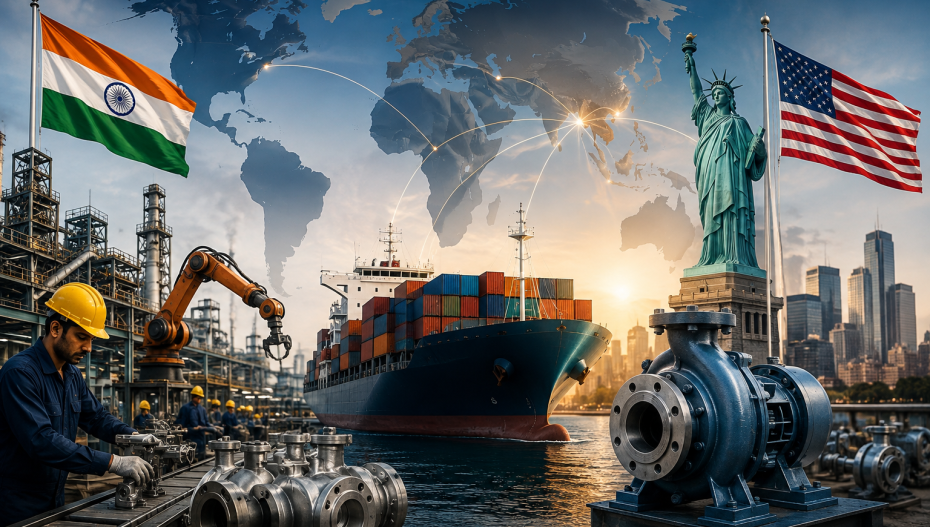
A new White House trade report has placed three major Indian manufacturing centres — Pune, Gujarat and Chennai — alongside Cincinnati, Dayton and Columbus in the United States. The unusual comparison is not about geography, culture or formal ties between the cities. It is about something much more industrial: pumps and compressors.
The White House describes such comparisons as “ugly sister cities”, using the term to highlight foreign manufacturing regions that produce goods similar to those made in American industrial centres.
The bigger issue behind the comparison is China’s role in global supply chains. Washington is examining whether Chinese goods are being sent through countries such as India before entering the US, potentially allowing them to avoid higher tariffs imposed on Chinese products.
For India, the report raises an important question: Is the country becoming a genuine alternative manufacturing base to China, or could some Chinese goods simply be passing through India before reaching the American market?
What Is the ‘Great Transshipment Scam’ Report?
The White House report examines what it describes as the growing movement of Chinese goods through third countries before they reach the US. The basic process is relatively simple.
A Chinese product may first be shipped to another country. There, it could undergo some processing, repackaging or paperwork changes before being exported to the United States.
The reason for doing this is largely related to tariffs.
A product imported directly from China can face a much higher US tariff than a similar product coming from another country. This creates an incentive for companies to move goods through countries where the tariff burden is lower.
Economists call this tariff arbitrage — taking advantage of differences in tariff rates between countries.
However, the report makes an important distinction. Not every company moving production out of China is necessarily trying to avoid tariffs.
Since the US began imposing higher tariffs on Chinese imports in 2018, many companies have genuinely shifted factories and diversified their supply chains.
The concern is about products that remain essentially Chinese-made but are given a different route — and potentially a different country of origin — before entering the US.
The ‘Shadow Transshipment Network’
The White House describes the broader movement of trade away from direct China-US routes as the “Great Reallocation.”
It also uses the term “Shadow Transshipment Network” for the network of countries through which China-linked goods may move before reaching the US.
India appears within this network, but that does not mean Washington has accused Indian exporters as a group of illegally avoiding tariffs.
India has been placed in Tier 1, alongside countries and regions including Canada, the European Union, Israel, Japan, Mexico, South Korea and Taiwan.
These countries are described as “Diversified Scale Leaders” because they have large manufacturing bases, strong trade links with China and significant exports to the US.
The report also says that the potential transshipment risk in these economies is embedded within broad legitimate trade flows.
In other words, India is on the list largely because of the size and complexity of its manufacturing and trade networks.
Why Is India Under the US Spotlight?
India has become an increasingly important manufacturing destination and is trying to attract companies looking to diversify production away from China.
At the same time, Indian manufacturers in several industries continue to depend on Chinese machinery, components and raw materials. That creates a complicated situation.
According to a US Commerce Department analysis cited in the report, around $67 billion worth of US-bound goods were estimated to have been transshipped from China through Mexico, India and Vietnam in 2025, using a specific product-matching methodology.
This figure does not mean that all of those goods were illegally routed through these countries. Rather, it is part of Washington’s analysis of potential transshipment patterns.
Why Pune, Gujarat and Chennai?
This is where the unusual city comparison comes into the picture.
The White House report identifies Pune, Gujarat and Chennai as Indian manufacturing regions associated with the production of pumps and compressors.
They are compared with Cincinnati, Dayton and Columbus, which are American manufacturing centres producing similar industrial goods.
The purpose is to show how manufacturing competition can work across borders.
The report is essentially asking what happens when an American company making pumps or compressors competes with a similar product coming from India — particularly if that Indian product contains Chinese inputs or, in the US government’s concern, is actually a Chinese product being routed through India.
Importantly, the report does not name a company in Pune, Gujarat or Chennai as having violated US tariff rules.
The comparison is about manufacturing regions and industrial competition, not an accusation against these cities or their companies.
Does a Chinese Component Make an Indian Product Chinese? No.
This is one of the most important distinctions in the entire issue.
An Indian manufacturer can legitimately import a motor, electronic component, steel part or other input from China, manufacture a finished product in India and then export that product to the US.
Using Chinese components does not automatically change the origin of the finished product. The real question is how much manufacturing actually happened in India.
For example, importing components and carrying out substantial manufacturing, assembly, finishing and testing in India is very different from importing an almost-finished Chinese product, changing its packaging and then exporting it as an Indian product.
The US report distinguishes between genuine manufacturing activities and activities such as warehousing, relabelling and re-invoicing.
That difference could become increasingly important as US customs authorities increase their scrutiny of imports.
How Big Does Washington Believe the Problem Is?
There is no single figure for the scale of suspected transshipment.
The White House report refers to different estimates ranging from $40 billion to $303 billion a year in potentially affected China-linked trade. Its central estimate is approximately $75 billion.
The administration also estimates that the practice could result in billions of dollars in lost tariff revenue for the US and that its central scenario could be associated with around 450,000 US jobs being displaced.
However, these figures should not be interpreted as confirmed cases of illegal shipments or actual verified job losses.
They are economic estimates based on different methodologies, intended to show the possible size of the problem.
US Plans to Use AI to Track Suspicious Trade
Washington also wants to make greater use of technology to identify potentially suspicious shipments.
The report outlines an AI-based system called “Detective Border.”
The proposed system would examine information such as:
Shipping routes
Product classifications
Company ownership
Production capacity
Trade patterns
The aim is to identify unusual movements and help customs officials distinguish between genuine manufacturing and goods that may simply be passing through another country. This could have a direct impact on Indian exporters.
A “Made in India” label alone may not answer every question if US customs officials want to know where the components came from, what work was actually carried out in India and whether the exporter has the production capacity to manufacture the quantity being shipped.
What Does This Mean for Indian Manufacturers?
The issue is particularly important for Indian companies hoping to benefit from the global shift away from China.
India wants to attract more factories and become a major alternative manufacturing base. But many industries still rely on Chinese components, equipment and raw materials.
That means exporters could face greater scrutiny in the US. Companies may need to maintain clearer records showing:
Where their components were sourced
What manufacturing was carried out in India
How much value was added in India
Whether their factories have the capacity to produce the exported quantities
How the final product qualifies as Indian-origin
The pressure could therefore be greater for companies whose supply chains are heavily dependent on China.
A Bigger Question for India’s Manufacturing Ambitions
The Pune-Gujarat-Chennai comparison is ultimately about more than pumps and compressors.
It highlights the larger challenge facing India’s manufacturing sector.
India wants to position itself as a reliable global manufacturing hub and attract businesses looking to reduce their dependence on China. But at the same time, the country must ensure that its trade routes and manufacturing systems are not used simply as a pathway for Chinese goods into markets such as the US.
For Indian exporters, the message from Washington is becoming clearer: having a product shipped from India may not be enough. Companies may increasingly have to demonstrate exactly where the product was made and how much manufacturing took place in India.
That makes the US report significant for India’s manufacturing ambitions. The question is no longer simply whether India can replace China as a manufacturing destination. It is also whether India can build supply chains that are transparent, genuinely value-adding and strong enough to withstand closer scrutiny from major export markets.
Also Read: From Taboo To National Award: The Gujarati Film That Challenged Eye Donation Myths https://www.vibesofindia.com/dhiru-mistry-saath-kuch-na-jayega-organ-donation-film/