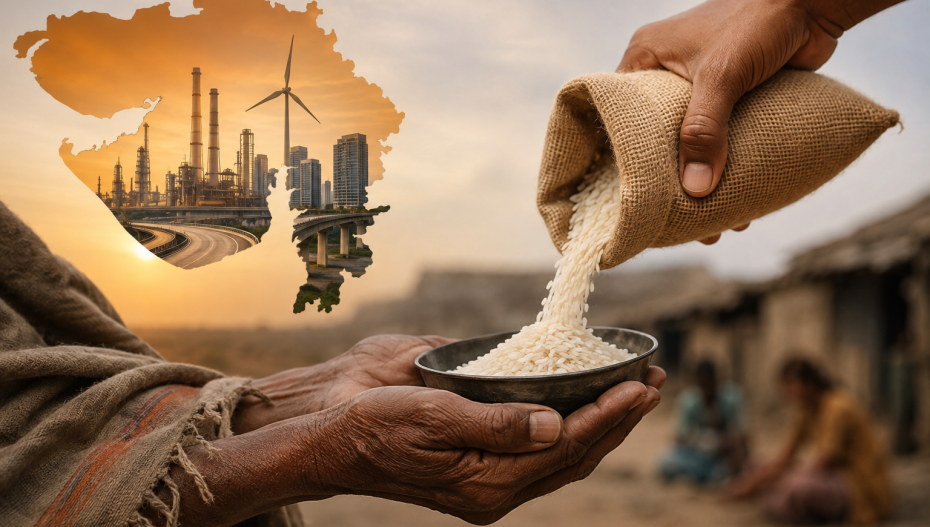
Gujarat is widely known for its industries, business growth, infrastructure and investment-driven economy. But recent parliamentary data on food security brings another side of the state’s economic story into focus.
According to the figures provided, 3,38,42,935 people in Gujarat are covered under the National Food Security Act (NFSA) and the Pradhan Mantri Garib Kalyan Anna Yojana (PMGKAY), which provide highly subsidised or free foodgrains to eligible beneficiaries.
When this figure is compared with the projected 2026 population of Gujarat of around 7.43 crore, it amounts to about 45.55 per cent of the state’s population — or nearly one in every two people.
The figures have raised questions about the reach of economic growth and whether prosperity in Gujarat is being shared equally across different sections of society.
Nearly 3.38 Crore People Covered Under Food Schemes
The data shows that 3.38 crore people in Gujarat are currently covered by NFSA and PMGKAY.
The National Food Security Act is designed to provide foodgrains to eligible sections of the population, while PMGKAY provides free foodgrains to beneficiaries covered under the food security system.
Based on the population figure provided, around 4.05 crore people would fall outside this coverage.
Gujarat’s beneficiaries account for around 4.28 per cent of the total beneficiaries covered nationally, according to the figures provided.
Key figures
According to the figures provided, Gujarat’s projected population in 2026 is around 7.43 crore, while 3,38,42,935 people are covered under NFSA and PMGKAY. This means approximately 45.55 per cent of the state’s population is covered by these food security schemes. Around 4.05 crore people fall outside the stated coverage. Gujarat’s beneficiaries also account for approximately 4.28 per cent of the total beneficiaries covered under these schemes across the country.
What Do These Numbers Actually Show?
The number of beneficiaries is significant, but it needs to be understood carefully.
Being covered under NFSA or PMGKAY does not automatically mean that every beneficiary is unemployed, extremely poor or completely dependent on government support. Food security coverage is based on eligibility rules, identification of households and prescribed coverage limits.
Therefore, the figure of 3.38 crore should not simply be interpreted as 3.38 crore people living in poverty.
However, the size of the beneficiary base does show how important public food support remains for a large section of Gujarat’s population.
It also raises a broader question about the difference between economic growth at the state level and the financial security experienced by individual households.
Gujarat’s Development Story Faces a Tough Question
Gujarat has long been presented as one of India’s leading economic and industrial states. The state has attracted major investments and is known for its manufacturing sector, business ecosystem, infrastructure projects, industrial corridors and rapidly growing cities.
But economic growth at the state level does not necessarily mean that every household experiences the same level of prosperity.
The food security figures highlight this gap.
While Gujarat continues to expand its industrial and urban economy, millions of residents remain eligible for government-supported foodgrains. This creates an important policy question: How can the benefits of economic growth reach a larger share of ordinary households and reduce economic vulnerability?
Congress Raises Questions Over Inclusive Growth
Congress spokesperson Dr Hiren Banker has questioned what the large beneficiary figure says about the state’s economic condition.
Banker argued that the fact that such a large share of the population is covered by food subsidy programmes could point to continuing problems such as low household incomes, unemployment, informal employment and economic uncertainty among sections of the population.
He also questioned the contrast between Gujarat’s image as a developed and economically strong state and the continued need for large-scale food support.
According to Banker, if economic growth reaches all sections of society equally, dependence on welfare support should gradually reduce.
His comments have added a political dimension to the debate over whether Gujarat’s economic growth has been sufficiently inclusive.
Free Foodgrains to Continue Until 2028
The food support is not expected to end in the near future.
The Union Government has extended free foodgrain distribution under PMGKAY for five years from January 1, 2024, until December 31, 2028. The programme has an estimated financial outlay of ₹11.80 lakh crore, which is being fully funded by the Centre.
This means eligible beneficiaries in Gujarat will continue receiving free foodgrains under the programme through 2028, unless there are changes or revisions to the beneficiary list.
For millions of families, the continuation provides an important layer of food security, particularly during periods of rising household expenses or unstable income.
Relief for Families, But Also a Development Challenge
Government food support can provide immediate relief to households and help ensure that people do not go without basic food.
At the same time, the scale and long-term continuation of such support raise a different question: Why do so many people continue to require government-backed food security in a state known for strong economic growth?
The answer is unlikely to be simple. Gujarat’s population includes people working in agriculture, construction, small businesses, informal employment, daily-wage work and other sectors where income can be uncertain. Economic growth can also be uneven, with some regions and communities benefiting more quickly than others.
Therefore, reducing dependence on welfare schemes would require more than simply ending food subsidies. It would involve creating stable jobs, improving wages, strengthening rural and informal livelihoods and ensuring that economic opportunities reach vulnerable households.
The Bigger Question for Gujarat
The latest figures do not, by themselves, prove that Gujarat’s development model has failed. Nor does food-scheme coverage mean that every beneficiary is poor or economically dependent.
But 3.38 crore beneficiaries is still a number that cannot be ignored.
For a state that aims to position itself as a global economic and industrial powerhouse, the challenge is to ensure that economic growth translates into better incomes, secure employment and greater financial stability for ordinary families.
The debate, therefore, is not simply about free foodgrains. It is about what development ultimately means for the people living in the state.
Gujarat’s economic story may be one of strong growth, but these food security figures show that the larger goal of ensuring broad-based and inclusive prosperity remains an important challenge.
Also Read: From Taboo To National Award: The Gujarati Film That Challenged Eye Donation Myths https://www.vibesofindia.com/dhiru-mistry-saath-kuch-na-jayega-organ-donation-film/