


By Dr Mahendra Kalyankar
Few public infrastructure projects in independent India match the scale and complexity of the Dharavi Redevelopment Project. Designed to improve the lives of more than 10 lakh people, it is as much a social transformation programme as it is an urban redevelopment initiative. While the scale of construction is unprecedented, the true measure of the project will be the lives it changes.
That is why redevelopment in Dharavi has always been about much more than new buildings. It is equally about livelihoods, education, health, public spaces and creating opportunities for future generations.
This approach is reflected in the Dharavi Social Mission, which has become an important part of the redevelopment effort. Thousands of residents have already enrolled in livelihood and skill development programmes designed to improve employability and create new income opportunities. Women are being supported through entrepreneurship and self-employment initiatives, while children and youth are benefitting from programmes focused on education, health, nutrition, life skills and personal safety. Employment partnerships, healthcare camps and outreach initiatives are also helping connect families with government welfare schemes and essential services. Together, these efforts are ensuring that redevelopment begins with people and that social progress keeps pace with physical development.
People-led initiative
Perhaps the strongest endorsement of the project is coming from the people of Dharavi themselves. Families are voluntarily signing agreements and peacefully handing over their homes so that construction can begin. They are moving out with the hope of returning to their new homes at the earliest. Hundreds have already shifted to transit accommodation, and many speak of the cleaner surroundings, better civic facilities and improved living conditions they are experiencing there. They now look forward to the day they receive the keys to their own permanent homes. Their confidence reflects a growing belief that redevelopment is no longer a distant promise, but a reality taking shape before their eyes.
The same confidence is reflected in the survey process. Communities that had earlier expressed reservations, including parts of Kumbharwada and Compound 13, are now cooperating with household surveys and home numbering. More than 91,000 families overall have completed the household survey and are now waiting for their rehabilitation homes.
Mixed-use neighbourhood
The shape of the future township is also beginning to emerge. Dharavi is being planned as a mixed-use, self-sustaining neighbourhood where homes, workplaces, shops, schools, hospitals, public transport, parks and community facilities exist together. The endeavour is to preserve Dharavi’s distinctive live-work culture while providing better housing, stronger civic infrastructure and a much better quality of life. Residents will soon be able to see this vision for themselves when the Dharavi Experience Centre opens with model homes and exhibits explaining the proposed township.
The aim is not simply to construct taller buildings. It is to create compact, well-planned mixed-use neighbourhoods where people can live, work and prosper without losing the community networks that have shaped Dharavi over decades. To achieve this, the rehabilitation buildings and township are being planned by internationally respected firms such as Sasaki, Buro Happold, Systra and Studio POD, bringing global expertise in planning, architecture, engineering and urban design. The emphasis is on creating neighbourhoods that are liveable, walkable and built to the highest standards of quality and sustainability.
Technology with a human touch
Technology is also helping shape the future of Dharavi in ways that place people at the centre of decision-making. The project is creating a comprehensive Digital Twin of Dharavi, a living digital replica of the township. It will help planners, engineers and government agencies visualise development, coordinate infrastructure, anticipate challenges and make better decisions as the project progresses. At the same time, Dharavi Didi, the project’s multilingual AI assistant, is helping residents receive verified information directly from the source in the language they are most comfortable with. Instead of relying on rumours or misinformation, Dharavikars can ask questions about surveys, eligibility, rehabilitation and other aspects of the project, and receive clear, empathetic and authenticated responses. Together, these initiatives are making the Dharavi Redevelopment Project not only smarter, but also more transparent, accessible and people-centric.
A green-blue urban oasis
Another important focus has been restoring Dharavi’s natural environment. Plans are in place to plant and nurture 40,000 trees within Dharavi, alongside the rejuvenation of the Mithi river, which has long been central to the area’s landscape. Beyond Dharavi, ANDPL has committed to planting and maintaining nearly two lakh trees across the Mumbai Metropolitan Region (MMR) to strengthen the region’s green cover. The river restoration follows internationally accepted Water Sensitive Urban Design (WSUD) principles, where healthy water systems become the foundation of better urban planning. Besides improving ecology, such an approach helps reduce flooding, improves environmental quality and makes cities more resilient to climate change. Together, the restored Mithi river and the expanded green cover will help create a greener, cleaner and healthier Dharavi. Our commitment is not only to build new homes, but also to improve livelihoods, strengthen communities and leave behind a better environment for future generations.
Rehabilitation construction
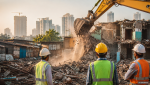
Construction activity is also gathering pace. Rehabilitation work on railway land buildings is progressing as scheduled. The first rehabilitation building is expected to be handed over by the end of 2028. Shortly after the monsoon, construction will begin for rehabilitation housing for nearly 10,000 families on the railway land. Every stage completed brings residents a step closer to moving into safe, modern homes with dignity.
Multi-pronged progress
Various government departments are also working together to remove bottlenecks so that work can gather speed after the monsoon. The Dharavi Bus Depot land has recently been cleared for rehabilitation, with a proposal to develop two modern depots in its place. A proposal for a large precast casting yard at Mulund is also under consideration to support faster construction. During the past year, progress has also been made in securing key land parcels, advancing rehabilitation on railway land, planning education continuity, consulting on religious structures and strengthening coordination across government agencies. These may appear to be administrative milestones, but together they are creating the foundation for one of the most complex urban regeneration programmes ever undertaken.
On Independence Day, we celebrate not only the nation’s achievements but also our shared responsibility to build a better future. The Dharavi Redevelopment Project is an opportunity to ensure that every family has access to safe housing, better public spaces, reliable infrastructure and new opportunities without losing the community bonds that make Dharavi unique.
Much remains to be done, but the direction is clear. With the continued trust of Dharavikars, this effort is steadily gathering momentum. In the years ahead, the success of this project will be measured not by the number of buildings that rise, but by the number of lives that are transformed with dignity.
(Dr Mahendra Kalyankar is CEO and Officer on Special Duty, DRP/SRA)