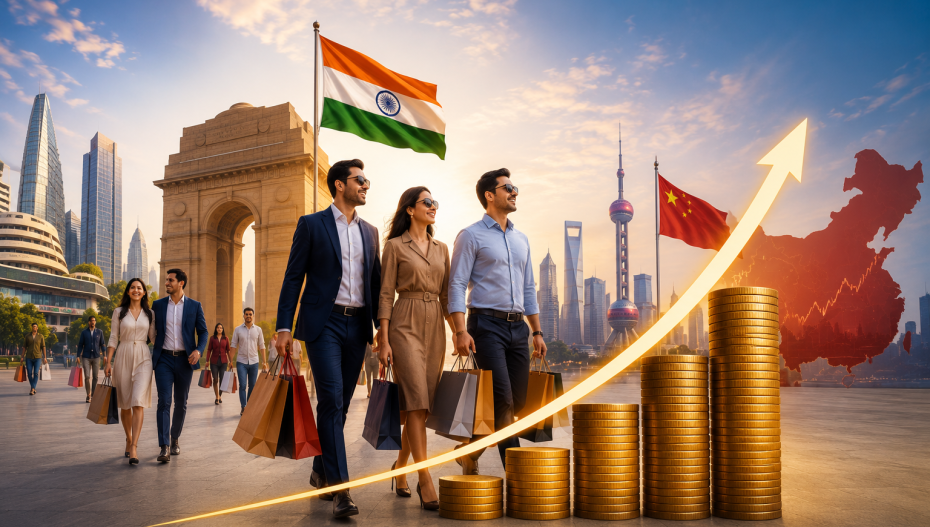
India is on track to become home to the world’s second-largest affluent consumer population by 2036, overtaking China as rising incomes, a growing middle class and expanding consumer demand reshape the country’s market.
A new report by NielsenIQ (NIQ) and World Data Lab projects that India could have 10.8 crore affluent consumers by 2036, slightly ahead of China’s projected 10.3 crore.
The shift points to a major change in India’s consumer economy. As more people move into higher spending groups, companies may see growing demand not only for affordable products but also for premium goods and services that offer better quality, convenience and status.
India’s affluent consumer base set to grow sharply
India is estimated to have around 2.6 crore affluent consumers in 2026. Over the next decade, this number is projected to increase by 8.2 crore, reaching 10.8 crore by 2036.
China, meanwhile, is expected to add around 6.2 crore affluent consumers during the same period, taking its affluent consumer population to 10.3 crore.
This means India is projected to record the largest increase among the countries covered in the report.
The report defines affluent consumers as people who spend more than $90 a day. This group is measured separately from another category called “core consumers”, who spend between $13 and $90 a day.
India already has a large core-consumer population
The growth story is not limited to affluent households.
India is estimated to have 64.9 crore core consumers in 2026. These consumers have daily spending levels between $13 and $90 and are considered a separate group from affluent consumers.
This large consumer base, combined with India’s expanding affluent population, gives companies a broad market at different income and spending levels.
The report classifies India as a “volume growth” market, largely because of its growing population and expanding middle class.
US remains ahead, but India is catching up
While India is expected to overtake China, the United States is projected to remain well ahead in terms of affluent consumers.
The US is projected to remain the largest affluent-consumer market, with 23.1 crore affluent consumers in 2026 and an expected increase of 3.1 crore by 2036. India is projected to see the fastest growth, adding 8.2 crore affluent consumers, followed by China with an increase of 6.2 crore. Germany and Japan are each expected to add around 0.5 crore, while the UK and Brazil could add 0.6 crore and 0.8 crore respectively. The rest of the world is projected to account for an additional 17 crore affluent consumers.
Overall, the global affluent population is expected to grow from 65.7 crore in 2026 to 102.5 crore by 2036, an increase of 36.9 crore over the decade. This points to a major expansion in global purchasing power and a growing opportunity for businesses targeting higher-spending consumers.
More affluent consumers, but changing buying habits
The rise in income does not necessarily mean consumers will automatically choose the most expensive products.
The report highlights a more complicated pattern among consumers who are moving towards higher spending.
Among what it calls “upgrade consumers”, around 60% say they focus on value for money, while 46% say they are willing to pay for convenience.
This means consumers may be ready to spend more, but they still want to understand what they are getting in return.
Even consumers with greater spending power may choose cheaper alternatives when the benefit of a premium product is unclear or when a lower-priced product meets their needs.
Premium products will need to offer real value
The changing consumer landscape could create opportunities for companies across several sectors.
In some categories, growth is expected to come from more households entering the market, better affordability and wider distribution.
In other categories, companies may benefit from premium purchases by newly affluent consumers looking for products that offer better quality, convenience or status.
This suggests that simply increasing prices may not be enough. Products will need to clearly explain why consumers should pay more.
At the same time, affordable options will remain important because India’s consumer market will continue to include people at very different income levels.
Rising prices are also changing consumer behaviour
The findings come at a time when consumers around the world are dealing with higher prices.
According to NIQ, global fast-moving consumer goods prices increased by 26% between 2021 and 2025.
Higher prices could make consumers more careful about their spending, even as incomes rise.
This could explain why value for money remains an important consideration among consumers who are otherwise becoming more willing to spend.
For businesses, the challenge will be to balance premiumisation with affordability.
Affluent consumers may spend more than their numbers suggest
Although affluent consumers are much smaller in number than the wider core-consumer group, their spending power is significantly higher.
In 2026, the global affluent population is estimated at 65.7 crore, compared with around 410 crore core consumers.
Yet affluent consumers are projected to spend about $35.9 trillion during 2026, compared with $31.6 trillion spent by the much larger core-consumer group.
This shows why affluent consumers are becoming increasingly important for businesses.
A relatively smaller group can generate a very large share of total consumer spending because of its higher purchasing power.
India’s consumer market could become increasingly important
India’s projected rise in affluent consumers could have a major impact on sectors such as retail, travel, hospitality, automobiles, electronics, financial services, personal care and premium consumer goods.
The country’s growing middle class can bring millions of new consumers into higher spending categories, while the existing core-consumer population provides a much larger base for mass-market products.
However, the report’s broader observations about consumer growth across different product categories are not limited specifically to India. They apply to emerging markets across Asia-Pacific, Latin America and Africa.
The US is projected to lead in 2036
Despite India’s rapid growth, the United States is expected to remain the largest affluent-consumer market among the countries highlighted in the report.
The US is projected to have around 23.1 crore affluent consumers by 2036, more than either India or China.
Globally, the affluent consumer population is expected to reach 102.5 crore by 2036, compared with 65.7 crore in 2026.
The increase of 36.9 crore people over the decade underlines the scale of the expected expansion in global purchasing power.
The “average consumer” may no longer be enough
One of the report’s key messages for businesses is that treating the “average consumer” as a single, reliable growth target may become increasingly difficult.
Consumers are becoming more diverse in terms of income, spending power and willingness to pay.
Some will continue to prioritise affordability, while others will increasingly spend on convenience, quality and premium products.
For companies operating in India, this means they may need to develop products for multiple consumer segments rather than relying on a single mass-market strategy.
What it means for India
If the projections hold, India will move from having 2.6 crore affluent consumers in 2026 to 10.8 crore in 2036.
That would add 8.2 crore people to the country’s affluent consumer base and put India ahead of China.
The change could make India one of the world’s most important markets for companies seeking long-term consumer growth.
But the opportunity will come with a clear challenge: consumers will still expect value for money, even as their ability to spend increases.
The report therefore points towards a future in which India’s consumer story is not simply about people spending more. It is about more people entering higher spending groups, becoming selective about what they buy and demanding stronger value from the products and services they choose.
The 2036 figures are projections based on available data, historical trends and assumptions, and actual outcomes could differ.
Also Read: What Was On A Harappan Plate? Ancient Teeth Reveal How Food Habits Changed https://www.vibesofindia.com/harappan-food-habits-teeth-study-juna-khatiya-rakhigarhi/