


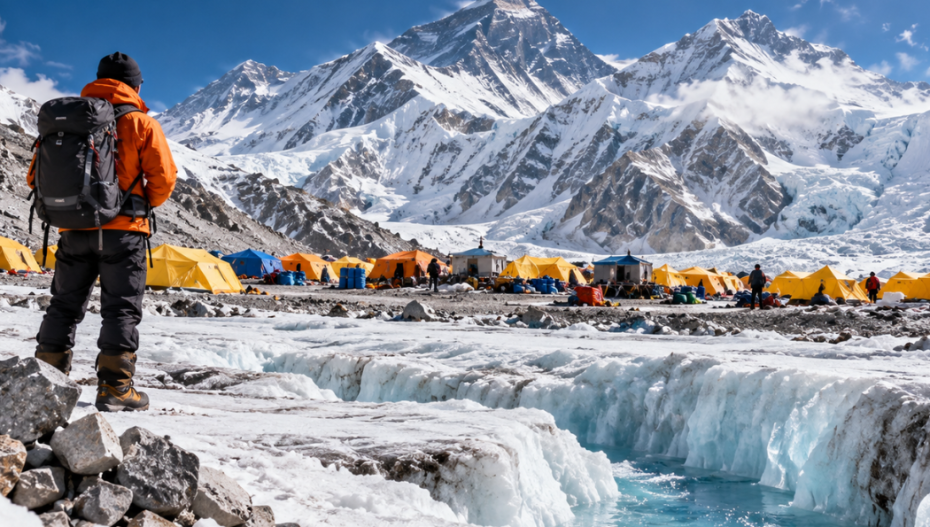
Mount Everest’s climbing season brings thousands of people to the world’s highest mountain, but the activity is also leaving a growing environmental impact on the fragile Khumbu Glacier. A new study by Nepalese and American scientists has found that the heat produced by human activity at Everest Base Camp contributes to the melting of the glacier — and even urine discharged by climbers plays a small role.
The study, published in Regional Environmental Change, examined the combined impact of global warming, fuel consumption and human activity at the base camp. Researchers found that the biggest source of human-caused heating is fuel used for cooking, heating and electricity, while urine accounts for a smaller but measurable share.
The findings come as concerns over Himalayan glaciers and glacial lake outburst floods continue to grow.
Nearly 1,600 Tents Come Up on the Glacier
Everest Base Camp is located directly on the Khumbu Glacier. During the climbing season, the area transforms into a temporary settlement.
Nearly 1,600 tents are set up every year, providing climbers and support teams with facilities such as kitchens, showers, generators and Wi-Fi. Some tents even have heated floors.
All of these activities generate heat. According to the researchers, this increases temperatures around the glacier surface and adds to the pressure on the already fragile ice.
The scientists examined how much of this human-generated heat could contribute to glacier melting.
Climbers Produce Thousands of Litres of Urine
At Everest’s high altitude, climbers need to drink more water, which also means they produce more urine.
Researchers led by Khim Lal Gautam estimated that during the 2023 climbing season, climbers and others at the camp produced nearly 6,766 litres of urine every day.
Urine leaves the human body at roughly 37°C, meaning it carries significant heat. The researchers calculated how much ice could theoretically be melted by that heat.
Their estimate showed that the glacier lost around 154 tonnes of ice from the heat associated with urine during that climbing season.
However, the researchers stressed that not all the heat from urine reaches the ice. Much of it escapes into the surrounding air or is absorbed by rocks as the liquid cools.
As a result, urine is only a small part of the overall human contribution to glacier melting.
Fuel Use Is the Much Bigger Problem
The study found that the main human source of heat at Everest Base Camp is fuel consumption. During the 2023 climbing season, the camp used:
824 LPG cylinders
18,935 litres of kerosene
5,130 litres of gasoline
These fuels were used for cooking, heating and generating electricity.
According to the researchers’ calculations, fuel consumption was responsible for about 94% of the melting caused by human activity, while urine accounted for the remaining 6%.
This makes fuel use a far bigger concern than urine, even though the latter has received attention because of its unusual contribution.
Khumbu Glacier Faces Rising Temperatures
The study also highlights the wider warming threat facing the Himalayan region.
Scientists have warned that the Himalayas are warming faster than many other regions. A 2019 study published in Science Advances found that ice loss nearly doubled after 2000 compared with the previous period examined.
At Everest Base Camp itself, the situation is particularly concerning. The researchers found that surface temperatures are increasing faster than in other parts of the Khumbu Glacier, at approximately 0.28°C per year.
The combination of rising temperatures and additional heat from human activity could further accelerate the glacier’s deterioration.
Nepal’s Recent Flash Flood Raises Concern
The findings come against the backdrop of a major disaster in Nepal on August 26, 2026, when a massive flash flood washed away villages and killed more than 1,200 people.
The disaster was attributed to a glacial lake outburst, highlighting the dangers associated with changing conditions in the Himalayan region.
The study suggests that human activity around glaciers needs to be considered alongside the broader impact of climate change.
Should Everest Base Camp Be Moved?
The researchers also examined whether Everest Base Camp should be relocated to reduce pressure on the Khumbu Glacier.
They identified two possible locations southwest of the existing camp.
However, moving the camp would not be simple. It could create major logistical challenges and could also expose another location to environmental damage.
For this reason, the researchers have called for measures that reduce the camp’s impact rather than relying only on relocation.
Solar Power and Better Waste Management Suggested
The scientists have recommended better waste management and greater dependence on solar power to reduce the environmental pressure created by the climbing camp.
They also suggested that some part of the camp could potentially be shifted away from the most vulnerable areas of the glacier.
The study ultimately points to a larger concern: while global warming remains the major threat to Himalayan ice, the concentration of human activity at Everest Base Camp is adding another layer of heat and environmental stress to an already fragile glacier.
Also Read: After Son’s Death, Gujarat HC Allows 54-Year-Old Man And Wife Over 50 To Seek IVF