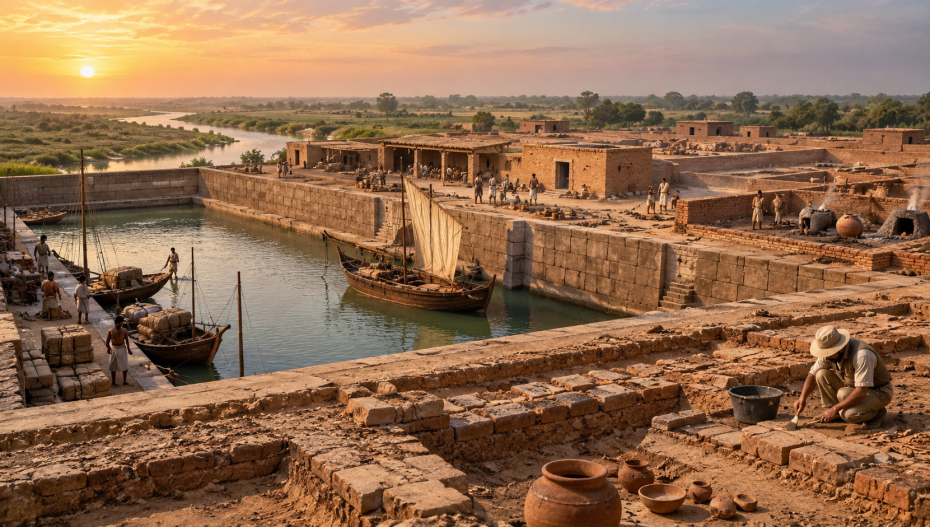
There are no machines running here anymore, no workers carrying goods and no boats moving in and out. Yet the remains being uncovered at Lothal are beginning to show just how busy this ancient town once was.
Hearths and furnaces found in the lower town point to areas where people worked and produced goods. Rows of structures appear to have connected these production spaces with the dockyard. Storage areas, passages and water-management systems add to the picture of a settlement where work, trade and everyday life were carefully organised.
Now, fresh excavations by the Archaeological Survey of India (ASI) have added another important piece to that picture — evidence suggesting that an ancient watercourse once existed close to the Harappan-era town.
A sand-rich sediment layer discovered during the excavation has caught the attention of archaeologists. The material suggests that water once moved through this part of the landscape, raising the possibility of an old river channel or palaeochannel near Lothal.
Archaeologists believe this ancient watercourse may have provided a connection between the town’s dockyard and a larger river network that eventually led towards the Arabian Sea.
The finding could help address one of the long-standing questions surrounding Lothal: how did a settlement located nearly 20 km from today’s coastline operate as an important maritime centre?
The Bhogavo River now passes roughly 5 km to the west and south of Lothal. However, the landscape surrounding the settlement thousands of years ago may have looked very different from what it does today.
A Town Built Around Work And Trade
The current ASI excavation is focused on the northeastern section of Lothal.
The remains emerging from the ground indicate that the settlement was much more than a residential centre. In the lower town, archaeologists have identified hearths and furnaces that suggest specialised areas where people carried out production-related activities.
One of the excavated areas appears to have been linked to the making of different kinds of goods.
The positioning of structures provides further clues. Archaeologists have identified a sequence of buildings extending towards the dockyard, suggesting that production areas may have been physically connected with the part of the settlement used for moving goods.
This arrangement points towards a settlement where economic activity was planned rather than randomly distributed.
The layout may have allowed materials to pass through different stages of production before finished goods were taken towards the dockyard. In other words, the town’s production spaces and trading infrastructure appear to have worked as parts of a larger system.
The Objects Left Behind
The people who lived and worked at Lothal left behind a wide variety of objects.
Excavations have uncovered stud-handled bowls, fishhooks, seals, black-slip jars, storage pots, terracotta figures of animals and humans, along with steatite and terracotta buttons and weights.
The discoveries also display characteristics associated with the Sorath Harappan tradition.
Taken together, the artefacts and structures offer clues about the range of activities that once took place at Lothal. They point not only to everyday life but also to production, storage and trade.
The remains further suggest that water was an important part of the town’s planning. Evidence of systems designed to conserve and manage water indicates that the settlement’s inhabitants had developed ways of dealing with water as part of their wider urban infrastructure.
Lothal Evolved With Its Population And Trade
Lothal did not remain unchanged throughout its existence.
The archaeological layout suggests that the town underwent changes as its population increased and patterns of trade developed. Different parts of the settlement appear to have been reorganised in response to changing needs.
The settlement is believed to have existed between around 2400 BCE and 1900 BCE, during the Harappan period.
The structures being uncovered today therefore belong to a settlement that was active roughly 4,000 years ago.
What makes the discoveries significant is the range of activities represented at the site. The remains indicate a community involved in production and storage while also maintaining systems for water management and movement of goods.
A Wall Beside The Dockyard
Another important discovery has emerged close to the dockyard, where archaeologists have found a large brick-built wall next to a warehouse.
Its position suggests that it may have formed part of the storage area and could have helped protect goods kept within the complex.
The structure follows a northward alignment before turning towards the east. A passage found nearby may have provided a route through the area or supported movement around the storage complex.
The discovery adds to the evidence that Lothal’s production, storage and movement areas were deliberately arranged around the town’s wider trading infrastructure.
Could This Be The Water Link?
The possible ancient river channel provides another clue to understanding Lothal’s famous dockyard.
The location of the dockyard has long raised questions because the ancient settlement is nearly 20 km away from the present coastline.
The newly identified sediment layer could offer part of the answer. Its characteristics indicate that water once moved through the area, leading archaeologists to investigate the possibility of an ancient river or channel.
According to the ASI, the palaeochannel may have connected the dockyard with a larger river system that eventually reached the Arabian Sea.
If that connection is established, it could help explain how Lothal’s dockyard was able to support maritime activity despite the settlement’s distance from the present-day sea.
The exact route followed by the ancient watercourse is still being investigated. Further excavation and analysis could help reconstruct what the landscape around Lothal looked like when the settlement was at its peak.
Six Decades After The First Excavations
The archaeological investigation of Lothal began in the 1960s.
More than six decades later, the ASI has undertaken fresh excavation work to build a clearer understanding of how the ancient settlement functioned.
The focus of the current work extends beyond the famous dockyard. The newly exposed remains are helping researchers examine how people lived and worked, how goods were produced and stored, how water was managed and how different parts of the settlement were connected.
The excavation is also taking place alongside plans to develop an experiential museum at Lothal, aimed at presenting aspects of Harappan life from around 4,000 years ago.
The site is expected to form part of the wider heritage experience around the upcoming National Maritime Heritage Complex in Lothal.
For archaeologists, the importance of the latest excavation lies in the way the discoveries connect with one another.
Workshops, production areas, storage spaces, water-management systems, a substantial boundary wall and the possible remains of an ancient watercourse are gradually revealing how Lothal functioned as an organised settlement.
The discoveries are therefore adding a new layer to the story of Lothal — not simply as a town remembered for its ancient dockyard, but as a carefully planned centre where production, storage, water and trade were closely connected.
Also Read: Gujarat’s Lion Population Faces 62 Disease-Related Deaths In One Year