


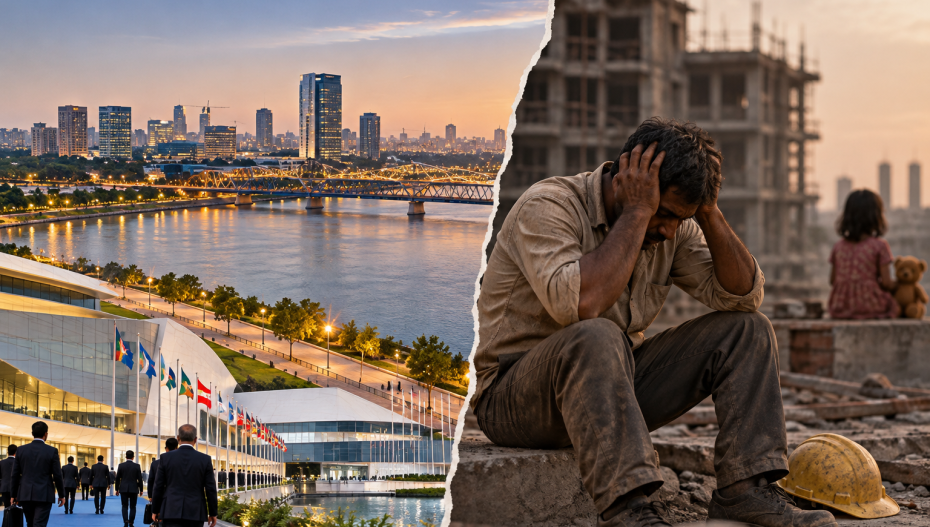
Gujarat likes to call itself “Vibrant.” Big investments, big summits, big GSDP numbers. But two very different pieces of news this month put that branding to the test — one is a global ranking of cities, the other is a heartbreaking case from Amreli.
Put together, they ask a simple but uncomfortable question: does Gujarat’s growth actually reach the people living inside it?
What the Global Cities Index Actually Measures
The Oxford Economics Global Cities Index ranks the world’s 1,000 largest urban economies using 27 indicators across five categories: Economics, Human Capital, Quality of Life, Environment and Governance. The index is designed to look beyond economic size and assess the different factors that determine the strength and performance of an urban economy. The five categories carry different weights:
Category Weight
Economics 30%
Human Capital 25%
Quality of Life 25%
Environment 10%
Governance 10%
The methodology matters because cities are assessed as functional urban areas, rather than simply as municipal corporation boundaries. Individual indicators are normalised before being combined into the final score.
Ahmedabad ranks 571st out of 1,000 cities globally, but that rank of 571 does not simply mean Ahmedabad is the “571st-best city in the world.” It is a composite result based on different categories carrying different weights.
The more revealing question is therefore not simply where Ahmedabad ranks overall, but where it performs well — and where the gaps appear.
Ahmedabad’s Numbers Tell Two Different Stories
Ahmedabad ranks 571st out of 1,000 cities globally, and 15th among Indian cities. On its own, that sounds unremarkable. But break the number down, and it gets far more interesting.
Economics: 379
Human Capital: 347
Governance: 415
Overall: 571
Environment: 795
Quality of Life: 881
According to the reports, Ahmedabad performs considerably better in economics and human capital than its overall ranking suggests. It ranks 379th globally in economics and 347th in human capital, both comfortably inside the global top 400.
But once the question changes from how the economy is performing to what it is like to live in the city, the ranking changes dramatically. Ahmedabad stands at 795th in environment and 881st in quality of life. The city ranks 415th in governance. Look at that gap.
Ahmedabad is not economically weak in the Oxford assessment. Its economic and human-capital rankings are substantially stronger than its overall position. The problem is what happens after economic growth.
In simple terms, Ahmedabad has built an economy considerably faster than it has built an equally strong urban living environment. That is the central finding hidden behind the headline number of 571.
How Other Indian and Gujarat Cities Compare
Delhi leads Indian cities at 268th globally, followed by Bengaluru at 311 and Mumbai at 320. Chennai ranks 381st, Hyderabad 421st, Pune 427th and Kolkata 496th, according to the reported rankings.
Within Gujarat, Ahmedabad ranks ahead of Surat at 697th, Vadodara at 702nd and Rajkot at 824th.
India has more than 90 cities represented among the world’s 1,000 largest urban economies. That is not, by itself, a poor showing. The more important question is where those cities sit within the table.
Interestingly, Oxford Economics classifies Ahmedabad and Surat as “Emerging Standouts” — cities in the developing world that are outperforming their respective countries and showing productivity and income characteristics associated with potential growth centres. So this is not about Gujarat’s cities having no economic potential. Quite the opposite.
It is about economic potential not yet translating proportionately into quality of life and environmental performance.
India’s Position Is Weaker Than Its Growth Story Suggests
And Ahmedabad’s gap becomes more meaningful when placed in the wider South Asian picture.
Oxford Economics’ analysis points to a broader contradiction: Indian and other South Asian cities are growing rapidly, but many remain weak on the factors that turn economic growth into broad urban prosperity.
A large share of Southern Asian cities remains in the lower half globally for GDP per capita, while Indian cities also face significant challenges around income inequality and educational attainment.
Environmental pressures add another layer. Southern Asian cities are heavily represented among the world’s poorest performers on air quality, with Indian cities accounting for a substantial share of that group.
The larger point is that rapid economic growth does not automatically produce high-income, healthy, environmentally sustainable and highly liveable cities.
Growth can be impressive precisely because it is coming from a lower base. But that does not mean the resulting prosperity is evenly distributed or that urban systems are developing at the same speed. And that is where Ahmedabad becomes particularly revealing.
Its economic ranking of 379 tells us that the city has significant economic strength. Its quality-of-life ranking of 881 tells us that economic strength alone is not enough.
Why Does the Gap Exist?
There are four broader structural issues behind this pattern.
- GDP growth is not the same as GDP per capita
Indian cities are among the fastest-growing urban economies, but aggregate GDP growth does not automatically translate into comparable growth in prosperity per person.
Oxford Economics expects 46 of the world’s 50 fastest-growing cities between 2025 and 2029 to be in Southern Asia. The region’s growth story is therefore far from over. But rapid growth from a lower starting point does not automatically make a city wealthy.
- Education and human capital have not fully caught up
Educational attainment remains a constraint for many Indian cities. That matters because the ability to move into higher-productivity and higher-paying sectors depends partly on the skills and education available within the workforce.
Ahmedabad’s relatively strong human-capital ranking is therefore an important part of its story — but it does not by itself resolve the wider quality-of-life gap.
- The environmental cost of urbanisation is real
Traffic, industrial activity, population density, emissions and exposure to extreme weather can all put pressure on a city’s environment.
The Times of India report notes that Oxford’s environment category considers factors including air quality, emissions intensity, exposure to natural disasters, temperature anomalies and rainfall anomalies. Environment, therefore, is not simply an aesthetic measure.
Poor environmental conditions can affect health, productivity, human capital and quality of life — meaning that the environmental gap can eventually become an economic gap as well.
- Urban infrastructure has to keep pace with urbanisation
This may be the underlying challenge. Economic activity can expand rapidly while the infrastructure supporting that activity develops more slowly.
Mobility, drainage, sanitation, housing, public spaces and resilient urban infrastructure all become increasingly important as populations and economic activity grow.
That is why Ahmedabad’s ranking is more revealing when the categories are placed side by side:
Economics 379 → Human Capital 347 → Quality of Life 881 → Environment 795.
The gap is arguably more important than the headline ranking of 571.
Then Came Amreli
Days after this index made headlines in Gujarat, a very different story surfaced from Amreli district — one that puts a human face on exactly the broader question of economic resilience.
According to report, a 40-year-old construction-site supervisor had taken a personal loan, invested the money in construction work and was awaiting ₹7.25 lakh from business associates.
The FIR stated that he had no money and could not find a solution, before he killed his five-year-old daughter and died by suicide. Police have registered a murder case and the investigation is continuing.
This is not a claim that Gujarat’s development model caused the tragedy.
The immediate circumstances described by police are a personal financial crisis and the alleged failure to receive ₹7.25 lakh. But the case is a legitimate prompt for a much larger question:
If Gujarat’s development story is as powerful as its branding suggests, why can one financial shock still become a point of absolute desperation for an ordinary working family?
Vibrant Gujarat — But Vibrant for Whom?
That’s really the sharper story sitting underneath both pieces of news. A Gujarat that proudly markets itself as “Vibrant” and investment-driven must still confront the reality that economic growth, investment and headline GSDP numbers do not automatically translate into financial security for every household.
The real test of a development model isn’t how many MoUs are signed, how many investors arrive, how large the GSDP becomes or how impressive the summit stage looks.
It is whether a construction supervisor in Amreli, facing a relatively modest financial crisis, has enough economic resilience, access to credit, social protection and institutional support to prevent a family from falling through the cracks.
That is where the Vibrant Gujarat paradox becomes uncomfortable. Gujarat can simultaneously be an industrial powerhouse and have vulnerable households. Those two facts aren’t mutually exclusive.
The policy question is whether the gains from growth are sufficiently broad-based — and whether the safety nets beneath that growth are strong enough.
The Oxford Economics numbers do not answer that question directly. The index is a city-level assessment, not a measure of household financial distress. But they do show why looking only at economic performance is insufficient.
Ahmedabad’s economy and human capital perform considerably better than its quality-of-life and environmental indicators. That does not mean economic growth has failed. It means the benefits and systems surrounding that growth need to be examined through more than one number.
The Question Beyond the Headline Numbers
Seen together, the Oxford Economics numbers and the Amreli case are pointing at the same blind spot from two different directions — one through city-level data, the other through one family’s story.
One shows the gap between economic performance and quality of urban life. The other shows, at the most painful human level, how a financial shock can expose the vulnerability that exists below aggregate economic numbers.
Again, the two should not be treated as proof of a direct causal relationship. But they do provide a legitimate basis for asking what a development model should ultimately deliver.
Ahmedabad has built considerable economic strength. Gujarat has built a powerful investment and industrial narrative.
The harder question is whether that strength is translating into better quality of life, stronger environmental conditions, greater household resilience, access to credit and social protection.
Because the real test of growth is not simply how high the headline number goes. It is what happens to people when something goes wrong.
Ahmedabad’s economy is racing ahead of Ahmedabad’s quality of life. Gujarat’s growth story raises a parallel question about whether the social and economic safety nets beneath that growth are strong enough.
Closing those gaps, not just growing the headline numbers further, is what “Vibrant” should actually mean.
Also Read: Too Much Sugar On The Plate: Gujarat Schools To Install ‘Sugar Boards’