What began with a food-safety complaint at an Ahmedabad school later turned into a dispute over books, religion and education — and eventually led to violence at a peaceful reading session in Vastrapur.
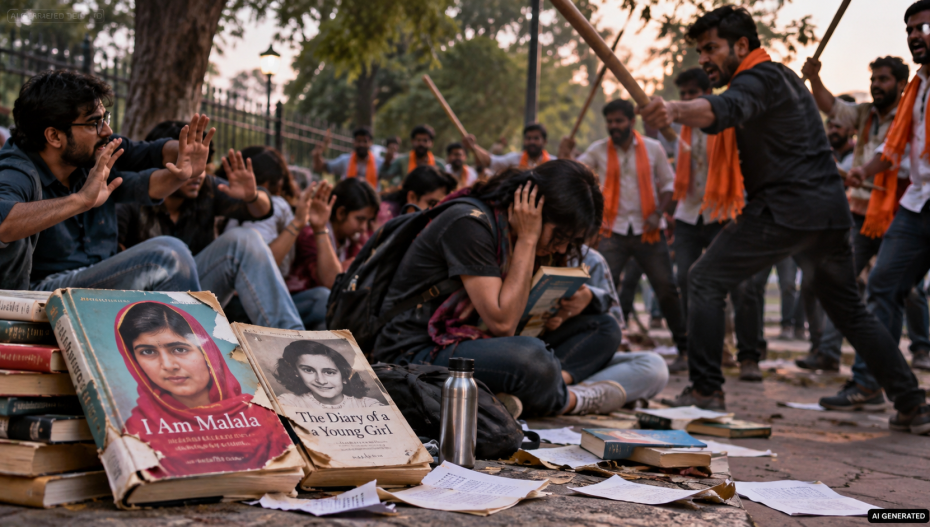
On August 27, a silent reading programme organised at AUDA Garden by the Students and Youth Collective, Ahmedabad (SYCA), was disrupted after a group of people allegedly associated with the Bajrang Dal and Vishva Hindu Parishad (VHP) arrived at the venue. Participants alleged that the group raised slogans, made communal remarks, tore books and assaulted people with sticks and rods.
The reading session had been organised in solidarity with an Ahmedabad school that had faced objections over books by Malala Yousafzai and Anne Frank.
How the School Controversy Began
The chain of events began on August 11, when several parents gathered outside Anand Niketan school in Shilaj following an incident involving food served at the school canteen.
According to the information provided, a Class 8 student reportedly found a hard object in his mouth while eating lunch at the school the previous day. The meal included bhindi, dal, chapati and rice. The student allegedly swallowed part of the object and handed the remaining piece to his teacher.
Following the incident, the Ahmedabad District Education Officer issued a show-cause notice to the school.
The school was asked to provide details about the agency supplying the food, its food-safety and quality checks, the action taken after the incident and steps planned to prevent such incidents in the future.
An inspection was also ordered. The authorities sought information based on statements from students and parents, CCTV footage, photographs, food samples and other available evidence.
The school reportedly said it had taken immediate corrective measures, including changing supervisory responsibilities and reviewing and strengthening its hygiene, food-safety and quality-control procedures.
Books Become the Centre of the Dispute
The controversy later moved beyond the canteen issue.
Some parents alleged that the school was discriminating against a particular religion because students were being asked to read books written by Malala Yousafzai and Anne Frank.
The inclusion of Malala’s book became a particular point of objection among people allegedly associated with the Bajrang Dal and VHP. They questioned why a book by a Pakistani activist was available at the school.
According to the information provided, members of the group entered the school premises by climbing over the gate, raised “Jai Shri Ram” slogans and threatened the school management.
The school rejected the allegations surrounding the books.
It said the books were part of its Book Club and were meant to encourage age-appropriate reading, empathy and awareness of the wider world. The school also said daily shlokas continued to be recited during breakfast and lunch, while physical exercise and yoga had been strengthened during the morning programme.
On August 14, the school’s Instagram account shared screenshots of emails from parents supporting the school. While some parents had raised concerns and made suggestions about the canteen, others supported the inclusion of the two books and said they were important for students’ development.
There were also allegations that two teachers from a religious minority community were being targeted and pressured to resign.
‘Reading Is Not a Crime’
Against this backdrop, SYCA issued a statement of solidarity with the school on August 22.
The collective said, “Reading is not a crime,” and described the controversy as a worrying development for education.
It argued that schools should remain spaces where students can read critically, discuss ideas and engage in healthy debate without outside interference.
Three days later, on August 25, SYCA announced a silent reading session at AUDA Garden, near the Ahmedabad District Education Officer’s office, from 4 pm to 6 pm on August 27.
An informal WhatsApp group called Gujarat Reads was also created to coordinate the event. The group was later deleted.
Sneh Bhavsar, an Ahmedabad-based entrepreneur associated with the group, said he was not a member of SYCA and that Gujarat Reads had been created shortly before the event to show solidarity with the school.
The Reading Session Begins Peacefully
According to people who attended the event, the August 27 reading session initially remained peaceful.
Bhavsar said people came to the park, some stayed to read and others left after showing their support. He estimated that around 30 to 40 people joined the session.
There were reportedly no banners or chanting.
Savan Zalariya, a theatre artiste and professor of political theatre at Ahmedabad University, said the gathering was not exclusively about Malala or Anne Frank.
Books by Mahatma Gandhi, Sardar Patel, Bhagat Singh and B R Ambedkar were also present.
“We only had books and water bottles,” Zalariya said.
The wider collective, according to Zalariya, was created by students and young people in Ahmedabad who felt that universities in Gujarat offered limited space for open discussions, particularly on political and social issues.
The decentralised group began in April during Dalit History Month and had no formal leader. It was not originally created to organise protests and initially functioned as a cultural forum, organising film screenings and discussions.
Group Arrives at the Park
Towards the end of the reading session, Bhavsar said four or five people arrived and appeared to observe the gathering before leaving and returning with more people.
According to him, around 30 to 40 people eventually arrived. Participants alleged that some wore saffron scarves and carried sticks and rods, which they said had been left outside the park near the gate.
Swati Goswami, an independent consultant and educator who was present at the event, said the group also chanted “Jai Shri Ram.”
Participants initially tried to speak with them.
Bhavsar said they asked the visitors to sit down and explain their objections so the issue could be discussed peacefully.
According to him, the discussion continued for around 15 minutes before the situation changed.
He alleged that the group began pushing people and attempting to intimidate participants.
National Anthem Becomes a Flashpoint
As tensions increased, participants said they began singing the national anthem.
Bhavsar alleged that this happened when the group tried to charge towards them and that the anthem briefly stopped the confrontation.
He said members of the group then accused some participants of disrespecting the national anthem because a person’s shoulder was allegedly moving while it was being sung.
The situation subsequently turned violent, according to participants.
They alleged that people were pushed and beaten and that books were torn.
Participants Allege Assault With Sticks and Rods
Zalariya alleged that participants were attacked with sticks and rods.
“They beat us with iron and wooden rods. They hit my head, back and elbow even though we were trying to have a dialogue with them,” he said.
Around six people were reportedly injured, according to SYCA members.
Participants also alleged that copies of I Am Malala by Malala Yousafzai and The Diary of a Young Girl by Anne Frank were torn during the confrontation.
Goswami alleged that some members of the group threatened women who were recording the incident and attempted to take away their phones and watches.
She alleged that women recording the incident were threatened with disappearance.
Goswami also alleged that members of the group made communal remarks and discussed pulling down the trousers of some participants to check their religion.
Zalariya said the group repeatedly questioned why Malala’s book was being read and raised her views on Kashmir.
Police Arrive as Violence Continues
Goswami said she confronted the group after they allegedly tried to lock the park gate and alerted the police.
Two police personnel, including one in uniform and another in civilian clothes, arrived at the location along with a police vehicle.
However, SYCA members alleged that the violence continued even after the police arrived.
Zalariya alleged that participants were attacked in front of police and that one policeman was grabbed by his uniform.
Both Goswami and Zalariya said a policeman told participants to quickly get into the police vehicle because they could otherwise be seriously harmed.
As the confrontation continued beyond 6 pm and moved onto the road, traffic was reportedly affected.
FIR Registered, Three Arrested
Police subsequently registered an FIR naming Hiren Rabari and Jimit Rabari as complainants identified by the participants.
SYCA members alleged that both were associated with the Bajrang Dal and were among those leading the group.
Goswami said Hiren Rabari was the person speaking most frequently during the confrontation and identified himself by name.
The FIR includes provisions of the Bharatiya Nyaya Sanhita relating to criminal intimidation, voluntarily causing hurt, unlawful assembly and rioting while armed with a deadly weapon or an object capable of causing death.
According to the police information provided, three people were arrested and later received bail. Police were still looking for Hiren and Jimit, and the investigation was continuing.
After the incident, seven to eight people from the reading session were taken to Vastrapur police station.
Members of the collective later went to Civil Hospital in cabs for medico-legal examinations, accompanied by police. They were given medication and underwent X-rays, according to Goswami.
She said participants initially tried to give their statements orally but alleged that some details, including the alleged intimidation and communal remarks, were not included. They then submitted a written statement, following which the FIR was registered.
Goswami said they left the police station after 2 am.
Bajrang Dal Rejects Allegations of Using Sticks
Jvalit Mehta, Gujarat vice president of the Bajrang Dal, gave a different account of the incident.
He said the scuffle began only after the national anthem was allegedly disrespected.
On the school controversy, Mehta said the organisation had received requests from parents who claimed Malala’s book was being forced on students.
He acknowledged that workers had entered the school premises by climbing over the school boundaries, but denied that there had been violence from their side.
He also referred to the earlier food complaint and alleged that canteen staff had been cooking eggs for themselves at a school where students were mostly strictly vegetarian.
Regarding the reading session, Mehta alleged that books other than those by Malala and Anne Frank were also present, including books concerning the Godhra riots and questioning the idea of Love Jihad.
He said such books could incite people.
According to his account, there was a debate between the two sides and the confrontation began after the national anthem was allegedly disrespected. He denied that his group used sticks.
He said the organisation’s main objection was to Malala’s book and her views on Kashmir, which he described as harmful to the country.
School Later Responds to the Controversy
The school later responded to questions about the food incident, the books and the allegations surrounding the institution.
School head Garima Singh said the child involved in the food incident was immediately taken to hospital and the parent was informed. She said the child was safe.
As a precaution, the school discontinued its food facility and began reviewing the arrangement and alternative options. She said the decision to restart the service would depend on appropriate safety assurances.
On the two books, Singh clarified that neither book was part of the prescribed or compulsory curriculum.
She said they were available through the school’s Book Club/Literary Initiative, which was designed to encourage reading, independent thought, critical thinking and meaningful dialogue beyond the prescribed curriculum.
According to her, the books were neither compulsory nor part of the prescribed curriculum.
The school also said it would not speculate about how information about the books reached any outside group or comment on the intentions of any external individual or group without verified facts.
On the allegation that a teacher had been forced to resign, Singh said employment and personnel matters were confidential. She added that the school stood by its employees and remained committed to providing a respectful, secure and supportive environment.
The school also categorically denied the allegation that non-vegetarian food was being cooked in its canteen.
Singh said Anand Niketan follows a strictly vegetarian and Satvik food practice. She also denied another claim circulating about namaaz being conducted at the school.
A Controversy That Went Far Beyond Two Books
The Ahmedabad episode has therefore moved through several stages — beginning with a complaint about food served at a school, expanding into objections over books by Malala Yousafzai and Anne Frank, and eventually spilling onto the streets during a reading session.
What was planned as a quiet gathering centred on books and solidarity ended with allegations of assault, injuries, an FIR and arrests.
At the centre of the dispute remain questions over what children should read, who gets to decide what is appropriate in an educational setting, and how disagreements over books and beliefs should be handled.
Also Read: Ahmedabad Peaceful Reading Session Turns Violent: Bajrang Dal Attack Youth, Tear Books