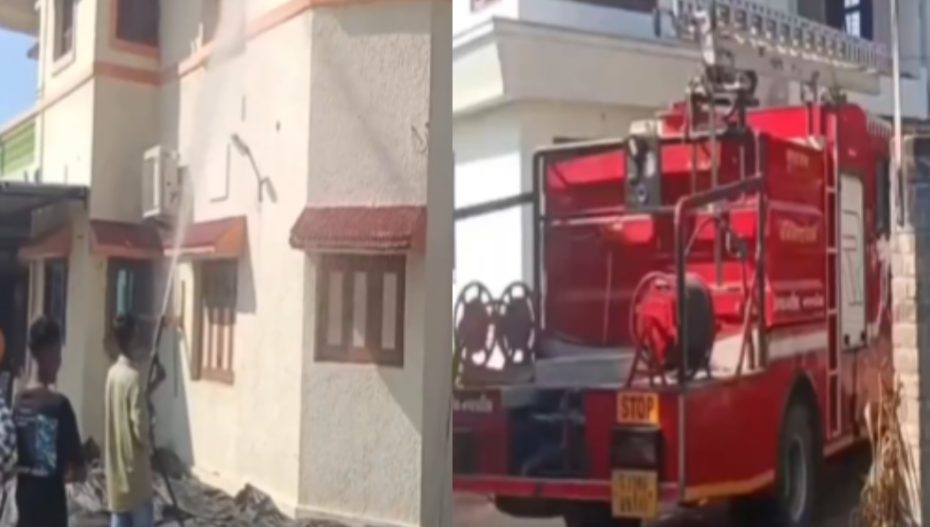
A fire brigade is an essential emergency service. When a fire breaks out or lives are at risk, these vehicles and their trained crews are called in to rescue people and protect property. But what happens when the same emergency service is used to clean a private house?
What may sound surprising and shocking at first became a real scene in Dahod, Gujarat, where a municipal fire vehicle was used to wash the bungalow of MLA and former minister Bachu Khabad ahead of Diwali.
The incident took place at Khabad’s residence in Pipero village of Dhanpur taluka. According to the report, the fire vehicle from Devgad Baria Nagarpalika travelled around 24 kilometres to reach the bungalow.
And there was apparently no fire to fight.
Instead, firefighters were seen using the vehicle to wash the exterior walls of the house.
From emergency response to bungalow cleaning
The visuals are difficult to ignore. A vehicle meant for firefighting and emergency response can be seen at a private residence, with firefighters spraying water on the outer walls of the bungalow.
The incident became controversial after videos of the incident went viral.
The basic question is simple: why was a municipal fire vehicle, meant primarily for emergency services, sent to a private residence for cleaning?
The concern becomes even more serious because a fire brigade is not an ordinary cleaning vehicle. It comes with trained personnel, equipment, fuel, water and public resources. If that vehicle is travelling 24 kilometres for a non-emergency purpose, questions naturally arise about who authorised the deployment and why.
How did the fire vehicle reach the bungalow?
The statements from the officials provide a revealing account of what happened.
Fire officer Mayur Chauhan said he received a call from Devgad Baria Nagarpalika president Dharmesh Kalal, who told him there was a fire call. Chauhan said he asked whether it was a special call or an actual fire call and was told to send the fire vehicle.
But when the firefighters reached the location, the situation was very different.
According to information, the firefighters were told by people associated with the MLA to wash the outer wall of the MLA’s house.
In other words, the team that had been sent believing it was responding to a fire-related call allegedly found itself being asked to perform a completely different task.
Nagarpalika president Dharmesh Kalal also said that the firefighters were told to wash the outer wall and that the work was stopped after the fire chief was contacted.
₹2,700 charge collected — but is that the real issue?
Following the incident, the municipality reportedly recovered ₹2,700 in fire charges from Balvant Khabad, Bachu Khabad’s son.
The recovery of money may appear to address the financial aspect of the incident. But it does not necessarily answer the larger question.
Can a public emergency vehicle be deployed for cleaning a private residence simply because a charge is later collected?
The issue is not only about the ₹2,700. It is about the purpose for which public emergency infrastructure exists.
The power equation raises another question
The incident has also triggered a wider debate about VIP culture and the use of government machinery.
For an ordinary citizen, getting a government emergency service to come to a house for cleaning would seem almost unimaginable. So when a fire brigade travels around 24 kilometres to a politician’s residence and firefighters end up washing the exterior walls, people are bound to ask whether the same treatment would have been available to an ordinary resident.
This is where the incident becomes more than just a story about a fire truck and a bungalow. It raises questions about accountability, protocol and the boundaries between public service and private convenience.
What if an actual emergency had occurred?
This is perhaps the most important concern raised in the controversy.
Congress leader Rajesh Raval, president of the Devgad Baria Congress unit, questioned who would have been responsible if an untoward incident had occurred while the fire vehicle and firefighters were away from their normal area for the cleaning exercise. It is a legitimate public-safety question.
Imagine a fire breaking out somewhere else at the same time. Imagine a family needing urgent rescue assistance. Imagine a major accident requiring emergency equipment.
What happens if the fire vehicle is 24 kilometres away, washing the walls of a private bungalow?
The point is not to suggest that such an emergency actually occurred. There is no reported evidence that one did. The concern is about the principle of keeping emergency resources available when they are needed.
Also Read: “Ruined India’s Economy”: Shaktisinh Gohil Hits Govt Over ₹26 Lakh Crore Investor Loss