

In a development that has sparked debate, the Gujarat government has suspended distribution of its prestigious annual Diwali magazine after the Vishva Hindu Parishad (VHP) objected to a published poem. The VHP alleges that the poem, written by veteran journalist and poet Aziz Tankarvi and featured in Gujarat,the state’s Diwali keepsake magazine edition, contains references that offend religious sentiments.
Heeding the VHP, the Chief Minister’s Office has ordered the immediate halt of magazine distribution. There is a buzz that the government may also set up a review committee to investigate editorial oversight. The controversy has ignited a polarised response on social media, with voices on both sides debating the balance between literary expression and religious sensitivity. The incident has spotlighted the role of public institutions in curating content for official publications, raising broader questions about freedom of expression and the responsibilities and limitations of government-controlled media.
The Diwali issue of the Gujarat magazine publsihed by the Information Department of the government is considered a keepsake, a collector’s edition,featuring outstanding poetry, essays, photographs, and humour pieces. This year, the 450-plus-page issue has drawn the attention of the Vishva Hindu Parishad (VHP). The VHP has objected to a poem penned by renowned poet and veteran journalist Aziz Tankarvi. The VHP says the poem hurts religious sentiments.
The VHP has demanded the poem’s immediate removal and swift disciplinary action against both the acclaimed writer and the senior official responsible for including it.
Following the complaint, the Chief Minister’s Office (CMO) ordered an immediate halt to the distribution of the Gujarat magazine.
VHP Raises Objections Over References to Lord Ram and Mirabai
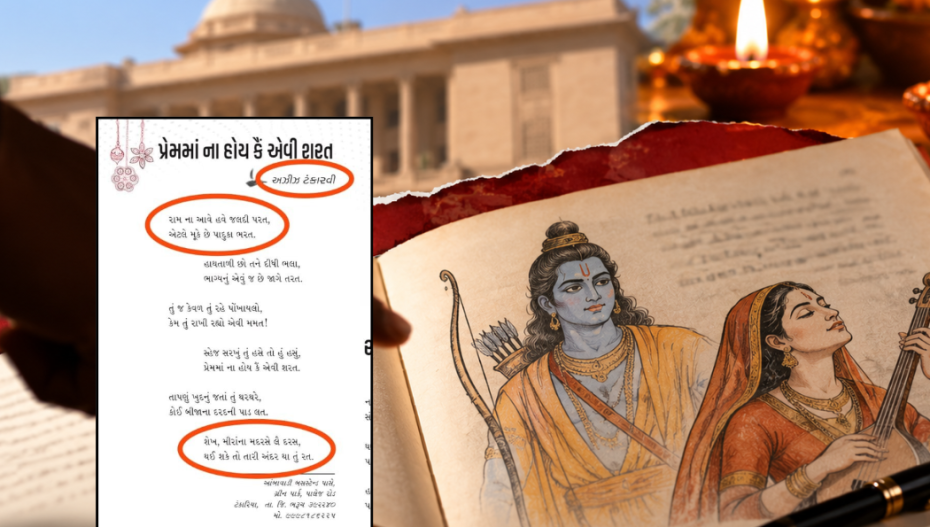
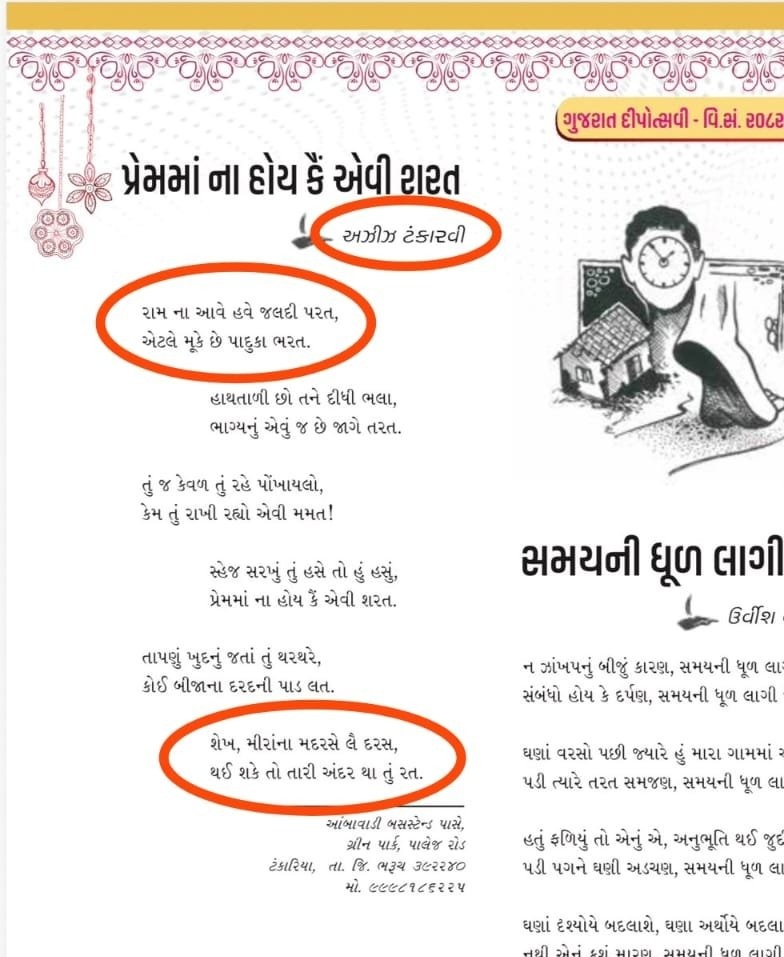
The poem titled “Prem Ma Na Hoy Kai Evi Sharat,” meaning “There Are No Such Conditions in Love,” written by Aziz Tankarvi, appears on page 389 of the annual Diwali issue, Gujarat Deepotsavi Ank, published by the Gujarat government’s Information Department.
The poem’s core message is that true love is unconditional, selfless, and beyond boundaries.
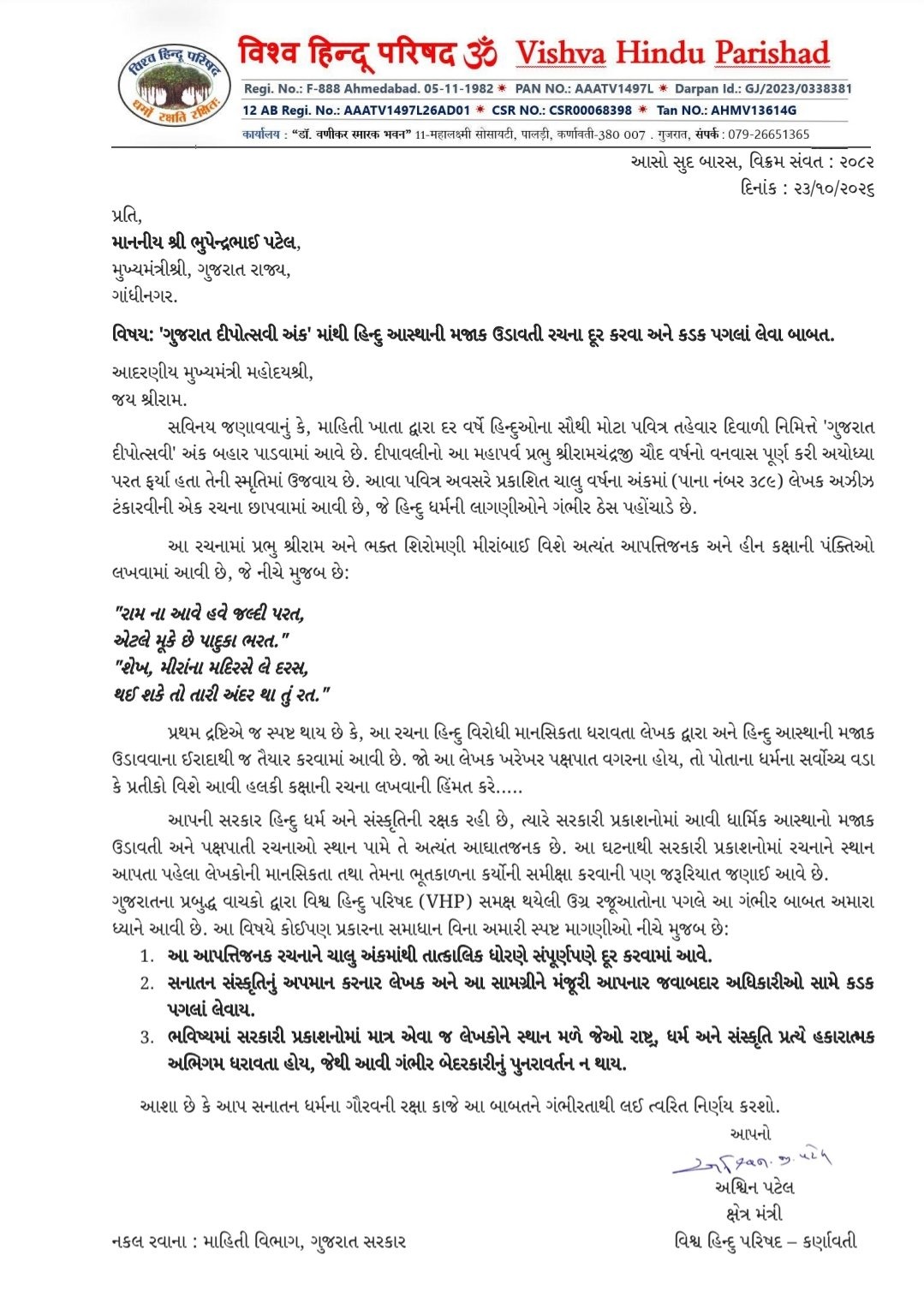
In a letter to Chief Minister Bhupendra Patel on Friday, VHP state secretary Ashwin Patel objected to including the poem, alleging it contained objectionable references to Lord Ram and Mirabai.
The objection relates to the poem’s final couplet, which contains the two lines: “Shekh, mirana madarase lai daras, thai shake to tari andar tha tu rat,” meaning, “O cleric (Sheikh), go and seek a lesson at Meerabai’s school of devotion; if possible, completely immerse yourself within your own soul.” However, the use of the word “Madarase,” referring to an Islamic school of learning, has sparked the objection.
The VHP’s objection centres on Diwali’s religious significance, which is associated with Lord Ram’s return to Ayodhya after 14 years of exile. The organisation has argued that publishing content it considers offensive to religious beliefs is unacceptable.
The objection also concerns the poem’s first couplet: “Ram na aave have jaldi parat, etle muke che paduka bharat,” meaning, “Knowing that Lord Ram will not return anytime soon, Bharat sets up his wooden sandals (Padukas) to rule in his place.”
The VHP has also called for the state to ensure no further copies reach the public and for strict punitive measures against Tankarvi and the official who approved the poem, intensifying scrutiny of the Information Department’s editorial process.
Government Halts Distribution
Following the complaint, the Chief Minister’s Office ordered an immediate suspension of the magazine’s distribution and sale. It also reportedly issued instructions to retrieve copies already sent to government offices and libraries.
The controversy has also prompted the Information Department to initiate an internal review. A committee comprising senior departmental officials has been formed to examine how the poem passed the scrutiny process and whether any lapses occurred before the issue went to print.
The government’s immediate halt to circulation has sparked controversy, expanding into a broader debate over the standards, accountability, and limitations involved in state-sanctioned content selection.
The dispute has triggered contrasting reactions on social media platforms, including X, Facebook, and Instagram. Supporters of the VHP’s objection argue that content they consider insulting to Sanatan religious beliefs should not appear in a magazine produced with public funds.
Some users have also called for Tankarvi’s arrest and the suspension of officials associated with the poem’s approval.
On the other hand, some writers and social media users have argued that the poem should be read in its literary context. According to this view, the references conveyed the intensity of love rather than disrespecting religious figures. They have maintained that literary works should be interpreted in their broader poetic context rather than viewed exclusively through a religious lens.
Aziz Tankarvi has not yet reacted to the controversy.
The controversy has now placed the government’s annual Diwali issue at the centre of a wider debate over religious sentiment, literary expression, and public institutions’ responsibility in selecting content for official publications.
Started From the Day the State Was Officially Formed
The Gujarat magazine (also known as Gujarat Pakshik) has been published by the Government’s Information Department since Gujarat became an independent State on May 1, 1960. The Directorate of Information, Government of Gujarat, Gandhinagar, publishes it fortnightly on the 1st and 16th of every month.
It informs Gujaratis about government policies, welfare schemes, and development milestones, and provides updates for citizens and aspirants preparing for competitive exams.
The Diwali issue, called the Deepotsavi Ank, is a massive keepsake cultural volume dedicated entirely to literature and art.
It prioritises creative writing, featuring short stories, poetry, travelogues, historical research, and humorous articles written by leading Gujarati litterateurs.
It is highly popular across Gujarat for its rich educational topics and curated novels, functioning more as a literary anthology than a government brochure.
Also Read: Gujarat Congress Questions School Camera Curbs, Seeks Transparency In Govt Schools